

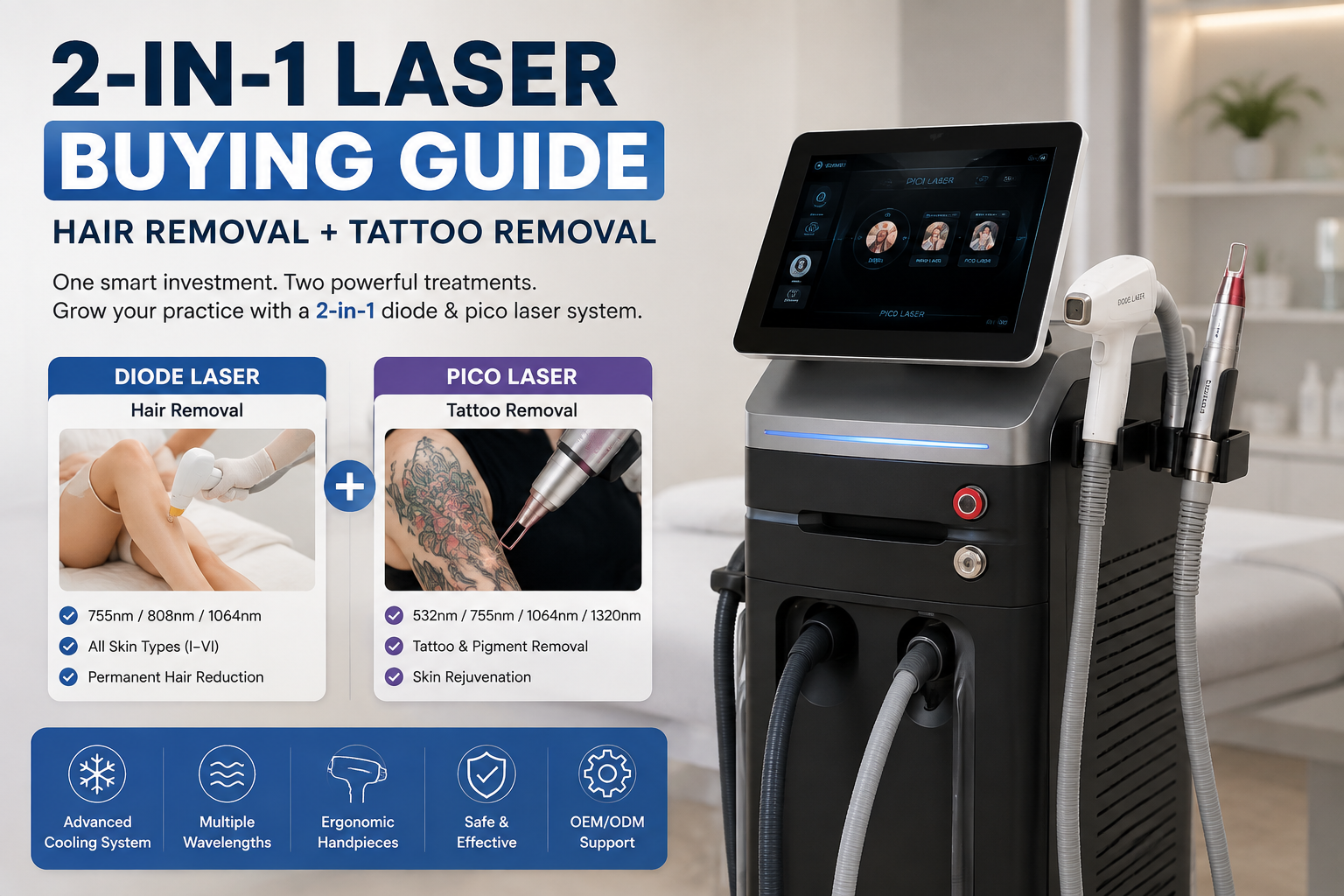
2-in-1 Diode Pico Laser Machine for Hair & Tattoo Removal
Quick Answer
A 2-in-1 diode pico laser machine combines a diode laser module for hair removal with a picosecond laser module for tattoo and pigmentation applications in one platform. For clinics, med spas, and distributors, this configuration can expand the treatment menu while reducing equipment footprint and avoiding the need to purchase two completely separate systems.
However, not every 2-in-1 system offers the same value. Buyers should compare the actual diode and picosecond configurations, wavelength options, energy parameters, cooling architecture, handpiece design, certifications, OEM capabilities, warranty, and long-term operating costs before making a purchase.
The key question is not simply whether a machine offers two functions. It is whether both laser modules provide the performance, reliability, and support required for the intended business model.
Introduction
Clinic owners and distributors often want to expand their treatment portfolio without continuously adding more equipment.
Purchasing separate systems for hair removal and tattoo removal can increase the initial investment, floor-space requirements, maintenance workload, and training requirements. A 2-in-1 diode pico laser machine offers an alternative by combining two different laser technologies within one equipment platform.
The diode module can support professional hair-removal services, while the picosecond module can be configured for tattoo and pigmentation-related applications.
For a clinic, this can create two complementary revenue streams from one equipment investment. For a distributor, it can provide a more versatile product that appeals to businesses with limited treatment space.
However, buyers should look beyond the "2-in-1" label. The quality of integration, individual module specifications, cooling performance, handpiece design, supplier support, and future spare-parts availability can have a major impact on the actual value of the system.
This guide explains what buyers should evaluate before purchasing a 2-in-1 diode and picosecond laser system.
What Is a 2-in-1 Diode & Pico Laser System?
A 2-in-1 laser system combines two laser technologies into one equipment platform.
Module 1: Diode Laser for Hair Removal
The diode module is designed for hair-removal applications and may use wavelengths such as:
-
755nm
-
808nm
-
940nm
-
1064nm
Different wavelength configurations can provide different treatment characteristics, so buyers should evaluate the actual configuration rather than simply counting the number of wavelengths.
For clinics already considering a diode laser hair removal machine, the diode module should be evaluated using the same criteria applied to a dedicated professional system: wavelength configuration, energy delivery, cooling, spot size, handpiece design, operating stability, and long-term serviceability.
Module 2: Picosecond Laser
The picosecond module uses extremely short pulses for applications such as tattoo and pigmentation treatment.
Common wavelength configurations may include:
-
532nm
-
755nm
-
1064nm
Some platforms may also include additional configurations for specialized aesthetic applications.
The important point for buyers is that the picosecond module should be evaluated independently from the diode module. A system should not receive a high overall rating simply because it combines two technologies.
Why Clinics Consider a 2-in-1 System
The primary advantage is equipment consolidation.
Instead of purchasing two separate platforms, a clinic can operate two treatment technologies from one equipment solution.
Potential Advantages
| Factor | Separate Systems | 2-in-1 System |
|---|---|---|
| Equipment footprint | Higher | Lower |
| Initial equipment count | Two systems | One platform |
| Treatment menu | Two technologies | Two technologies |
| Training | Separate systems | Consolidated platform |
| Maintenance | Two equipment platforms | One integrated platform |
| Branding | Separate products | One product platform |
| OEM opportunity | Multiple products | One combined product |
However, consolidation only creates real value if both modules meet the clinic's requirements.
A lower equipment count should not come at the expense of treatment capability, cooling performance, reliability, or serviceability.
Who Should Consider a 2-in-1 Laser System?
A 2-in-1 platform may be particularly relevant to businesses that want to expand their services without significantly increasing their equipment footprint.
Hair Removal Clinics
A clinic focused primarily on hair removal can add tattoo or pigmentation services without purchasing another complete platform.
Med Spas
Med spas often provide multiple aesthetic treatments. A dual-function platform can help expand the treatment menu within limited treatment-room space.
Distributors
For distributors, a 2-in-1 system can provide a more versatile product for customers that want multiple treatment capabilities from one machine.
New Clinics
A new business may prefer a platform that supports multiple services rather than purchasing several machines immediately.
What Specifications Should You Compare?
A 2-in-1 system should be evaluated as two laser systems plus their integration architecture.
This is one of the most important purchasing principles.
1. Compare the Diode Laser Configuration
For the diode module, evaluate:
-
Wavelength configuration
-
Energy output
-
Pulse duration
-
Repetition rate
-
Spot size
-
Cooling system
-
Handpiece design
-
Expected operating workload
-
Software controls
-
Replacement-part availability
Do not judge the diode module only by its advertised maximum power.
A machine with a higher headline power specification may not provide better practical performance if its cooling, energy stability, handpiece, or operating design is inadequate for the intended workload.
2. Compare the Picosecond Configuration
The picosecond module should be evaluated separately.
Check:
-
Available wavelengths
-
Energy range
-
Pulse characteristics
-
Frequency
-
Spot-size options
-
Handpiece configuration
-
Cooling requirements
-
Treatment modes
-
Replacement parts
-
Software controls
Different wavelengths may be used for different tattoo ink colors or pigmentation-related applications.
For example, 532nm and 1064nm are commonly found in picosecond platforms, while additional wavelengths may be offered depending on the system configuration.
The buyer should request the actual technical configuration in writing, rather than relying only on a product page.
3. Check Whether It Is Truly Integrated
One of the most important questions is:
Is this a genuinely integrated system, or simply two independent laser systems installed in one housing?
Some products marketed as "2-in-1" may essentially combine two separate modules with limited integration.
Ask the Manufacturer:
-
Do both modules share the same control interface?
-
How are the two systems managed through the software?
-
Is the cooling architecture integrated?
-
Are the power systems integrated or independent?
-
Can each module be serviced separately?
-
Are the handpieces independently controlled?
-
Are replacement components available for each module?
-
Can future production maintain the same internal configuration?
Why This Matters
A compact housing does not automatically mean better engineering.
A genuinely well-designed platform should make operation, maintenance, and service straightforward rather than simply placing two systems inside one cabinet.
4. Evaluate Cooling Under Real Operating Conditions
Cooling is important for both treatment comfort and equipment operating stability.
For the diode module, buyers may encounter technologies such as:
-
Sapphire contact cooling
-
TEC semiconductor cooling
-
Water cooling
-
Air cooling
-
Combined cooling architectures
The appropriate configuration depends on the system design and intended workload.
Cooling Checklist
-
Cooling technology is clearly documented
-
Handpiece cooling performance is specified
-
Cooling temperature is documented
-
Recovery time is understood
-
Extended-use performance has been tested
-
Cooling maintenance requirements are documented
-
Replacement cooling components are available
-
The cooling architecture can support the intended treatment volume
The Important Question
Do not ask only:
"How cold can the handpiece become?"
Also ask:
"Can the cooling remain stable during repeated treatments?"
A system that performs well during a short demonstration may behave differently during a busy clinic schedule.
5. Evaluate the Handpieces
A 2-in-1 system normally requires different handpiece configurations for different applications.
The diode handpiece and picosecond handpiece should therefore be evaluated independently.
Diode Handpiece
Check:
-
Ergonomics
-
Weight
-
Cable design
-
Spot size
-
Cooling performance
-
Pulse lifespan
-
Replacement cost
Picosecond Handpiece
Check:
-
Ergonomics
-
Spot-size options
-
Energy handling
-
Lens or tip configuration
-
Replacement availability
-
Maintenance requirements
Handpiece quality can directly affect operator workflow.
A machine may have strong specifications on paper but become inconvenient to operate if the handpiece is heavy, poorly balanced, or difficult to maintain.
6. Check Wavelength Coverage Carefully
Wavelength count is useful, but it should not be the only comparison factor.
Diode Wavelengths
A system may include:
| Wavelength | Typical Position in a Multi-Wavelength System |
|---|---|
| 755nm | Often included for lighter or finer hair applications |
| 808nm | Common general-purpose diode configuration |
| 940nm | Additional wavelength option in multi-wavelength platforms |
| 1064nm | Often selected when deeper penetration and darker skin considerations are important |
The actual clinical suitability depends on the complete system configuration and treatment protocol.
Picosecond Wavelengths
Common configurations include:
| Wavelength | Common Application Considerations |
|---|---|
| 532nm | Often used for selected lighter-color pigments |
| 755nm | Used in some pigmentation and tattoo applications |
| 1064nm | Commonly used for darker tattoo pigments |
| Additional wavelengths | Depend on the specific system configuration |
The important purchasing principle is:
Do not buy based on wavelength count alone.
A four-wavelength machine is not automatically better than a three-wavelength machine if the actual output, cooling, control system, and reliability are inferior.
7. Check Certifications and Regulatory Documentation
International buyers should verify the regulatory documentation associated with the exact model.
Potential documentation may include:
-
CE documentation where applicable
-
ISO 13485 quality-management certification
-
Electrical safety documentation
-
EMC documentation
-
Laser safety documentation
-
Destination-market regulatory documentation
Important Buyer Checklist
-
Documents match the exact model
-
Model number is consistent across documents
-
Product configuration matches the documentation
-
Manufacturer information is consistent
-
Destination-market requirements have been reviewed
-
Import requirements have been confirmed
A certification logo shown on a website is not enough.
Ask the supplier to provide the relevant documentation for the actual model being purchased.
8. Evaluate OEM and Private-Label Capability
For distributors, OEM capability can significantly affect the value of a 2-in-1 platform.
OEM customization may include:
-
Logo
-
Housing appearance
-
Color
-
Software language
-
User interface
-
Packaging
-
User manuals
-
Accessories
-
Marketing materials
However, buyers should confirm whether these customizations are included in the standard quotation or require additional fees.
OEM Questions to Ask
-
What is the MOQ?
-
What is the OEM lead time?
-
Is logo customization included?
-
Can the software interface be branded?
-
Can packaging be customized?
-
Are custom colors available?
-
Are mold fees required?
-
Can the manufacturer maintain the same configuration for repeat orders?
-
Will spare parts remain available for the customized model?
OEM capability should be evaluated as a long-term manufacturing relationship, not simply as a branding service.
9. Calculate the Total Cost of Ownership
A 2-in-1 machine may have a higher purchase price than a basic single-function system, but comparing purchase prices alone can be misleading.
Consider:
Total Cost = Equipment + Shipping + Installation + Training + Maintenance + Replacement Parts + Downtime
Costs to Review
-
Machine price
-
Shipping
-
Import or customs costs
-
Installation
-
Training
-
Handpiece replacement
-
Laser-module maintenance
-
Cooling-system maintenance
-
Spare parts
-
Technical support
-
Potential downtime
The real advantage of a 2-in-1 platform is not simply that one machine costs less than two machines.
The business case should also consider:
space saved + services added + equipment utilization + maintenance requirements + revenue potential
10. Think About Equipment Utilization
One potential weakness of a multifunction machine is that buying two technologies does not automatically mean both will be used equally.
For example, a clinic may perform hundreds of hair-removal sessions but only a small number of tattoo treatments.
In that situation, buyers should ask:
Will the second module generate enough additional business to justify its cost?
This is a more useful ROI question than simply calculating the theoretical revenue of both treatments.
A Simple Evaluation
Estimate:
Monthly Hair Removal Revenue
Monthly Tattoo/Pigmentation Revenue
−
Monthly Operating Costs
=
Estimated Monthly Contribution
Then compare this figure with the total equipment investment.
This provides a more realistic basis for evaluating whether a 2-in-1 platform makes commercial sense.
11. Watch for These 2-in-1 Laser Buying Red Flags
Buyers should be cautious when a supplier cannot clearly explain the technical architecture or commercial terms.
Red Flags Include:
-
The supplier cannot explain how the two modules are integrated
-
Wavelength specifications are inconsistent
-
Energy specifications are missing
-
Cooling claims are not documented
-
Certification documents do not match the model
-
Handpiece replacement costs are unclear
-
Warranty coverage is vague
-
Spare parts are difficult to obtain
-
OEM promises are not included in writing
-
Future configuration consistency is not guaranteed
-
The supplier focuses almost entirely on purchase price
A good supplier should be able to answer technical and commercial questions with specific documentation.
12. 2-in-1 vs Separate Laser Systems
Before buying, compare the two approaches.
| Factor | 2-in-1 System | Separate Systems |
|---|---|---|
| Equipment footprint | Lower | Higher |
| Initial equipment count | One | Two |
| Treatment flexibility | Two technologies | Two technologies |
| Maintenance architecture | Combined platform | Independent |
| Training | Consolidated | Separate |
| Redundancy | Lower | Higher |
| Replacement flexibility | Depends on design | Independent |
| OEM opportunity | One combined product | Multiple products |
| Space requirements | Lower | Higher |
The biggest potential advantage of separate systems is redundancy.
If one system requires service, the other may continue operating.
For a 2-in-1 system, buyers should therefore pay particular attention to serviceability and spare-parts availability.
13. Final Buyer’s Checklist
Before purchasing a 2-in-1 diode and picosecond laser system, confirm:
-
Both laser modules are clearly specified
-
Diode wavelengths are documented
-
Picosecond wavelengths are documented
-
Energy parameters are available
-
Cooling technology is clearly explained
-
Handpieces have been evaluated
-
Integration architecture is understood
-
Software functions have been demonstrated
-
Certifications match the exact model
-
Warranty coverage is documented
-
Spare parts are available
-
OEM requirements are confirmed
-
MOQ and lead time are confirmed
-
Shipping and import costs are understood
-
Total cost of ownership has been estimated
-
Expected treatment demand has been evaluated
-
The second treatment module has a realistic business case
Frequently Asked Questions
What is a 2-in-1 diode and pico laser?
A 2-in-1 diode and pico laser combines a diode laser module for hair-removal applications with a picosecond laser module for tattoo and pigmentation-related applications in one equipment platform.
Is a 2-in-1 laser better than two separate machines?
Not necessarily.
A 2-in-1 platform can reduce equipment footprint and consolidate investment, but separate machines may provide greater redundancy and independent serviceability.
The right choice depends on treatment demand, available space, budget, maintenance requirements, and business strategy.
What should I check when buying a 2-in-1 laser?
Focus on the individual specifications of both modules as well as their integration.
Key factors include wavelengths, energy parameters, cooling, handpieces, software, certifications, warranty, spare parts, OEM capability, and total cost of ownership.
Can a 2-in-1 system replace a dedicated diode laser hair removal machine?
It depends on the configuration.
The diode module should be evaluated using the same technical criteria as a dedicated diode laser hair removal machine, including wavelength configuration, energy delivery, cooling, handpiece design, operating stability, and expected workload.
What is the advantage of combining diode and picosecond technology?
The main advantage is service diversification.
A clinic can offer hair-removal services and tattoo or pigmentation-related treatments from one equipment platform, potentially reducing equipment footprint and expanding the treatment menu.
Is a multi-wavelength 2-in-1 system always better?
No.
More wavelengths can provide greater flexibility, but buyers should also verify actual output, energy control, cooling performance, handpiece design, software, and reliability.
What should distributors check when buying a 2-in-1 system?
Distributors should evaluate both technical and commercial factors.
In addition to machine specifications, check OEM capabilities, MOQ, lead time, packaging, software customization, spare parts, warranty, production consistency, and after-sales support.
How important is cooling?
Cooling can affect treatment comfort, operating stability, and equipment durability.
Buyers should evaluate cooling performance during extended operation rather than relying only on the lowest advertised cooling temperature.
Should I buy a 2-in-1 laser for my clinic?
Consider the actual demand for both treatment categories.
If your clinic already has strong demand for hair removal and expects additional revenue from tattoo or pigmentation services, a 2-in-1 platform may provide a practical way to expand the service menu.
If the second module is unlikely to be used regularly, a dedicated system may provide better value.
Conclusion
A 2-in-1 diode and picosecond laser can be a practical equipment solution for clinics, med spas, and distributors that want to expand treatment capabilities without adding multiple large machines.
However, the "2-in-1" label should never be the only reason to buy.
The best purchasing decision comes from evaluating the diode module, picosecond module, cooling architecture, handpieces, integration, certifications, OEM capabilities, after-sales support, and total cost of ownership as a complete system.
For clinics, the key question is whether both treatment modules will be used enough to create meaningful business value.
For distributors, the key questions include product reliability, OEM flexibility, production consistency, spare-parts support, and long-term supplier capability.
A well-selected 2-in-1 platform can provide more treatment options from a compact equipment footprint while creating opportunities for additional service revenue.