

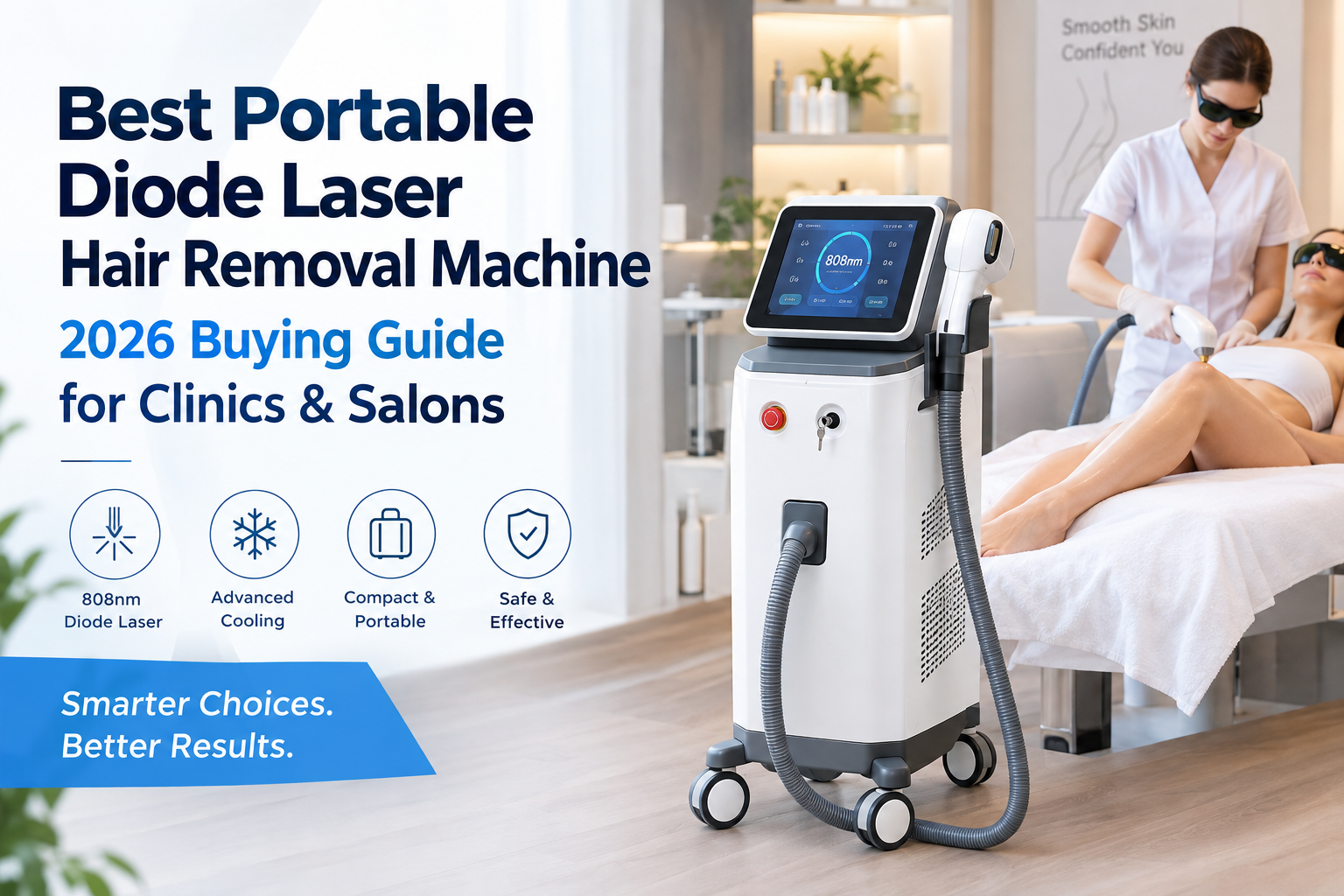
Best Portable Diode Laser Hair Removal Machine: 2026 Buying Guide for Clinics & Salons
Quick Answer
The right portable diode laser hair removal machine is not necessarily the smallest, most powerful, or most heavily advertised system. For clinics and salons, the better purchasing decision comes from matching the laser architecture to treatment demand, patient profiles, operating workflow, cooling requirements, and expected utilization.
A professional system should be evaluated as an integrated platform rather than through a single specification. Wavelength, fluence, pulse duration, spot size, repetition rate, cooling performance, handpiece design, software controls, electrical architecture, and output stability all influence how the system performs in actual treatment conditions.
For 2026 procurement, buyers should therefore ask a more useful question:
Does this machine provide the right combination of clinical capability, workflow efficiency, reliability, and supplier support for my business?
That question is more meaningful than simply asking how many watts the machine has.
Why Portable Diode Laser Systems Need a Different Buying Strategy
Portable systems are often marketed around compact dimensions, lightweight construction, or lower purchase cost. Those characteristics can be useful, but they do not automatically determine clinical or commercial value.
A portable platform has to solve several competing engineering problems:
-
Deliver sufficient optical energy to the treatment area
-
Maintain stable output during repeated treatments
-
Remove heat from both the treatment interface and internal components
-
Keep the handpiece manageable during long sessions
-
Provide sufficient spot coverage without sacrificing control
-
Fit into smaller treatment rooms
-
Remain serviceable when moved between rooms or locations
-
Support the treatment protocols used by the clinic
This makes portability an engineering and workflow concept, not simply a physical-size concept.
A machine that is compact but difficult to cool, uncomfortable to operate, or difficult to service may create more operational problems than a slightly larger professional platform.
1. Start With the Clinic's Treatment Model
Before comparing laser specifications, define how the equipment will actually be used.
A small beauty salon treating several localized areas per day has different requirements from a medical aesthetic clinic performing full-body treatments continuously.
Consider four variables.
Treatment Area
Face, underarms, bikini areas, arms, legs, chest, and back require different combinations of coverage and precision.
Large treatment areas benefit from efficient spot coverage and rapid repetition. Smaller or contoured areas require better handpiece control.
Daily Treatment Volume
A low-volume clinic may prioritize:
-
compact size
-
easy setup
-
moderate acquisition cost
-
simple maintenance
-
flexible room usage
A high-volume clinic may place greater emphasis on:
-
cooling endurance
-
output stability
-
handpiece ergonomics
-
fast repetition
-
service response
-
spare-part availability
Treatment Environment
A machine operating in one permanent room has different requirements from equipment that is moved between treatment rooms.
If mobility is part of the business model, wheel design, cable management, handle placement, handpiece storage, system weight, and mechanical durability become meaningful purchasing criteria.
Client Profile
The clinic should also consider:
-
Fitzpatrick skin type distribution
-
hair thickness
-
hair density
-
treatment areas
-
prevalence of tanned skin
-
facial versus body treatments
-
previous hair-removal treatments
Laser hair reduction is influenced by both patient characteristics and device parameters. Reviews of treatment challenges emphasize wavelength, fluence, spot size, and pulse duration as important technology variables, particularly when treating darker skin.
2. Understand What the Diode Laser Is Actually Targeting
Professional diode hair-removal systems rely on selective photothermolysis.
The basic concept is straightforward: laser energy is preferentially absorbed by melanin in the hair structure, converted into heat, and delivered to follicular structures.
But the clinical result does not depend on wavelength alone.
The actual treatment effect is influenced by the interaction of:
wavelength + fluence + pulse duration + spot size + repetition rate + cooling + tissue characteristics
This is why two machines advertising the same wavelength can produce very different user experiences and treatment workflows.
A buyer should therefore avoid evaluating a laser by asking only:
“Is this an 808 nm machine?”
A more useful question is:
“How does this system control energy delivery around the selected wavelength?”
3. Why 808 nm Remains Important
The 808nm diode laser machine remains an important configuration in professional hair-removal equipment because diode wavelengths in the approximately 800 nm range have extensive clinical use.
However, 808 nm should not be treated as a universal answer for every patient.
Hair color, hair thickness, skin pigmentation, treatment area, treatment history, and selected parameters all influence the treatment response.
Clinical literature also demonstrates that diode systems can be used in darker skin populations when treatment parameters and safety protocols are appropriately selected. A 2025 prospective study of 808 nm treatment in Fitzpatrick IV–VI patients reported meaningful hair reduction after three treatments, while also documenting a transient adverse event that required adjustment of fluence. The small sample size means the results should not be generalized to every patient or device.
The purchasing implication is important:
Do not buy a wavelength. Buy a controllable treatment platform.
4. Single-Wavelength vs Multi-Wavelength Systems
Multi-wavelength diode platforms have become increasingly common because they allow manufacturers to combine different optical characteristics in one system.
A common configuration may include wavelengths around:
-
755 nm
-
808/810 nm
-
1064 nm
Some systems also incorporate additional wavelengths.
The important question is not whether four wavelengths look better on a specification sheet.
Instead, ask:
Are the wavelengths independently controlled?
If multiple wavelengths are included, determine whether the system allows:
-
independent energy adjustment
-
independent pulse-duration control
-
different treatment modes
-
wavelength-specific calibration
-
appropriate cooling for each configuration
Are the wavelengths actually being delivered?
Some systems use marketing terminology such as “four wavelength technology” without clearly explaining how the optical output is generated.
Ask the manufacturer to explain:
-
How each wavelength is generated
-
Whether wavelengths are delivered simultaneously or sequentially
-
Whether each wavelength has independent output control
-
How the manufacturer verifies wavelength accuracy
-
How optical output is measured during production testing
This is considerably more useful than simply counting wavelengths.
5. Do Not Confuse Electrical Power With Clinical Output
One of the most common purchasing mistakes is comparing machines according to advertised wattage.
A manufacturer may advertise a system as 1200 W, 2000 W, 3000 W, or more. But the number alone does not tell you how efficiently optical energy is delivered to tissue.
A serious technical evaluation should separate:
Electrical input power
from
Optical output
and from
Delivered fluence at the treatment spot.
These are not interchangeable measurements.
A high electrical input rating can reflect the requirements of cooling systems, power electronics, pumps, fans, control systems, and laser modules.
For procurement, ask for measurable output information rather than relying on a headline wattage.
6. Fluence Matters More Than a Headline Power Number
Fluence describes energy delivered per unit area, usually expressed in J/cm².
It becomes particularly useful when comparing systems because the same total energy can be distributed across different spot sizes.
For example, changing spot size changes the treated area and energy density relationship.
Therefore, when evaluating a machine, ask:
-
What is the adjustable fluence range?
-
At which spot sizes is that range available?
-
How is output calibrated?
-
Is the displayed fluence verified against measured output?
-
Does output remain stable during repeated pulses?
-
Are different treatment modes associated with different energy-delivery characteristics?
A useful specification sheet should explain these relationships rather than presenting isolated maximum values.
7. Pulse Duration Is Part of the Treatment Equation
Pulse duration determines how energy is distributed over time.
It should not be evaluated independently from fluence, wavelength, hair characteristics, and skin characteristics.
A system offering a wide pulse-duration range may provide greater flexibility, but the value comes from whether that range is usable and accurately controlled.
For procurement, request:
-
minimum pulse duration
-
maximum pulse duration
-
adjustment increments
-
whether pulse duration changes with operating mode
-
output consistency across different pulse settings
The 2026 engineering-to-clinical literature increasingly emphasizes multi-parameter selection rather than choosing a laser based on wavelength alone.
8. Spot Size Affects Both Treatment Speed and Control
Spot size is one of the most practical specifications for salon and clinic workflow.
A larger spot can cover more surface area with each pulse, which can improve efficiency when treating large areas such as:
-
legs
-
back
-
chest
-
arms
Smaller treatment interfaces can provide greater control around:
-
facial areas
-
smaller contours
-
difficult anatomical regions
Therefore, buyers should evaluate the actual treatment portfolio rather than simply asking for the “largest spot.”
A useful professional system should balance:
coverage + precision + cooling + ergonomics.
9. Cooling Is a Core System Component
Cooling should not be treated as an accessory.
During diode laser treatment, the epidermis is exposed to the treatment energy while the target hair structure is being heated. Effective cooling can improve patient comfort and help manage unwanted thermal effects.
Professional systems may combine:
-
sapphire contact cooling
-
water circulation
-
refrigeration
-
air cooling
-
temperature monitoring
-
multiple cooling stages
The important issue is not simply whether the machine says “ice cooling.”
Ask how the cooling system performs during a complete treatment day.
Questions to ask the manufacturer
-
What temperature range does the treatment tip maintain?
-
How quickly does the cooling system reach operating temperature?
-
How stable is cooling during continuous use?
-
What coolant is used?
-
How often should coolant be replaced?
-
What happens if coolant temperature rises?
-
Is there an automatic over-temperature protection system?
-
Is the handpiece temperature monitored?
A cooling system that performs well for five minutes but loses capacity during continuous operation is not equivalent to a system designed for high utilization.
10. Evaluate the Handpiece, Not Just the Main Console
The handpiece is where the operator interacts with the patient.
That makes it one of the most important parts of the equipment.
Assess:
Weight
A heavy handpiece can increase operator fatigue during full-body sessions.
Cable flexibility
A stiff cable can make movement around curved body surfaces more difficult.
Treatment window
The optical window should be designed for stable contact and consistent treatment.
Cooling interface
The cooling surface should remain effective across repeated passes.
Trigger and controls
Controls should allow predictable activation without unnecessary hand movement.
Replaceability
Ask whether the handpiece can be replaced independently from the main console and what the replacement cost is.
A technically strong laser with a poorly designed handpiece can still create workflow problems.
11. Output Stability Is More Important Than Maximum Output
Maximum output is a peak specification.
Clinics operate on repeated treatments.
Therefore, the more useful question is:
How stable is the output after hundreds or thousands of pulses?
Ask suppliers for factory or service documentation covering:
-
output testing
-
calibration procedures
-
diode-module testing
-
cooling verification
-
pulse consistency
-
electrical safety testing
-
final quality inspection
If a supplier cannot explain how the machine is tested before shipment, the specification sheet tells you only part of the story.
12. Portable Does Not Mean Consumer-Grade
The word “portable” can describe very different products.
For professional procurement, distinguish between:
Consumer-oriented compact devices
Usually designed around:
-
lower energy levels
-
simplified controls
-
small treatment areas
-
home-use convenience
Professional portable platforms
Typically designed around:
-
higher operating duty cycles
-
professional handpieces
-
active cooling
-
adjustable treatment parameters
-
operator controls
-
serviceable components
-
professional safety systems
The physical size of a machine cannot tell you which category it belongs to.
A professional portable system should be evaluated according to its operating architecture, not its dimensions.
13. Portable vs Stationary: Compare the Workflow
| Factor | Portable Professional System | Larger Stationary System |
|---|---|---|
| Room requirements | Lower | Higher |
| Movement between rooms | Easier | Limited |
| Installation | Generally simpler | More infrastructure may be required |
| High-volume operation | Depends on configuration | Often easier to optimize |
| Treatment flexibility | Configuration dependent | Usually broader platform options |
| Storage | Easier | Requires dedicated space |
| Maintenance access | Model dependent | Model dependent |
| Mobile-service potential | Higher | Lower |
| Initial investment | Often lower | Often higher |
The correct choice depends on utilization.
For a clinic with several treatment rooms, a portable platform may allow the same equipment to be deployed where demand occurs.
For a high-volume facility with a dedicated laser room, the benefits of a larger stationary platform may become more significant.
The goal is not to prove that one form factor is universally better.
The goal is to match the machine architecture to the business model.
14. Build a Treatment-Volume Model Before Buying
A simple utilization calculation can make equipment comparisons much more practical.
Suppose a clinic expects:
-
4 treatment sessions per day
-
22 operating days per month
-
average treatment revenue of $100
That represents approximately:
4 × 22 = 88 treatment sessions/month
and:
88 × $100 = $8,800 gross treatment revenue/month
This is not profit. It is simply potential treatment revenue before rent, staff costs, consumables, marketing, payment fees, maintenance, and other operating expenses.
The equipment decision should then consider:
-
purchase cost
-
financing
-
expected useful life
-
warranty
-
service costs
-
handpiece replacement
-
coolant and maintenance
-
downtime
-
training
-
expected utilization
This provides a much better investment framework than comparing machine prices alone.
15. Calculate Total Cost of Ownership
A machine advertised at a lower purchase price can become more expensive if it has high maintenance requirements or poor supplier support.
A practical TCO model includes:
Initial Cost
-
equipment price
-
shipping
-
installation
-
training
-
taxes or duties
Operating Cost
-
electricity
-
coolant
-
routine maintenance
-
consumables
-
replacement parts
Risk Cost
-
downtime
-
delayed parts
-
service travel
-
lost appointments
-
warranty exclusions
Upgrade Cost
-
software
-
new handpieces
-
additional wavelength modules
-
replacement cooling components
When comparing suppliers, ask for a three- to five-year ownership estimate rather than looking only at the initial quotation.
16. Certification Is Necessary, But Certification Alone Is Not Enough
Professional buyers should verify regulatory and quality documentation appropriate to their market.
Depending on the destination country, documentation may include:
-
applicable market authorization
-
electrical safety testing
-
EMC testing
-
quality-management certification
-
product technical documentation
-
labeling and user manuals
ISO 13485 certification, for example, concerns a manufacturer's medical-device quality management system. It does not by itself prove that every individual model has the clinical performance a buyer expects.
Similarly, a CE mark should not be treated as a universal guarantee of clinical superiority.
Always verify that documentation corresponds to:
the exact manufacturer + exact model + exact configuration.
17. What to Ask a Manufacturer Before Purchasing
A serious supplier evaluation can begin with these questions.
Laser Source
-
Which diode module manufacturer is used?
-
What wavelengths are available?
-
Are the wavelengths independently controlled?
-
How is optical output measured?
Energy Delivery
-
What is the fluence range?
-
What pulse-duration range is available?
-
What spot sizes are offered?
-
What repetition rates are available?
-
How is output stability tested?
Cooling
-
What cooling technologies are integrated?
-
How is handpiece temperature monitored?
-
What happens if cooling performance falls outside the operating range?
Reliability
-
What is the expected diode-module service life?
-
What components are considered replaceable?
-
What is the typical repair process?
-
Which spare parts are stocked?
Quality Control
-
Does every unit receive final output testing?
-
Can the factory provide a test report?
-
How are calibration records maintained?
-
Is serial-number traceability available?
These questions quickly distinguish a manufacturer focused on engineering and quality control from a reseller focused mainly on product appearance and price.
18. How to Evaluate a Diode Laser Device During a Demonstration
A live demonstration should not be limited to seeing whether the laser fires.
Evaluate the entire operating sequence.
Step 1: Inspect the Interface
Check whether the software clearly displays:
-
wavelength
-
fluence
-
pulse duration
-
repetition rate
-
cooling status
-
treatment mode
Step 2: Test Cooling Before Treatment
Allow the cooling system to reach its operating condition and observe whether the temperature remains stable.
Step 3: Observe Handpiece Ergonomics
Hold the handpiece for several minutes.
Check:
-
weight
-
grip
-
trigger position
-
cable movement
-
screen visibility
-
treatment-window contact
Step 4: Test Repeated Operation
Do not evaluate the system after one pulse.
Run a representative sequence and monitor:
-
cooling
-
alarms
-
interface response
-
pulse consistency
-
handpiece temperature
Step 5: Request Measurement Data
Ask the supplier how the displayed treatment parameters are validated.
A professional demonstration should answer technical questions, not simply showcase the machine's appearance.
19. Common Buying Mistakes
Mistake 1: Choosing the Highest Wattage
More electrical power does not automatically mean better treatment performance.
Mistake 2: Choosing the Most Wavelengths
A four-wavelength label has limited value if the manufacturer cannot explain how each wavelength is generated and controlled.
Mistake 3: Comparing Only Purchase Prices
A cheaper machine may have higher maintenance, downtime, or replacement-part costs.
Mistake 4: Ignoring the Handpiece
The operator uses the handpiece throughout every treatment.
Mistake 5: Treating Cooling as a Marketing Feature
Cooling should be evaluated through temperature stability, operating endurance, and safety controls.
Mistake 6: Assuming Portable Means Limited
Some portable professional systems can provide substantial treatment flexibility. The relevant question is whether their architecture matches the intended workload.
Mistake 7: Buying From a Supplier Who Cannot Explain the Technology
A supplier should be able to explain wavelength generation, output measurement, cooling, quality control, warranty, and service procedures.
20. When a Portable System Makes Sense
A portable professional laser can be particularly useful when a business values:
-
limited treatment-room space
-
equipment mobility
-
multiple treatment rooms
-
moderate treatment volume
-
flexible room scheduling
-
lower infrastructure requirements
-
mobile or multi-location service models
-
gradual equipment expansion
It may be less suitable when the business requires extremely high daily utilization and has a dedicated room designed specifically around a larger laser platform.
This is why “portable” should be considered a business-model decision as much as an equipment decision.
21. A Practical Buyer Scorecard
Instead of ranking machines by price or advertised power, create a procurement scorecard.
| Category | Questions |
|---|---|
| Clinical configuration | Does the wavelength configuration match your patient population? |
| Energy control | Are fluence and pulse duration sufficiently adjustable? |
| Spot size | Is coverage appropriate for your treatment areas? |
| Cooling | Can cooling remain stable during actual workload? |
| Handpiece | Is it comfortable and serviceable? |
| Output stability | Is performance tested and documented? |
| Safety | Are interlocks, alarms, and temperature controls appropriate? |
| Workflow | Can operators use the machine efficiently? |
| Reliability | What is the service and spare-parts strategy? |
| Compliance | Is documentation appropriate for the target market? |
| Training | Does the supplier provide technical and operational training? |
| TCO | What will ownership cost over several years? |
This scorecard is more useful than simply asking which machine has the highest power.
22. What Makes a Strong Portable System in 2026?
A well-designed system should bring several elements together.
1. Appropriate wavelength architecture
The system should provide wavelengths suitable for the intended patient population rather than simply maximizing the number of wavelengths.
2. Controllable energy delivery
Fluence, pulse duration, spot size, and repetition rate should be configurable within a meaningful operating range.
3. Stable cooling
Cooling should remain effective throughout realistic treatment workloads.
4. Ergonomic handpiece
The operator should be able to perform extended treatments without unnecessary fatigue.
5. Reliable output
Displayed settings should correspond to controlled and validated energy delivery.
6. Professional safety architecture
The system should include appropriate monitoring, alarms, interlocks, temperature protection, and fault handling.
7. Serviceable construction
The manufacturer should have a clear plan for parts, repairs, calibration, and technical support.
8. Documentation
Specifications, certifications, manuals, test records, and warranty conditions should be available and consistent.
Frequently Asked Questions
Is a portable diode laser suitable for professional clinics?
Yes, provided the system is designed for professional operation and its output, cooling, safety systems, and duty cycle match the clinic's workload. Portability itself does not determine whether a system is professional-grade.
Is 808 nm still relevant for hair removal?
Yes. Diode systems around the 808 nm range remain widely used for hair reduction, and clinical studies continue to evaluate their effectiveness and safety across different skin types. However, wavelength should be considered together with fluence, pulse duration, spot size, cooling, and patient characteristics.
Does higher wattage mean faster treatment?
Not necessarily. Treatment speed also depends on spot size, repetition rate, energy delivery, cooling capacity, operator workflow, and the treatment area.
Are multi-wavelength systems always better?
No. Additional wavelengths can increase flexibility, but their value depends on how they are generated, controlled, calibrated, and applied to the clinic's patient population.
Can diode lasers be used on darker skin?
Diode lasers can be used for hair reduction in darker skin under appropriate protocols, but darker skin contains more epidermal melanin, increasing the importance of parameter selection and thermal management. Evidence supports the use of diode systems in some darker-skin populations, but results should not be generalized across every device or patient.
What is more important: cooling or power?
Neither should be evaluated alone. A professional system needs sufficient energy delivery while controlling unwanted thermal exposure. Cooling, energy, pulse duration, spot size, and treatment technique work together.
How long do diode laser results last?
Laser hair removal is better described as long-term hair reduction rather than guaranteed permanent removal. A systematic review found substantial variation among studies, including diode-laser long-term reduction results that varied by study and follow-up period.
What should I request from a manufacturer?
Request detailed specifications, output-testing documentation, cooling specifications, regulatory documentation applicable to your market, warranty conditions, spare-parts information, training details, and a clear after-sales process.
Final Takeaway
Choosing the right professional laser is not a contest between the highest wattage, the largest number of wavelengths, or the lowest purchase price.
The better approach is to evaluate the complete system:
patient population → treatment goals → wavelength → fluence → pulse duration → spot size → cooling → handpiece → workflow → output stability → service → total cost of ownership
For clinics and salons, a portable diode laser hair removal machine can provide an efficient balance between professional treatment capability and operational flexibility when its technical architecture matches the business's actual workload.
The most valuable supplier is therefore not necessarily the one offering the longest specification sheet. It is the manufacturer that can explain, document, test, and support every major part of the system.