

Can You Use a Laser Hair Removal Machine on Ingrown Hairs? Clinical Evidence and Practical Guidance
Quick Answer
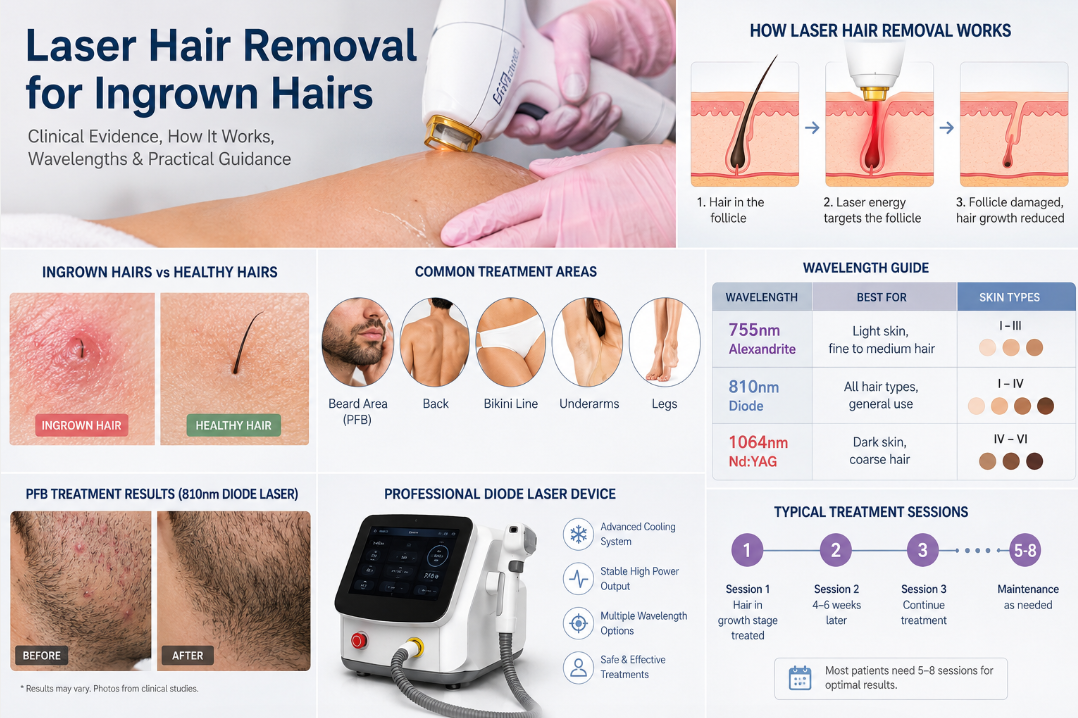
Yes. Laser hair removal machines are clinically proven to treat and prevent ingrown hairs—a condition medically known as pseudofolliculitis barbae (PFB) . Unlike shaving or depilatory creams that only address surface-level symptoms, laser energy targets the hair follicle directly, destroying its ability to regrow hair and preventing hairs from curling back into the skin.
Key clinical evidence: A 2024 study funded by the Patient-Centered Outcomes Research Institute (PCORI) comparing laser hair removal versus shaving/creams alone for preventing recurrent pilonidal disease (caused by ingrown hairs) found that only 10% of patients who received laser treatments had recurrence after one year, compared to 34% in the shaving/creams-only group .
In laser hair removal, different wavelengths are suited for different skin types and indications. 755nm, 808nm, and 1064nm are widely recognized as the "golden three wavelengths," while modern advanced multi-wavelength systems (such as 5-wavelength systems) add 830nm (for sensitive skin) and 940nm (for targeting blood vessels around the follicle) to achieve comprehensive skin type coverage. Among these, the 808nm diode laser is highly effective for Fitzpatrick Skin Types I-IV , while the 1064nm Nd:YAG laser is the safer choice for darker skin types (Fitzpatrick V-VI) .
Introduction
Ingrown hairs are one of the most frustrating and persistent skin concerns affecting both men and women. Medically known as pseudofolliculitis barbae (PFB) when occurring in the beard area, the condition is particularly common among individuals with coarse or curly hair. It can lead to redness, painful bumps, post-inflammatory hyperpigmentation, and in severe cases, scarring.
Traditional methods like shaving, waxing, and chemical depilatories often worsen the problem—they cut hair at or below the skin surface, creating sharp tips that curl back into the skin. This is where a professional diode laser system offers a fundamentally different approach: targeting the root cause rather than managing symptoms.
This guide explains how laser hair removal works for ingrown hairs, what clinical evidence supports its use, which wavelengths are most effective, and what patients and clinics should expect.
What Are Ingrown Hairs and Why Do They Occur?
Ingrown hairs occur when a hair shaft that has been shaved or removed grows back into the skin instead of emerging from the follicle. The body treats the ingrown hair as a foreign object, triggering an inflammatory response that results in:
-
Red, irritated bumps
-
Painful pustules or papules
-
Post-inflammatory hyperpigmentation (dark spots)
-
Scarring in chronic cases
Common causes:
| Cause | Mechanism |
|---|---|
| Shaving | Creates sharp hair tips that pierce the skin |
| Waxing/plucking | Hair may break below the surface and grow sideways |
| Coarse/curly hair | Natural curl pattern increases likelihood of re-entry |
| Tight clothing | Pressure pushes hair back into the follicle |
PFB is particularly common in the beard area of men with coarse, curly hair, but it can affect any area where hair is regularly removed—including bikini lines, underarms, and legs.
Why Laser Hair Removal Works for Ingrown Hairs
Laser hair removal for ingrown hairs works by directing energy into the hair follicle, destroying the follicle's ability to regrow hair and preventing hairs from curling back into the skin.
The mechanism:
Laser hair removal devices operate on the principle of selective photothermolysis: laser energy is absorbed by melanin in the hair follicle and converted to heat, which damages the follicular structures responsible for hair growth.
Key advantages over temporary methods:
| Method | Approach | Impact on Ingrown Hairs |
|---|---|---|
| Shaving/Creams | Surface-level removal | Often worsens condition |
| Waxing | Root removal, but temporary | May cause trauma |
| Laser Hair Removal | Destroys follicle | Addresses root cause |
Clinical Evidence: What the Research Shows
Study 1: PCORI Study on Pilonidal Disease (2024)
A 2024 study funded by the Patient-Centered Outcomes Research Institute (PCORI) directly compared laser hair removal versus shaving/creams alone for preventing recurrence of pilonidal disease—a skin infection near the buttocks caused by ingrown hairs.
Study details:
-
230 patients ages 11–21
-
Average age: 17, 56% male
-
All patients received razors or hair removal cream
-
Laser group received 5 treatments spaced 4–6 weeks apart
Results:
| Group | Recurrence Rate at 1 Year |
|---|---|
| Shaving/Creams Only | 34% |
| Shaving/Creams + Laser | 10% |
The study concluded that patients with pilonidal disease and their doctors can use these results when considering treatments to prevent repeat infections.
Study 2: 810nm Diode Laser for Pseudofolliculitis Barbae
A clinical study evaluating an 810nm diode laser for PFB treatment found:
-
Complete hair-growth delays of 3–8 weeks
-
Greater than 50% decrease in hair density in all subjects
-
Greater than 50% improvement in PFB signs in all patients
-
Existing pigmentary changes improved with therapy
Conclusion: "Diode laser treatment is a safe and effective method for improving pseudofolliculitis barbae in patients with skin phototypes I to IV."
Study 3: Nd:YAG Laser for Darker Skin Types
For Fitzpatrick V-VI darker skin types, the 1064nm Nd:YAG laser is the safer choice. Studies have confirmed that using 1064nm Nd:YAG laser for PFB treatment significantly improves quality of life for affected individuals, and the treatment has been proven safe for darker skin types.
Additional Clinical Evidence
Case Study – Pilonidal Cyst Prevention (2022): A 20-year-old male with Fitzpatrick Skin Type V and recurrent pilonidal abscess post-surgery underwent 10 laser hair removal sessions using a 1064nm Nd:YAG laser. Results showed significant reduction in ingrown hairs and no recurrence of the cyst after the second session. The patient reported improved quality of life and high satisfaction.
Which Wavelengths Are Best for Treating Ingrown Hairs?
Different wavelengths have different clinical applications for treating ingrown hairs. Below are the common wavelengths and their indications:
755nm Alexandrite Laser
Best for: Fitzpatrick Skin Types I-III (lighter skin)
755nm has the highest melanin absorption, making it suitable for lighter skin and fine hair.
808nm Diode Laser
Best for: Fitzpatrick Skin Types I-IV (Asian skin types)
The 808nm diode laser is the "gold standard" wavelength in hair removal, offering the optimal balance between melanin absorption and penetration depth. Clinical studies have confirmed its effectiveness for PFB treatment, with greater than 50% improvement in symptoms.
830nm Diode Laser
Best for: Sensitive skin, facial areas
830nm serves as a complementary wavelength in advanced multi-wavelength systems, providing gentler absorption characteristics suitable for sensitive areas.
940nm Diode Laser
Best for: Targeting blood vessels around the follicle
The 940nm wavelength targets blood vessels surrounding the hair follicle, enhancing hair removal results by blocking nutrient supply while also improving skin redness.
1064nm Nd:YAG Laser
Best for: Fitzpatrick Skin Types IV-VI (darker skin)
The 1064nm wavelength is the preferred choice for darker skin types, offering deeper penetration and lower epidermal melanin absorption, effectively reducing the risk of pigmentation changes.
Clinical Selection Guide
| Skin Type | Recommended Wavelength | Clinical Rationale |
|---|---|---|
| I-III (Lighter skin) | 755nm | Highest melanin absorption |
| I-IV (Asian/General) | 808nm | Gold standard, optimal absorption-penetration balance |
| IV-VI (Darker skin) | 1064nm | Deep penetration, low epidermal absorption, safer |
Dark Skin Considerations
Treating ingrown hairs in darker skin types requires special attention to avoid complications like post-inflammatory hyperpigmentation.
Key considerations:
-
Wavelength selection – 1064nm Nd:YAG is preferred for Fitzpatrick IV-VI
-
Pulse duration – Appropriately extended pulse duration reduces thermal damage risk
-
Cooling – Advanced cooling systems are essential for epidermal protection
-
Conservative fluence – Start with lower energy settings and adjust gradually
What to Expect from Treatment
Number of Sessions Required
For optimal results in treating ingrown hairs, a series of treatments is typically required:
| Condition | Typical Sessions | Interval |
|---|---|---|
| PFB (Beard Area) | 3–5 sessions | 6–8 weeks |
| Pilonidal Disease | 5 sessions | 4–6 weeks |
| General Ingrown Hairs | 5–8 sessions | 4–6 weeks |
Clinical Outcomes
Patients can expect:
-
Reduction in hair density – Greater than 50% decrease
-
Reduced inflammation – Fewer papules and pustules
-
Improved pigmentation – Existing hyperpigmentation often improves
-
Quality of life improvement – Significant positive impact, especially for patients with chronic PFB
Contraindications
Laser hair removal for ingrown hairs is not suitable for every patient:
-
Active skin infections, inflammation, or wounds
-
Pregnancy or breastfeeding
-
Recent tanning, sunburn, or chemical peels
-
Photosensitizing medications (isotretinoin, certain antibiotics)
-
History of keloid scarring
-
Very light, white, red, or gray hair (insufficient melanin)
Business Implications for Clinics
Adding ingrown hair treatments to a clinic's service menu offers several business advantages:
-
Addresses a highly prevalent condition, especially in male patients
-
Expands patient demographics
-
Generates steady revenue through packages and maintenance
-
Enhances clinic reputation by offering evidence-based solutions
A professional diode laser system featuring multiple wavelengths—755nm, 808nm, 830nm, 940nm, and 1064nm—achieves the goal of "one system, all skin types," making it particularly versatile for treating diverse patient populations with ingrown hairs.
Frequently Asked Questions
Can laser hair removal permanently cure ingrown hairs?
While laser hair removal does not technically "cure" the condition, it can provide long-term reduction by destroying hair follicles. Clinical studies show recurrence rates are significantly lower with laser (10%) compared to shaving/creams alone (34%).
Is laser hair removal safe for dark skin with ingrown hairs?
Yes, when using the appropriate wavelength (1064nm Nd:YAG) and parameters. Studies have confirmed its safety for darker skin types.
Which is better for ingrown hairs: diode laser or IPL?
Diode lasers are generally more effective because they deliver a specific, focused wavelength (e.g., 808nm) precisely targeting melanin in the hair follicle. IPL uses broad-spectrum light that is less precise and may be less effective for treating ingrown hairs.
Can a portable diode laser hair removal machine treat ingrown hairs?
Yes, if it uses the same diode laser technology as larger systems. Effectiveness depends on wavelength, energy output, and cooling system—not the device form factor.
Conclusion
Yes, laser hair removal machines are clinically proven to effectively treat and prevent ingrown hairs. The scientific evidence is clear:
-
✅ PCORI study: 10% recurrence with laser vs 34% with shaving/creams
-
✅ 808nm diode laser (Types I-IV): PFB symptom improvement >50%
-
✅ 1064nm Nd:YAG laser (Types V-VI): Safe and effective
-
✅ Treatment can prevent pilonidal cyst recurrence and improve quality of life
For clinics investing in professional diode laser hair removal equipment, adding ingrown hair treatments represents a significant business opportunity. A professional diode laser system featuring 755nm, 808nm, 830nm, 940nm, and 1064nm wavelengths can serve the full spectrum of patients with ingrown hair concerns—"one system, all skin types."
For patients, the choice between shaving, creams, or laser is clear—laser offers the only long-term solution that addresses the root cause rather than just managing symptoms.