

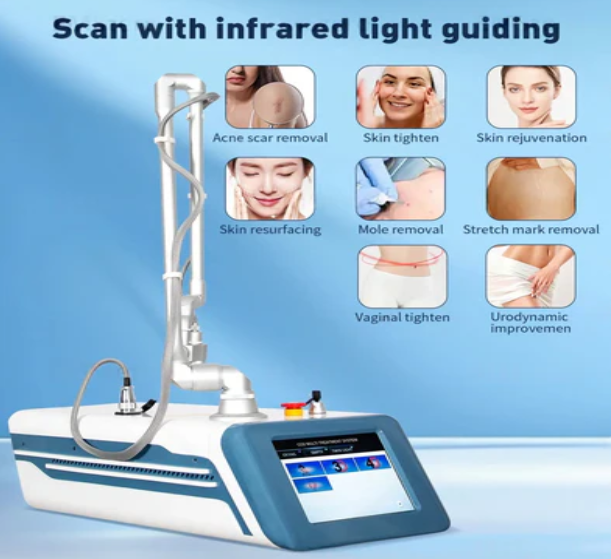
CO2 Laser Cost & ROI: 5-Yr Analysis for MedSpa Scar Repair
The Economic Reality Behind Investing in a Fractional CO2 Laser
For medical spas and aesthetic clinics, adding a fractional CO2 laser is a major capital decision. The sticker price is only the beginning. Understanding the full 5-year total cost of ownership (TCO) —from purchase to maintenance to revenue generation—is essential for making a sound investment.
This guide breaks down every cost component, provides real-world ROI calculations, and helps you evaluate whether a CO2 laser is the right financial move for your medspa's CO2 laser resurfacing and scar repair services.
Part 1: Upfront Costs — What Does a CO2 Laser Machine Cost in 2026?
The fractional CO2 laser market today offers a much wider and more accessible range of price options. Entry-level professional systems are far more affordable than traditional perceptions suggest, making this technology accessible to a broader range of clinics and entrepreneurs.
Real-World Market Pricing (2026)
| Category | Price Range (USD) | Best For | Key Features |
|---|---|---|---|
| Entry-Level Professional (B2B Direct) | $2,000 – $4,000 | Startups, solo practitioners, first-time buyers | FDA/CE cleared, RF metal tube, basic fractional mode, factory-direct support, 2-year warranty |
| Mid-Range | $4,000 – $7,000 | Established medspas, growing practices | Advanced scanning, better cooling, multiple handpieces, stronger software |
| High-End | $7,000 – $10,000+ | High-volume clinics, multi-department applications | UltraPulse technology, multiple modes, richer accessory packages |
Comparison with Traditional Market Perception
Historically, the medical aesthetic equipment market has been dominated by a few traditional brands that priced their systems at $20,000–$120,000+. However, the market has evolved significantly. Manufacturers in Asia, particularly in China, have developed competitive systems with comparable core technology—often at significantly lower price points.
A fractional CO2 laser system manufactured in an ISO 13485-certified facility, equipped with an RF metal tube, and carrying verifiable FDA/CE certifications can now be found in the $2,000–$10,000+ range. This makes gold-standard CO2 laser resurfacing technology economically viable for a much wider range of clinic types.
When evaluating different laser technologies, it's also worth understanding the broader landscape. For clinics considering alternative or complementary wavelengths, working with a reputable thulium laser supplier can provide additional options for superficial resurfacing and pigmentation treatments, though the cost structure and ROI profile will differ from CO2 systems.
Part 2: 5-Year Total Cost of Ownership — What the Sticker Price Hides
The purchase price is just one part of the equation. The true 5-year cost difference between a $3,000 system and a $10,000 system may not be as large as you might think. Below is a conservative 5-year cost estimate based on an entry-level $3,000 system:
| Cost Category | Year 1 | Years 2–5 (Cumulative) | Key Notes |
|---|---|---|---|
| Acquisition Cost | $2,000 – $10,000 | — | One-time capital expense; varies by model selected |
| Laser Tube Replacement | $0 (under warranty) | $0 – $2,000 | RF metal tubes last 15,000–20,000+ hours; most units will not require replacement within warranty period |
| Annual Calibration & Service | $200 – $500 | $800 – $2,000 | Typically 5–8% of capital cost per year for maintenance contracts |
| Protective Lenses / Handpieces | $100 – $200 | $400 – $800 | Replaced 1–2 times per year in moderate-volume clinics |
| Training (Initial + Refresher) | $300 – $600 | $300 – $600 | Operator safety training is essential |
| Disposable Supplies | $1,000 – $2,000 | $4,000 – $8,000 | Gauze, numbing cream, post-care kits; scales with patient volume |
| Electricity | $200 – $400 | $800 – $1,600 | CO2 lasers typically draw 1.5–2 kW during operation |
| Estimated 5-Year TCO | — | $9,000 – $23,000+ | Moderate-volume scenario, entry-level system |
Key Insight: Fractional CO2 Is a Low-Consumable Modality
Unlike RF microneedling (single-use tips at $30–$80 per patient) or IPL platforms (consumable cartridges), a properly maintained fractional CO2 laser has almost no per-patient consumable cost. This means the economics improve as your patient volume grows. By contrast, if you are exploring other energy-based devices, a thulium laser supplier may offer systems with different consumable profiles—typically higher per-treatment costs due to fiber degradation—which should be factored into your modality comparison.
Part 3: Revenue & ROI — How Fast Can You Recoup Your Investment?
Per-Session Revenue Potential
| Treatment Type | Avg. Price per Session (USD) | Typical Sessions per Patient |
|---|---|---|
| Full-face resurfacing | $800 – $2,500 | 1–2 |
| Acne scar treatment | $300 – $600 | 2–3 |
| Fractional scar revision | $400 – $1,200 | 2–3 |
| Vaginal rejuvenation | $800 – $1,500 | 1–3 |
| Spot treatment / pigmentation | $150 – $350 | 1–3 |
Break-Even Math: Based on Real Device Costs
Using an entry-level professional CO2 laser system at $2,500:
| Input | Conservative Estimate |
|---|---|
| Device acquisition cost | $2,500 |
| Annual fixed operating cost | $1,200 (calibration, supplies, electricity) |
| Average revenue per session | $600 (mid-range pricing for scar repair or spot resurfacing) |
| Metric | Calculation |
|---|---|
| Sessions to break even | $2,500 ÷ $600 ≈ 5 sessions |
| At 1 session/week | Payback in ~1–2 months |
| At 2–3 sessions/week | Payback in ~2–3 weeks |
| First-year ROI (at 2 sessions/week) | ~1,500% – 2,000% |
For a **higher-end system at $8,000**, with an average session price of $800:
-
Sessions to break even: $8,000 ÷ $800 = 10 sessions
-
At moderate volume (2–3 sessions per week), payback is still achieved within 1–2 months.
This means that even with a higher initial investment, the ROI timeline for a CO2 laser resurfacing service remains very short, provided patient flow is steady.
Comparing CO2 Laser ROI to Alternative Modalities
| Parameter | Fractional CO2 | Erbium Fractional | RF Microneedling |
|---|---|---|---|
| Typical capital cost | $2,000 – $10,000+ | $30,000–$90,000 | $15,000–$65,000 |
| Average session price | $400–$1,200 | $300–$800 | $200–$600 |
| Sessions per patient | 1–2 | 1–3 | 3–6 |
| Typical downtime | 5–14 days | 2–7 days | 24–72 hours |
For clinics considering a broader technology portfolio, consulting a trusted thulium laser supplier can complement your CO2 offerings, particularly for patients seeking milder resurfacing with shorter downtime, though the ROI calculation will vary based on the specific treatment pricing in your market.
Part 4: The Technology Behind the Cost — What You're Really Paying For
1. Wavelength & Laser Type
A medical-grade fractional CO2 laser operates at 10,600nm — the industry-standard wavelength for CO2 laser resurfacing. It uses a sealed RF-excited metal tube, which offers significantly longer life (15,000–20,000+ hours) and more stable energy output than DC-excited or glass tubes.
2. Scanning System
Premium systems feature galvo-based fractional scanners with adjustable density, depth, and randomized scanning patterns. This is critical for treating diverse skin types (Fitzpatrick III–VI) safely, as it helps dissipate heat and reduces the risk of post-inflammatory hyperpigmentation (PIH).
3. Cooling System
Sapphire contact cooling (maintaining 0°C to +5°C) or cryogen spray cooling protects the epidermis while allowing therapeutic heat (55–70°C) to reach the dermis. This is a key differentiator between professional-grade and lower-quality devices.
4. Certifications: Non-Negotiable
| Certification | What It Means |
|---|---|
| FDA 510(k) | Cleared for U.S. clinical use; searchable by exact model number |
| Medical CE (MDR) | Meets EU medical device regulation requirements |
| ISO 13485 | Manufacturer operates under a certified medical device quality management system |
Part 5: When Is a CO2 Laser a Good Investment for Your MedSpa?
Signs It's the Right Time
-
You have a steady flow of patients seeking scar revision (acne, surgical, traumatic)
-
Your existing clients frequently ask about wrinkle reduction and skin resurfacing
-
You want to differentiate your medspa with a gold-standard treatment that commands premium pricing
-
You can commit to training staff properly to ensure safety and efficacy
Signs You Should Wait
-
Your patient volume is too low to cover the monthly operating costs (at least 2–3 sessions per week is recommended)
-
You cannot verify the device's regulatory clearance for your target market
-
You are not prepared to invest in proper maintenance and calibration
Part 6: Frequently Asked Questions (FAQ)
Q1: Is a $2,000+ CO2 laser system reliable?
A: Yes. The main differences between entry-level and high-end systems are power output, scanning modes, and accessory richness—not the core laser source quality. Choosing a system manufactured in an ISO 13485-certified facility with FDA/CE certification and a 2+ year warranty ensures reliable core performance.
Q2: Can I upgrade an entry-level system later?
A: Most systems support firmware upgrades and additional handpiece purchases. When purchasing, look for a modular system design that allows for future expansion as your practice grows.
Q3: Are CO2 laser maintenance costs high?
A: No. CO2 lasers are low-consumable devices. The primary annual maintenance cost is calibration and service agreements (approximately 5–8% of the device price). RF metal tubes typically last 5–8 years under normal use without replacement.
Q4: Can an entry-level system treat all skin types?
A: Yes, but with proper parameter settings. For Fitzpatrick IV–VI darker skin types, lower fluence and longer pulse durations are required. Before purchasing, confirm whether the system offers preset modes or parameter ranges for darker skin types.
Q5: Is training provided with the purchase?
A: Most professional equipment manufacturers (including us) provide initial operator training and clinical parameter guidance. Before purchasing, confirm whether the training covers safety protocols, parameter selection, and complication management.
Summary: The True Cost of a Bargain vs. The Value of a Smart Investment
A $2,000 CO2 laser might seem like a bold entry-level choice, but if it comes from a supplier without certification, without technical support, and without warranty, you could face significantly higher hidden costs.
A carefully selected entry-level professional CO2 laser system ($2,000–$4,000) from a reputable manufacturer with verifiable certifications and reliable support can deliver:
-
Gold-standard results for scar revision and resurfacing that patients are willing to pay for
-
Low consumable costs that improve margins as volume grows
-
1–2 month payback at moderate utilization
-
5+ years of reliable service with proper maintenance
-
Low barrier to entry, allowing startups to offer premium services
The key is understanding the total cost of ownership, not just the sticker price, and evaluating specifications and certifications—not just brand names—to determine true value for your medspa.