

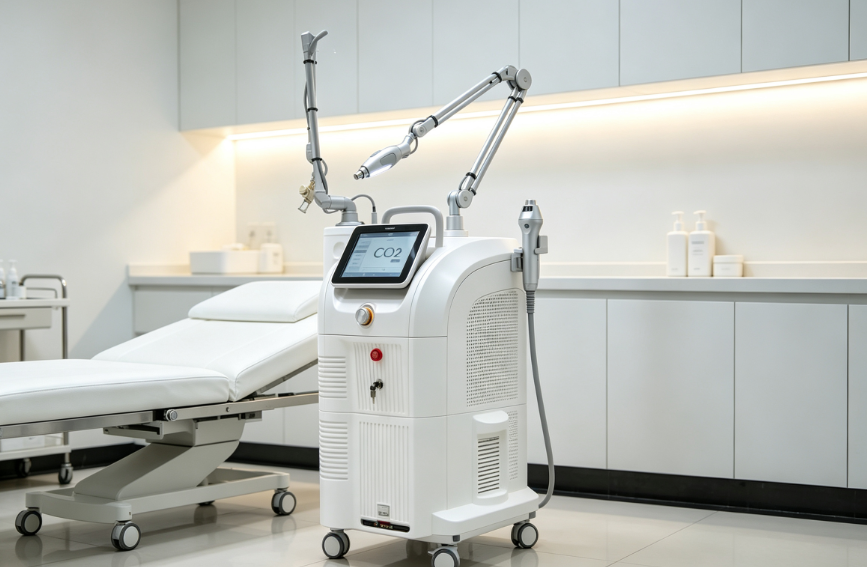
CO2 Laser Machine Buying Guide: Everything You Need to Know Before Purchase
If you're reading this, chances are you're making one of the most significant capital investments for your clinic or medical practice. Whether you're a dermatology clinic expanding your aesthetic service menu, a medical spa looking to offer fractional laser treatments, or a distributor sourcing equipment for your market, choosing the right CO2 laser machine is a decision that will impact your clinical outcomes and your bottom line for years.
This guide will walk you through everything you need to know—from understanding the core technology to evaluating suppliers and avoiding costly mistakes.
Why CO2 Laser Technology Remains the Gold Standard
CO2 lasers operate at a wavelength of 10,600 nm (10.6 µm) , which is highly absorbed by water in the skin . This makes them exceptionally effective for precise tissue ablation, skin resurfacing, and a wide range of dermatological procedures.
What sets CO2 lasers apart is their versatility. They can treat everything from fine lines and deep wrinkles to acne scars, pigmentation issues, and even certain skin lesions. For clinics looking to offer comprehensive aesthetic solutions, a CO2 laser is often considered the cornerstone of any laser treatment room.
CO2 vs. Thulium: Understanding Your Options
While CO2 remains the industry standard, you may also encounter fractional thulium laser technology during your research. The 1927nm thulium laser represents a different approach to skin rejuvenation .
Recent clinical research comparing CO2 and 1927nm thulium lasers found distinct differences:
Research published in Lasers in Medical Science showed that while CO2 lasers induced a higher level of inflammation that persisted subclinically for 30 days, thulium-treated skin returned to a metabolic state similar to untreated skin within the same timeframe . Both technologies effectively enhance cutaneous uptake of topical treatments, but they serve different patient profiles.
For many practices, the CO2 laser remains the go-to for patients seeking dramatic resurfacing results. The thulium laser may be better suited for patients who prioritize minimal downtime .
Critical Factors to Consider Before Buying
1. Laser Tube Technology: The Heart of Your Machine
The laser tube is the most important component of any CO2 laser system. The choice between RF (Radio Frequency) metal tubes and traditional DC glass tubes will significantly impact performance, maintenance costs, and longevity .
| Feature | RF Metal Tube | Glass Tube |
|---|---|---|
| Lifespan | 20,000+ hours | ~2,000 hours |
| Speed | Up to 10,000 mm/s | ~1,200 mm/s |
| Precision | 0.01 mm engraving | 0.05 mm |
| Efficiency | 30W = 50-60W equivalent | Bulkier, less efficient |
If your practice plans high-volume treatments, an RF tube technology investment can be justified by reduced downtime, lower tube replacement frequency, and increased throughput .
2. Galvo System vs. Traditional Motion Systems
For aesthetic applications, the scanning system matters enormously. A galvanometer (galvo) system uses high-speed mirrors to direct the laser beam, achieving marking speeds up to 10,000 mm/s—dramatically faster than traditional CNC systems operating at 500-800 mm/s .
This matters in a clinical setting because faster treatment times mean more patients per day and better patient comfort.
3. Beam Quality and Precision
Look for a built-in beam expander—a 4x beam expander helps achieve a fine 0.01mm line width, enabling the precise, detailed treatment your patients expect . The beam quality directly affects treatment outcomes and safety.
4. Safety and Compliance
For medical use, safety isn't optional. Ensure your machine includes:
-
Emergency stop functionality
-
Door interlock systems
-
Overheat protection
-
Class 4 laser shielding
Beyond hardware, verify compliance documentation. For the US market, FDA clearance is essential. Many Chinese manufacturers are certified ISO 13485 and welcome third-party factory inspections .
OEM vs. Branded: What's Right for Your Practice?
This is where many buyers get confused. You have two basic paths:
Buying a branded machine means you're paying a premium for marketing, support infrastructure, and the brand name itself.
Working with an OEM supplier means you can source directly from the manufacturer. Many reputable Chinese CO2 laser manufacturers, for example, offer private labeling, custom housing design, software customization, and white-label solutions .
If you're considering a fractional thulium laser device OEM supplier, there are several advantages:
-
Access to both CO2 and thulium technology from the same source
-
Lower costs without sacrificing quality
-
Branding flexibility for your practice or distribution business
-
Direct technical support from engineers who understand the hardware
When evaluating OEM suppliers, look for:
-
ISO 13485 certification (medical device quality management)
-
Minimum order quantities that work for your needs
-
Customization options (housing, software interface, handpiece design)
-
72-hour burn-in testing and calibration records
The Buying Checklist
Before making your final decision, use this checklist:
-
□
RF metal tube (if budget allows) for superior lifespan and performance
-
□
Galvo scanning system for maximum treatment speed
-
□
Beam expander (4x minimum) for precision
-
□
FDA 510(k) clearance (for US market) or applicable regional certification
-
□
ISO 13485 certified manufacturer
-
□
Training and after-sales support clearly defined
-
□
Spare parts availability confirmed
-
□
Clear warranty terms documented
-
□
On-site or remote technical support availability
-
□
User training options understood
Red Flags to Avoid
-
Vague compliance claims: If the manufacturer can't provide clear documentation of FDA clearance or CE marking, walk away.
-
No after-sales support: A machine without reliable technical support is a liability.
-
Unrealistic pricing: If it seems too good to be true, it probably is. The cheapest machines often have glass tubes that need replacement in months rather than years.
-
No demo or trial: Reputable suppliers offer demonstrations or trial periods.
Partnering with the Right Supplier
As a leading global supplier of laser solutions, many established manufacturers provide comprehensive ecosystems including machines, accessories, and core components . For practices working directly with manufacturers, here's what to look for:
-
Global warehousing and supply chain for quick fulfillment
-
Online resources for training and troubleshooting
-
International safety certifications (CE, FDA, FCC, RoHS)
-
Customization services for specific practice needs
If you're exploring partnership with a fractional thulium laser device OEM supplier, ensure they offer the same level of support and quality assurance as established brands—ideally with the flexibility to customize your equipment with your own branding, software preferences, or specialized treatment protocols.
Final Thoughts
Choosing a CO2 laser machine is an investment in your practice's future. Focus on core technology (RF tube, galvo system, beam quality) rather than marketing features. Verify compliance documentation. And don't underestimate the value of good supplier support.
Whether you choose a branded system or partner with a fractional thulium laser device OEM supplier, the right machine will serve your patients well and generate a strong return on investment for years to come.
Have questions about specific specifications or need help evaluating a supplier? Contact our team for personalized guidance.