

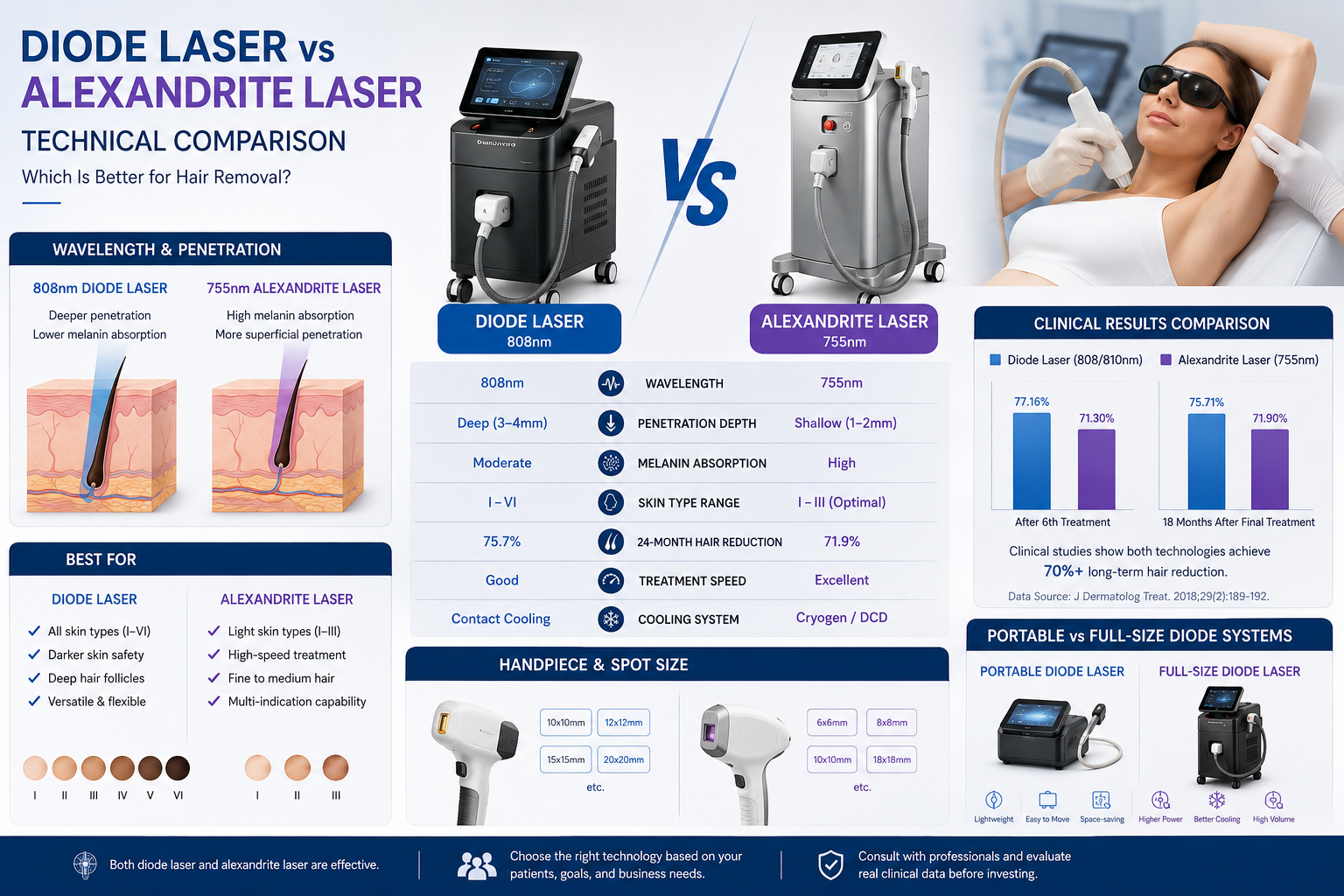
Diode Laser vs Alexandrite Laser: Technical Comparison
Quick Answer
When comparing diode laser vs alexandrite laser, the most important difference is wavelength and how each wavelength interacts with melanin.
Alexandrite laser operates at 755nm and has relatively strong melanin absorption. This makes it particularly effective for hair removal on lighter skin types when appropriate parameters are used.
Diode laser systems commonly operate around 808nm. The longer wavelength penetrates deeper and generally has lower epidermal melanin absorption than 755nm, making diode technology a versatile option for clinics treating a broader range of skin types.
Neither technology is universally better.
For clinics focused primarily on lighter skin and high-speed treatment, Alexandrite can offer important advantages. For clinics serving a diverse patient population, an 808nm diode platform can provide broader treatment flexibility.
The final choice should consider skin type, hair characteristics, treatment speed, cooling, equipment specifications, patient volume, and clinic business goals.
Introduction
Selecting a professional hair removal platform is an important equipment decision for aesthetic clinics, dermatology practices, and medical spas.
Two established technologies frequently considered for professional hair removal are 755nm Alexandrite and 808nm diode laser systems.
At first glance, the difference appears simple: 755nm versus 808nm. In practice, wavelength affects melanin absorption, penetration characteristics, treatment parameters, skin-type suitability, and cooling requirements.
The diode laser vs alexandrite laser decision therefore should not be based only on which wavelength has a higher or lower number.
Clinics should evaluate how the technology fits their actual patient population and treatment workflow.
For clinics evaluating a portable diode laser hair removal machine, the underlying wavelength physics remain important. A compact device and a full-size platform can have very different hardware configurations, but the clinical principles associated with the wavelength remain relevant.
Understanding Alexandrite Laser Technology
Alexandrite Laser at 755nm
Alexandrite lasers operate at a wavelength of approximately 755nm.
Because melanin absorbs this wavelength relatively strongly, Alexandrite can efficiently target pigmented hair follicles, particularly when treating patients with lighter skin and dark, coarse hair.
Key Characteristics
-
Wavelength: 755nm
-
Strong melanin absorption
-
Commonly used for: Hair removal
-
Particularly suitable for: Lighter skin types
-
Potential advantage: Fast treatment coverage with appropriate spot sizes and repetition rates
-
Important limitation: Greater interaction with epidermal melanin can increase the risk of adverse pigmentary effects on darker skin
Alexandrite technology also has applications beyond hair removal, including certain pigmented and vascular lesions depending on the specific platform and clinical indication.
This broader capability can be valuable for practices that want a technology with multiple aesthetic applications.
Understanding Diode Laser Technology
Diode Laser at 808nm
Diode laser systems commonly use an 808nm wavelength for hair removal.
Compared with 755nm Alexandrite, the 808nm wavelength generally penetrates deeper into tissue and interacts less strongly with epidermal melanin.
This characteristic makes diode technology particularly useful for clinics treating patients with medium to darker skin types.
An 808nm diode laser machine can also be configured with different pulse widths, energy levels, spot sizes, and cooling systems depending on the manufacturer.
Key Characteristics
-
Wavelength: Approximately 808nm
-
Moderate melanin absorption compared with 755nm
-
Deeper penetration characteristics
-
Broad skin-type applicability when appropriate parameters are used
-
Common application: Professional hair removal
-
Important advantage: Flexibility for clinics serving diverse patient populations
However, wavelength alone does not determine treatment performance.
The actual results of a diode platform depend on factors such as energy delivery, pulse duration, cooling efficiency, treatment technique, hair characteristics, and patient selection.
755nm Alexandrite vs 808nm Diode: Wavelength Physics
The main technical distinction between these technologies is their wavelength.
| Parameter | Alexandrite | Diode |
|---|---|---|
| Typical Wavelength | 755nm | 808nm |
| Spectrum | Visible/Near-IR boundary | Near-IR |
| Melanin Absorption | Higher | Moderate |
| Penetration Characteristics | Relatively shallower | Deeper |
| Main Application | Hair removal | Hair removal |
| Skin-Type Advantage | Lighter skin | Broader skin-type flexibility |
| Common Cooling | Cryogen/DCD or other systems | Contact/sapphire cooling or other systems |
The important clinical principle is selective photothermolysis.
Hair-removal lasers aim to deliver sufficient energy to the follicular target while limiting unnecessary damage to surrounding tissue.
Because melanin exists in both hair follicles and the epidermis, the balance between target absorption and epidermal absorption becomes particularly important when treating darker skin.
Skin Type: Which Technology Is More Versatile?
Skin type is one of the most important factors when selecting between these technologies.
Fitzpatrick I–III
For lighter skin types with dark hair, both Alexandrite and diode lasers can be effective.
Alexandrite can offer a strong advantage because 755nm has high melanin absorption and can efficiently target pigmented hair.
Diode remains a viable option, particularly for clinics that want one platform capable of serving a broader patient population.
Fitzpatrick III–V
As skin pigmentation increases, the safety margin becomes increasingly important.
An 808nm diode system can be attractive because its longer wavelength generally interacts less strongly with epidermal melanin than 755nm.
This does not mean every diode system is automatically safe for every skin type. Treatment parameters, cooling, operator training, and patient assessment remain essential.
Fitzpatrick IV–VI
For darker skin types, clinics typically need to pay particular attention to epidermal melanin absorption and thermal injury risk.
Diode or Nd:YAG technologies may offer advantages depending on the specific system and treatment protocol.
The key consideration is not simply the laser name but whether the device can deliver appropriate energy while maintaining adequate epidermal protection.
Clinical Evidence: What Does the Research Suggest?
Clinical comparisons indicate that both Alexandrite and diode lasers can produce substantial long-term hair reduction when appropriately matched to the patient and treatment protocol.
One head-to-head comparison described in the source material evaluated 755nm Alexandrite against an 810nm fiber-coupled diode system in patients with skin types I–IV.
The reported hair-reduction results were:
| Follow-Up | Alexandrite | Diode |
|---|---|---|
| Immediately after 6th treatment | 71.30% | 77.16% |
| 18 months after final treatment | 71.90% | 75.71% |
These results illustrate an important point:
A higher-performing wavelength cannot be identified simply by comparing the nominal wavelength number.
Both technologies can achieve strong results when the device, patient characteristics, and treatment parameters are appropriately matched.
The source material also describes a meta-analysis involving darker skin types in which diode and Nd:YAG systems demonstrated favorable safety and efficacy characteristics compared with Alexandrite, particularly when darker skin was being treated.
The practical implication for clinics is that patient demographics should be considered before equipment selection.
Diode Laser vs Alexandrite Laser: Treatment Speed
Treatment speed is another important consideration for high-volume clinics.
Alexandrite
Alexandrite systems can provide fast treatment on suitable patients because professional systems may combine:
-
Large spot sizes
-
High repetition rates
-
Efficient energy delivery
-
Rapid treatment coverage
This can be particularly valuable when treating large areas on lighter skin with dark, coarse hair.
Diode
Modern diode systems can also achieve high treatment speeds.
Some platforms use continuous-motion or in-motion treatment techniques, allowing the handpiece to move continuously across the treatment area.
This can improve workflow efficiency and reduce the importance of comparing only single-pulse treatment speed.
The Practical Difference
For a busy clinic, the more useful metric is not simply:
How fast is one pulse?
Instead, evaluate:
How many patients can the clinic safely and consistently treat per hour?
This depends on:
-
Treatment area
-
Patient skin type
-
Hair density
-
Spot size
-
Repetition rate
-
Cooling
-
Treatment technique
-
Operator experience
Cooling Technology Comparison
Cooling is a critical component of professional laser hair removal.
It protects the epidermis, improves patient comfort, and helps clinicians maintain appropriate treatment parameters.
Alexandrite Cooling
Many Alexandrite systems use dynamic cooling approaches, including cryogen spray systems.
These systems can provide rapid epidermal cooling immediately before or around laser delivery.
However, systems using consumable cryogen may introduce additional operating considerations.
Diode Cooling
Many diode systems use contact cooling, often through a sapphire cooling surface.
The cooling element remains in contact with the skin and can provide continuous thermal management during treatment.
For clinics, this can offer operational advantages because contact cooling does not necessarily require consumable cryogen.
However, cooling performance should always be evaluated from the actual device specifications rather than assuming that every diode or Alexandrite system uses the same configuration.
Treatment Comfort and Safety
Patient comfort is influenced by much more than wavelength.
Relevant factors include:
-
Energy density
-
Pulse duration
-
Cooling temperature
-
Spot size
-
Treatment technique
-
Hair thickness
-
Skin pigmentation
-
Treatment area
Alexandrite's strong melanin absorption can provide efficient follicular targeting on lighter skin, but the same characteristic requires careful parameter selection as epidermal pigmentation increases.
Diode systems may provide a broader safety margin across different skin types because of their longer wavelength, but appropriate cooling and parameter selection remain essential.
A well-designed diode laser device should therefore be evaluated not only by its wavelength but also by its cooling performance, energy stability, pulse control, and treatment interface.
Treatment Results: What Matters More Than Wavelength?
A common mistake when purchasing a laser is assuming that wavelength alone determines clinical performance.
In reality, several technical factors interact.
1. Energy Output
The system must be capable of delivering appropriate energy consistently.
2. Pulse Duration
Pulse duration affects how energy is delivered to the target.
3. Spot Size
Larger spot sizes can improve treatment coverage and workflow efficiency.
4. Repetition Rate
Higher repetition rates can reduce treatment time when combined with appropriate energy delivery and cooling.
5. Cooling
Effective cooling can help protect the epidermis and improve patient comfort.
6. Energy Stability
Consistent energy delivery is important for reproducible treatment protocols.
7. Handpiece Design
The handpiece affects ergonomics, contact with the skin, treatment speed, and operator fatigue.
Therefore, when comparing two machines, clinics should compare complete technical specifications, not just 755nm versus 808nm.
ROI: Which Technology Makes More Business Sense?
The best technology from a clinical perspective is not necessarily the best investment for every clinic.
Alexandrite May Make More Sense When:
-
The clinic primarily treats lighter skin types
-
Patients commonly have dark, coarse hair
-
High treatment speed is important
-
The clinic wants additional applications associated with 755nm technology
-
The local patient population matches the technology's strengths
Diode May Make More Sense When:
-
The clinic serves a diverse patient population
-
Medium to darker skin types represent a significant percentage of clients
-
The clinic wants broader patient reach
-
Contact cooling is preferred
-
Hair removal is the primary treatment category
A clinic should therefore evaluate:
Patient population × treatment demand × utilization × treatment speed × operating cost
rather than choosing a device solely because one technology is considered more powerful.
Portable vs Full-Size Diode Systems
Clinics sometimes assume that a portable system must provide weaker results than a full-size platform.
That is not necessarily true.
A portable diode laser hair removal machine can use the same general wavelength technology as a larger system. However, actual performance depends on the device's:
-
Energy output
-
Cooling system
-
Pulse parameters
-
Spot size
-
Handpiece
-
Power management
-
Treatment modes
Therefore, buyers should compare specifications rather than judging a machine based solely on its physical size.
Portability can be particularly valuable for:
-
Smaller treatment rooms
-
Mobile aesthetic businesses
-
Clinics with limited floor space
-
Multi-room practices
-
Distributors seeking flexible product configurations
What Should Clinics Check Before Buying?
Before choosing an Alexandrite or diode system, request a detailed specification sheet from the manufacturer.
Wavelength
Confirm the exact wavelength rather than relying on a general product description.
Energy Range
Check maximum and minimum energy settings and how consistently energy is delivered.
Pulse Duration
Review available pulse-width ranges and whether they can be adjusted for different treatment requirements.
Spot Size
Determine whether the available spot sizes are suitable for both small and large treatment areas.
Repetition Rate
Higher repetition rates can improve workflow, but they should be considered together with energy output and cooling.
Cooling System
Ask whether the system uses:
-
Sapphire contact cooling
-
Cryogen cooling
-
Air cooling
-
Water cooling
-
Hybrid cooling
Handpiece
Check ergonomics, weight, spot size, replacement cost, and expected service life.
Service and Warranty
Equipment performance is only one part of the investment.
Also evaluate:
-
Warranty period
-
Technical support
-
Spare parts
-
Training
-
Maintenance
-
Response time
-
OEM/ODM capability
755nm Alexandrite vs 808nm Diode: Decision Guide
| Clinic Requirement | Recommended Option |
|---|---|
| Primarily lighter skin types | Alexandrite or Diode |
| Broad patient demographics | 808nm Diode |
| Strong focus on large-area hair removal | Alexandrite can be advantageous |
| Darker skin types | Diode or Nd:YAG depending on protocol |
| Hair removal as primary service | Diode or Alexandrite |
| Need for broader 755nm applications | Alexandrite |
| Preference for contact cooling | Diode |
| Limited treatment-room space | Compact diode platforms may be attractive |
| Need for broad patient reach | Diode |
This table should be viewed as a purchasing guide rather than a universal clinical prescription. Actual treatment selection should be based on patient assessment, device specifications, and appropriate professional protocols.
Frequently Asked Questions
Which is better: diode laser or Alexandrite laser?
Neither is universally better. Alexandrite can be highly effective for lighter skin types, while diode technology generally provides broader flexibility across different skin types. The appropriate choice depends on patient demographics, treatment goals, device specifications, and clinic workflow.
What is the difference between 755nm and 808nm?
755nm Alexandrite has stronger melanin absorption, while 808nm diode generally penetrates deeper with lower epidermal melanin absorption. This difference contributes to their different skin-type and treatment characteristics.
Is 808nm diode laser safe for darker skin?
An 808nm diode system can be suitable for darker skin types when appropriate treatment parameters, cooling, patient selection, and professional protocols are used. Device quality and operator technique remain important.
Which laser is faster for hair removal?
Alexandrite systems can provide very fast treatment on appropriate lighter-skin patients, particularly when large spot sizes and high repetition rates are available. Modern diode systems can also achieve efficient treatment speeds, especially when using in-motion technology.
Is Alexandrite better for light skin?
Alexandrite can be an excellent option for lighter skin with dark, coarse hair because 755nm has strong melanin absorption. However, diode systems can also provide effective hair removal for these patients.
Is an 808nm diode laser better for a mixed patient population?
For clinics treating a wide range of skin types, an 808nm diode platform can provide a practical advantage because of its broader skin-type flexibility. However, the exact device specifications and treatment protocols should still be evaluated.
Is a portable diode laser hair removal machine effective?
A portable system can be effective if its energy output, wavelength, pulse parameters, cooling, and handpiece design are appropriately engineered. Physical size alone does not determine clinical performance.
Can diode lasers replace Alexandrite lasers?
For hair removal, diode technology can serve many of the same patient populations, but it does not necessarily replace every application associated with Alexandrite. Clinics should select the technology according to their treatment menu and patient demographics.
Conclusion
The diode laser vs alexandrite laser comparison ultimately comes down to the relationship between wavelength, patient skin type, treatment requirements, and clinic objectives.
Alexandrite's 755nm wavelength provides strong melanin absorption and can offer excellent treatment performance and speed for appropriate lighter-skin patients. Its additional applications can also make it attractive to practices looking beyond hair removal.
An 808nm diode laser offers deeper penetration characteristics and generally lower epidermal melanin absorption, making it a versatile option for clinics serving a broader range of skin types.
For a clinic with a diverse patient base, an 808nm diode laser machine can provide a strong balance between patient reach, treatment flexibility, cooling, and operating efficiency.
When selecting a professional system, do not compare wavelength alone. Evaluate energy stability, pulse duration, spot size, repetition rate, cooling, handpiece design, patient compatibility, maintenance, and manufacturer support.
The right laser is not necessarily the one with the strongest marketing claims. It is the system that can safely and consistently deliver the treatments your clinic performs most often while supporting your long-term business goals.
Looking for a professional diode laser system for your clinic? Mecavie Laser provides diode laser platforms designed for professional hair removal applications, with configurable specifications and OEM/ODM support for clinics and distributors.