

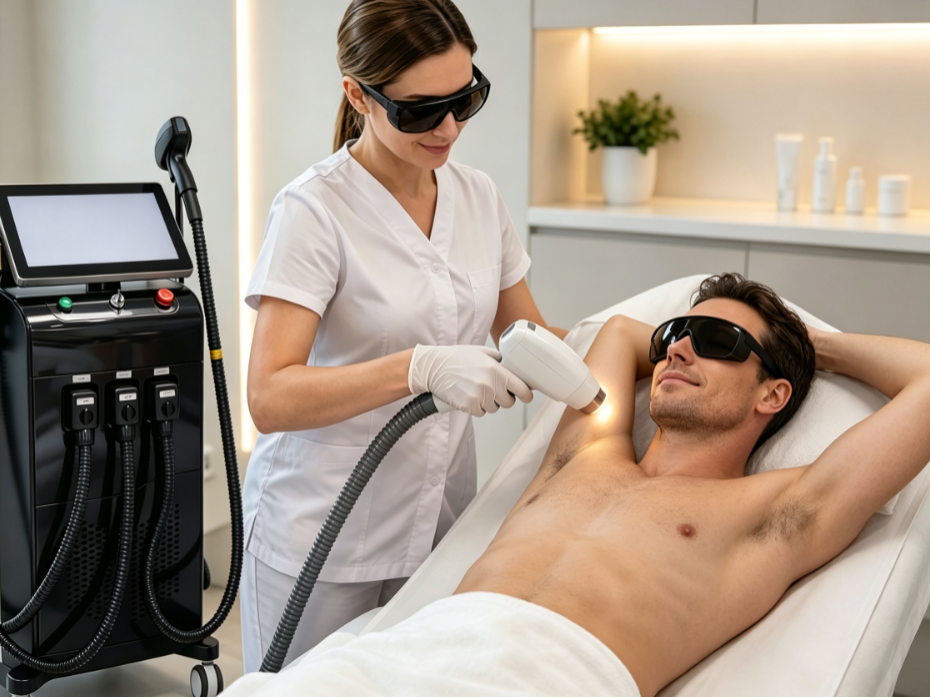
Full-Body Laser Hair Removal: How Long Does a Session Take?
A Comprehensive Guide for Salon Owners and Clients
Full-body laser hair removal has become a cornerstone service in modern beauty clinics, prized for its long-lasting smooth skin effects and non-invasive comfort. For salon owners, understanding treatment duration is critical for optimizing appointment scheduling, maximizing daily client capacity, and setting realistic expectations. For clients, knowing what to expect helps plan their time and choose the right provider.
So, how long does a full-body session actually take? The answer: 20 to 35 minutes, but the exact time depends on several key factors. This guide breaks down everything you need to know about treatment duration, the factors that influence it, and why the right equipment makes all the difference. High-quality salon systems—like those using 808nm diode laser technology—are specifically designed to balance speed, safety, and efficacy for full-body treatments.
Part 1: Average Duration of a Full-Body Session
A standard full-body laser hair removal session using certified salon-grade equipment typically takes 20 to 35 minutes to cover major areas including the arms, legs, chest, back, abdomen, and underarms.
This efficient timeframe is a major advantage of professional aesthetic equipment. In comparison, low-power home-use lasers or outdated IPL devices can take 60 minutes or longer for the same coverage—often with less consistent results.
Time Breakdown by Body Area
To understand the total time, it helps to look at how long each major area typically takes:
| Body Area | Approximate Time | Notes |
|---|---|---|
| Legs (full) | 8–12 minutes | The largest area; requires careful scanning |
| Arms (both) | 4–6 minutes | Smaller area, faster treatment |
| Back/Chest | 4–6 minutes | Varies significantly by hair density |
| Abdomen | 2–4 minutes | Usually straightforward, lower hair density |
| Underarms | 1–2 minutes | Small area, but requires precision |
| Bikini Line | 1–2 minutes | Sensitive area requiring careful parameter adjustment |
| Total | 20–35 minutes | Combined time for all areas |
Client Profile-Based Estimates
| Client Profile | Typical Session Duration |
|---|---|
| Sparse, fine hair & fair skin | 18–22 minutes |
| Average hair density & skin tone | 25–30 minutes |
| Thick, dense, coarse hair & darker skin | 30–35 minutes |
These times include pre-treatment skin assessment, the laser procedure, and basic post-treatment soothing care. Professional technicians ensure standardized, effective service without compromising results.
Part 2: Why High-Quality Salon Systems Save Treatment Time
The efficiency difference between salons comes down to one thing: equipment quality. Professional-grade devices are engineered to deliver consistent, high-energy output with minimal downtime between pulses—directly translating to faster treatment sessions.
Key Features That Speed Up Treatment
| Feature | How It Reduces Time |
|---|---|
| Larger Spot Size | Covers more skin area per pulse (e.g., 12x15mm or larger), significantly reducing overall treatment time |
| High-Frequency Pulse Output | Increases treatment efficiency by up to 60% compared to low-power devices |
| Multi-Wavelength Capability | 755+808+940+1064nm allows one device to treat all skin types without changing equipment |
| Advanced Cooling Systems | Built-in intelligent cooling (TEC/sapphire) prevents overheating, allowing continuous operation for 7+ hours |
| Stable Energy Output | Consistent energy delivery means fewer "touch-up" passes needed |
Real-World Impact: A salon using high-quality equipment can treat 12-15 full-body clients per day, while a salon using outdated or low-power devices might only manage 6-8 clients in the same time—directly impacting revenue.
Part 3: Key Factors That Affect Treatment Duration
1. Hair Density and Thickness
Hair condition is the most intuitive factor affecting session time.
-
Fine, sparse hair: Standard energy parameters and one round of scanning
-
Thick, dense hair: Requires higher energy, additional passes, and more time on areas like the back and thighs
Hair density varies significantly by individual and body area. A client with heavy back hair may require 30% more time than one with sparse hair on the same area.
2. Skin Tone and Sensitivity
For darker skin tones or sensitive skin, technicians need to appropriately reduce single laser energy and increase pulse intervals to ensure safety. This slightly extends treatment time.
-
Fitzpatrick I-III (lighter skin): Can use higher energy, faster treatment
-
Fitzpatrick IV-VI (darker skin): Requires lower energy, more careful parameter adjustments
High-quality salon systems offer multi-mode parameter adaptation to balance safety and efficiency for all skin types.
3. Technician Skill and Standardization
Standardized operation directly determines treatment efficiency. Formal salon technicians follow unified process specifications:
-
Pre-treatment skin cleansing and gel application (3-5 minutes)
-
Precise regional scanning (15-25 minutes)
-
Post-treatment cold compress soothing (2-5 minutes)
Mature operating procedures paired with high-performance equipment maximize treatment speed while ensuring uniform coverage without missed spots.
4. Number of Areas Treated
Some clients choose "full-body" but skip certain areas. The most common variations:
-
Full body (arms, legs, back, chest, abdomen, underarms, bikini): 20-35 minutes
-
Full body minus back: 16-28 minutes
-
Full body minus legs: 12-20 minutes
5. Client Tolerance and Feedback
Some clients experience more discomfort and request brief pauses during treatment. While modern systems minimize pain with built-in cooling, a few clients may still need extra time. This adds 2-5 minutes to the session.
Part 4: Why Session Time Varies Between Salons
Many clients report inconsistent treatment durations across different beauty salons. This is caused by uneven equipment quality and operational standards.
| Equipment Type | Typical Session Time | Issues |
|---|---|---|
| Genuine professional aesthetic equipment | 20-35 minutes | Stable output, consistent results, minimal side effects |
| Low-cost imitation devices | 45-60+ minutes | Unstable energy, requires multiple scans, poor results |
| Home-use IPL devices | 60-90+ minutes | Low power, limited coverage, requires repeated use |
Key Insight: Low-quality devices often require multiple repeated scans to achieve basic hair removal effects, leading to prolonged sessions and poor user experience. Worse, unstable energy easily causes skin redness, burning, and other side effects.
In contrast, salons using genuine professional-grade systems have standardized, controllable treatment times, stable single-session effects, and fewer total treatment cycles. Professional equipment undergoes strict factory aging tests and serial number compliance certification, ensuring uniform energy distribution and no hot spots—reducing the risk of post-treatment skin problems.
Part 5: How Salons Can Optimize Treatment Time
For salon owners, reducing per-session time without compromising quality directly improves revenue.
5 Time-Saving Strategies
| Strategy | Impact |
|---|---|
| Invest in high-quality professional aesthetic equipment | Reduces treatment time by 30-40% immediately |
| Standardize pre-treatment preparation | Saves 3-5 minutes per client |
| Train staff on efficient scanning techniques | Reduces operator variability |
| Use larger spot sizes for large areas | Covers more area per pulse |
| Implement proper scheduling software | Minimizes downtime between clients |
Real-World Revenue Impact
| Scenario | Clients/Day | Revenue/Day (at $200/session) |
|---|---|---|
| Low-power device (60 min/session) | 6 clients | $1,200 |
| Professional equipment (30 min/session) | 12 clients | $2,400 |
Upgrading to high-quality salon systems effectively doubles daily revenue capacity.
Part 6: Treatment Sessions and Cycles
A single full-body laser hair removal treatment only acts on hair follicles in the active growth phase. Human body hair grows in cycles of growth, regression, and resting phases, so multiple sessions are required to achieve permanent hair removal results.
Standard Treatment Protocol
| Phase | Frequency | Sessions | Expected Results |
|---|---|---|---|
| Initial Phase | Once every 4 weeks | 3-5 sessions | Remove 70%+ of body hair |
| Maintenance Phase | Once every 6-8 weeks | As needed | Long-term smooth skin |
With standard professional systems, the recommended treatment cycle is once every 4 weeks for the first 3-5 sessions, which can remove more than 70% of body hair. Subsequent maintenance sessions can be extended to once every 6-8 weeks according to hair regrowth conditions, ultimately achieving long-term smooth skin.
Why Multiple Sessions Are Needed
| Hair Growth Phase | Effect of Laser |
|---|---|
| Anagen (Growth) | Most susceptible to laser—active hair follicles are targeted effectively |
| Catagen (Regression) | Limited effect—follicle is transitioning |
| Telogen (Resting) | No effect—follicle is dormant and not targeted |
This biological limitation explains why even with the best equipment, multiple sessions over several months are necessary for permanent results.
Frequently Asked Questions (FAQ)
Q1: How long does a full-body laser session take?
A: A professional full-body session using salon-grade systems typically takes 20 to 35 minutes. The exact time depends on your hair type, skin tone, and the specific areas treated.
Q2: Why do some salons take 60 minutes for the same service?
A: Longer sessions usually mean the salon is using low-power, outdated, or counterfeit equipment that lacks the energy output and spot size efficiency of genuine professional systems. These devices require multiple passes to achieve basic results.
Q3: Can I do full-body laser hair removal faster at home?
A: No. Home-use IPL devices have significantly lower power output and typically take 60-90+ minutes for full-body coverage—and results are less consistent. Professional systems are much faster and more effective.
Q4: How many full-body sessions do I need?
A: Most clients require 3-5 initial sessions (spaced 4 weeks apart) to achieve 70%+ hair reduction. Maintenance sessions every 6-8 weeks are recommended for long-term results.
Q5: Does full-body laser hair removal hurt?
A: Professional salon systems feature built-in cooling (TEC or sapphire contact cooling) that minimizes discomfort. Most clients describe the sensation as mild tingling or snapping. If you experience significant pain, the equipment quality or technician skill may be the issue.
Q6: What's the fastest way to reduce full-body laser treatment time?
A: Choose a salon that uses genuine professional-grade equipment. Higher-quality devices with larger spot sizes, higher frequencies, and stable output reduce treatment time by 30-50% compared to low-power devices.
Final Verdict
A formal, standardized full-body laser hair removal treatment takes 20 to 35 minutes per session. The core of efficient and safe treatment lies in qualified professional aesthetic equipment.
As the most mature and reliable hair removal technology in the beauty industry, 808nm diode laser technology balances speed, safety, and effectiveness perfectly. It helps salons:
-
Increase client throughput by 2x
-
Deliver faster, more comfortable treatments
-
Reduce total sessions needed for permanent results
Choosing a salon equipped with genuine professional laser equipment is the key to avoiding ineffective treatments and wasted time and cost. For salon owners, investing in high-quality professional systems is one of the most effective ways to grow revenue and build client trust.