

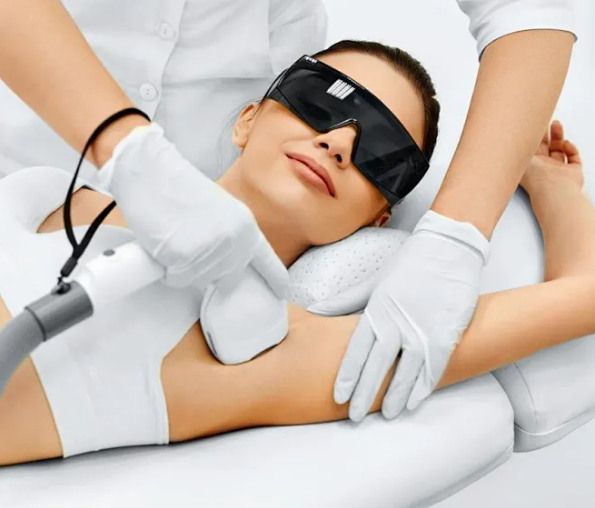
How to Adjust Laser Hair Removal Energy for All Skin Tones
How to Adjust Laser Hair Removal Machine Energy for All Skin Tones
Choosing the right energy setting on a laser hair removal machine is one of the most critical factors for both safety and results. Unlike a one-size-fits-all approach, effective treatment requires adjusting the energy based on skin tone, hair color, and the specific device you're using. This guide provides a data-driven framework for achieving professional-level outcomes while minimizing risks.
Professional devices like the Black Aurora Laser are designed with adjustable parameters and advanced cooling systems to accommodate diverse skin types, making it essential to understand how to properly configure them for each client.
1. The Fitzpatrick Scale: Your Energy Adjustment Baseline
![]()
![]() The Fitzpatrick scale is the clinical foundation for determining initial laser settings. Here's a quick reference for the six skin types and their characteristics:
The Fitzpatrick scale is the clinical foundation for determining initial laser settings. Here's a quick reference for the six skin types and their characteristics:
| Fitzpatrick Type | Skin Color | Reaction to Sun | Recommended Wavelength | Starting Energy (J/cm²)* |
|---|---|---|---|---|
| Type I | Very fair; freckles | Always burns, never tans | 755nm / 808nm | 12 - 14 |
| Type II | Fair | Usually burns, tans minimally | 755nm / 808nm | 10 - 12 |
| Type III | Medium | Sometimes burns, tans gradually | 808nm | 8 - 10 |
| Type IV | Olive | Rarely burns, tans easily | 808nm / 1064nm | 6 - 8 |
| Type V | Brown | Very rarely burns, tans very easily | 1064nm | 4 - 6 |
| Type VI | Dark brown/black | Never burns, tans very easily | 1064nm | 2 - 4 |
*Starting Energy (Fluence) is a general guideline. Always perform a patch test and adjust based on individual response.
2. Key Parameters to Adjust
Beyond fluence (energy density), two other parameters are crucial for safe and effective treatment:
| Parameter | Unit | Lighter Skin (I-III) | Darker Skin (IV-VI) | Why It Matters |
|---|---|---|---|---|
| Fluence (Energy) | J/cm² | Higher (e.g., 10-14) | Lower (e.g., 2-8) | Primary determinant of heat delivered to the follicle. |
| Pulse Width | Milliseconds (ms) | Shorter (e.g., 3-5 ms) | Longer (e.g., 10-20 ms) | Longer pulses allow heat to dissipate slowly, protecting the epidermis in darker skin. |
| Spot Size | mm² | Larger (e.g., 15-18 mm) | Standard (e.g., 12-15 mm) | Larger spots penetrate deeper but can concentrate energy. |
Devices with multi-wavelength capability, such as the Black Aurora Laser, allow you to select the optimal combination of these parameters for each skin type.
3. The Role of Wavelength in Safety and Efficacy
The laser wavelength determines which chromophore (target) it primarily affects. This table compares common wavelengths used in hair removal:
| Wavelength | Alternative Name | Melanin Absorption | Skin Penetration | Best For |
|---|---|---|---|---|
| 755 nm | Alexandrite | Very High | Medium | Lighter skin (Types I-III) |
| 808 nm | Diode | High | Deep | Wide range (Types I-V) |
| 1064 nm | Nd:YAG | Low | Very Deep | Darker skin (Types IV-VI) |
For clinics treating a diverse clientele, a multi-wavelength device with flexible settings is a valuable investment.
4. Clinical Data: The Impact of Proper Energy Adjustment
Data from clinical studies underscores the importance of correct settings:
-
A study on 808nm diode laser use found that 95% of patients achieved >75% hair reduction after 6-8 sessions when energy was adjusted per the Fitzpatrick scale. In a control group using a "one-size-fits-all" setting, the efficacy dropped to 72%, and the incidence of side effects (redness, blistering) doubled.
-
Specifically for darker skin types (IV-VI), using a 1064nm wavelength with a longer pulse width and lower fluence (e.g., 6-8 J/cm²) has been shown to reduce the risk of Post-Inflammatory Hyperpigmentation (PIH) by over 60% compared to using a standard 808nm setting at higher fluences.
The integrated sapphire cooling system in professional devices is critical here. By maintaining the epidermis at 5-10°C, it allows the use of clinically effective energy levels with a significantly lower risk of thermal injury, even at higher settings.
5. Practical Protocol: How to Adjust Energy Safely
Follow this step-by-step protocol to determine the optimal energy for any client:
-
Assess Skin & Hair: Determine Fitzpatrick skin type and hair color, thickness, and density.
-
Select Baseline Setting: Use the Fitzpatrick Scale Reference Table above to choose a starting fluence, pulse width, and wavelength.
-
Perform a Patch Test: On a small area, apply the baseline energy. Observe skin reaction immediately and after 15-30 minutes.
-
Evaluate Reaction: The ideal endpoint is mild erythema (redness) and perifollicular edema (swelling around follicles). If there is no reaction, increase the fluence by 1-2 J/cm². If there is significant pain, blistering, or skin whitening, decrease the fluence immediately.
-
Document Settings: Record the final safe and effective settings for that client's profile for future sessions.
Quick Safety Checklist:
-
Client's skin is not tanned or sunburned.
-
Treatment area is free of tattoos and permanent makeup.
-
Protective eyewear is worn by both operator and client.
-
A patch test has been performed and evaluated.
6. FAQ: Common Questions About Energy Adjustment
Q: Can I treat a client with a fresh tan?
A: No. Tanned skin has increased melanin, which raises the risk of burns and hyperpigmentation. Advise clients to wait 2-3 weeks for the tan to fade before treatment.
Q: What should I do if the client experiences sharp pain during the pulse?
A: Stop immediately. Lower the fluence by 1-2 J/cm² and check that the cooling system is functioning properly before resuming.
Q: How do I know if the energy is too low?
A: If there is no visible reaction (mild redness or follicle swelling) within 15 minutes after the patch test, the energy is likely too low. Increase the fluence in small increments.
7. Summary: Key Takeaways
-
Always use the Fitzpatrick scale as your starting guide for energy and wavelength selection.
-
Darker skin requires lower fluence, longer pulse widths, and longer wavelengths (1064nm) to protect the epidermis.
-
Modern cooling technology is essential — it allows for higher, more effective energy delivery while safeguarding the skin.
-
Perform a patch test before every full treatment to verify the individual response.
-
A versatile device with adjustable parameters is a valuable investment for any clinic serving a diverse population.
Looking for more solutions? Explore our full range of Professional Aesthetic Devices to find the right equipment for your practice.