

How To Identify Low-Quality Laser Hair Removal Machine
A Practical Q&A Guide for Clinic Owners and Aesthetic Practitioners
You have found a "professional laser hair removal machine" on a B2B marketplace. The price is compelling. The brochure lists impressive specs. But how do you know if it's actually a quality device—or a relabelled low-quality machine that will cost you more in repairs, complications, and lost revenue?
This guide answers the 8 most critical questions buyers ask when evaluating laser hair removal equipment. Each answer is grounded in clinical data and technical specifications, helping you make an informed decision.
Q1: What is the first and most important technical spec I should check?
A: Wavelength. This is the single most revealing specification on any laser hair removal machine datasheet. Wavelength determines which patients you can treat safely and effectively.
A modern, clinically versatile diode laser system should offer a combination of wavelengths to address different skin types and hair characteristics. A mature multi-wavelength architecture is the 755+808+940+1064nm configuration:
| Wavelength | Primary Target | Skin Type Suitability |
|---|---|---|
| 755nm | Melanin in superficial hair | Fitzpatrick I–III (lighter skin) |
| 808nm | Melanin with deeper penetration | Fitzpatrick IV–V (medium skin) |
| 940nm | Vascular and deeper tissue | Fitzpatrick IV–VI (darker skin) |
| 1064nm | Deepest penetration | Fitzpatrick V–VI (very dark skin) |
A genuine 808nm diode laser system with true multi-wavelength capability allows practitioners to treat the broadest possible range of clients—from fair-skinned individuals with fine hair to darker-skinned clients with coarse hair—using a single platform.
Red flags to watch for:
-
"Multi-wavelength" claims without specific wavelengths listed.
-
No wavelength specification at all (often indicates an IPL unit relabelled as a "laser").
-
Wavelength tolerance exceeding ±5nm (indicates poor manufacturing quality).
Q2: How can I tell if a supplier's "multi-wavelength" claim is genuine?
A: Ask for the exact wavelengths and verify them. A legitimate multi-wavelength system will clearly specify each wavelength and its clinical application. Some wholesalers print "755/808/1064 nm" on brochures even when the device only contains a single 808nm diode.
Questions to ask the supplier:
-
"Can you provide a measured wavelength specification on the data sheet—not a marketing brochure number?"
-
"Which specific wavelengths does this system include, and what skin types is each validated for?"
-
"Is this a true multi-wavelength system, or does it use a single diode with different settings?"
If the supplier cannot answer these questions clearly, consider it a significant red flag.
Q3: Does spot size really matter? And what should I look for?
A: Yes, spot size directly determines treatment speed and your daily revenue capacity. A larger spot size allows you to cover more area per pulse, significantly reducing treatment time for large areas like the back, legs, and chest.
A well-equipped professional system offers multiple spot size options to balance speed and precision:
| Spot Size | Application | Treatment Speed |
|---|---|---|
| 12x15mm (Mini) | Small areas (face, underarms, bikini line) | Slower, high precision |
| 13x28mm (Standard) | Medium areas (abdomen, arms) | Balanced |
| 15x30mm (Large) | Large areas (chest, upper back) | Fast |
| 15x40mm (Extra Large) | Extra-large areas (full back, legs) | Very fast |
Critical insight: A larger spot size requires significantly more total power to maintain effective fluence. For example, to achieve 10 J/cm² with a 15x40mm spot (600mm² area), the system needs to deliver approximately 6 times more total energy per pulse than with a 12x15mm spot (180mm² area). Low-quality machines may advertise large spot sizes but lack the power output to actually deliver effective energy across that area.
Red flags:
-
Large spot size listed with low total power (mathematically impossible).
-
Only one spot size option available.
-
No spot size specification at all.
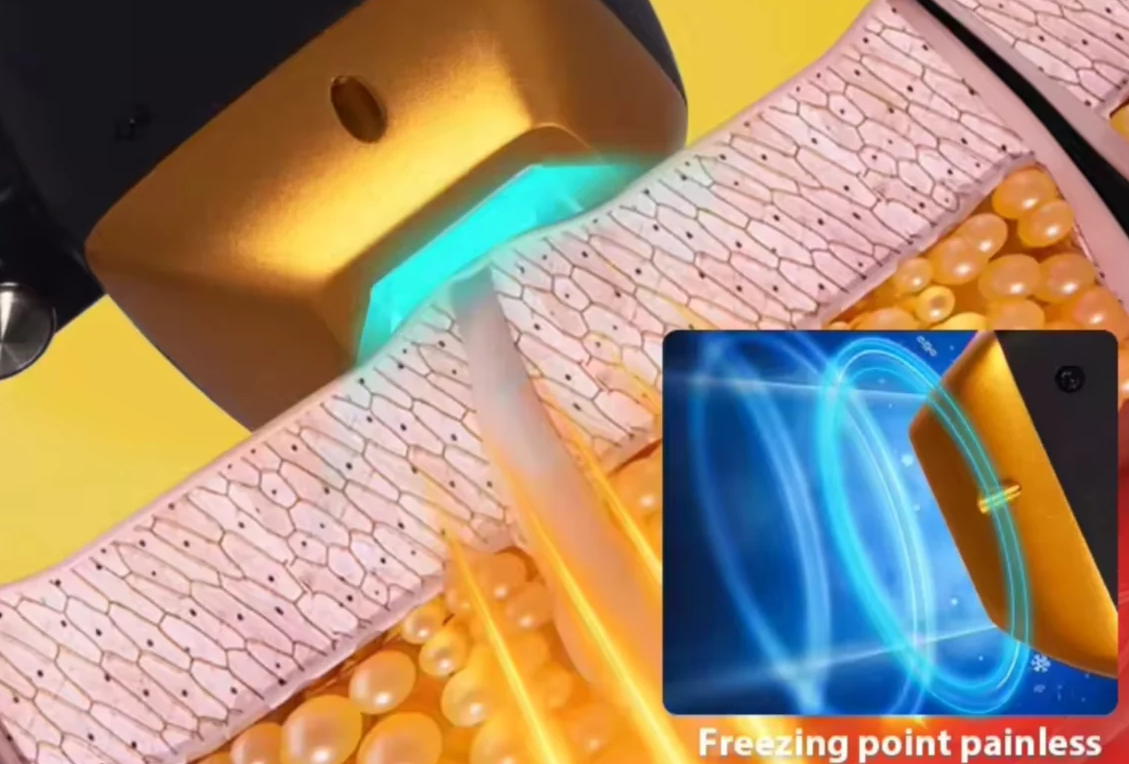
Q4: How important is the cooling system, and what type should I look for?
A: Cooling is not a luxury—it is a clinical necessity. The cooling system directly determines patient comfort, treatment safety, and your ability to deliver effective energy without causing thermal injury.
| Cooling Type | Description | Clinical Significance |
|---|---|---|
| Contact cooling (sapphire tip) | A chilled sapphire window contacts the skin during treatment | Gold standard for diode lasers; protects epidermis while allowing deep energy delivery |
| Cryogen spray cooling (DCD) | Precise cryogen bursts cool the skin before each pulse | Most effective for epidermal protection |
| Air/water cooling | Internal system cools the handpiece, not the skin | Insufficient for high-energy treatments |
| No active cooling | Single fixed temperature or no cooling mechanism | High risk of burns; should be avoided entirely |
A well-designed cooling system maintains consistent contact temperature even at maximum duty cycle. High-end Beauty Laser equipment typically integrates sapphire contact cooling with real-time temperature monitoring.
Red flags:
-
The spec sheet lists "cooling" without specifying the type or mechanism.
-
The system only uses air or water cooling (not skin-contact cooling).
-
No mention of skin temperature monitoring sensors.
Q5: How do I read energy output specs correctly? What numbers are real?
A: Energy density (measured in J/cm²) is often manipulated by low-quality manufacturers to appear more powerful than they actually are.
Effective hair removal typically requires fluence in the 10–40 J/cm² range, depending on skin type and hair characteristics. The critical question is not the maximum number on the spec sheet—it is whether the device can deliver that energy consistently and accurately.
| Specification Component | What It Should Indicate | What Low-Quality Devices Hide |
|---|---|---|
| Maximum fluence | Peak energy that the device can deliver | Often inflated to a theoretical "peak power" rather than clinically usable energy |
| Pulse duration | The time over which energy is delivered | Wide tolerances indicate poor power supply regulation |
| Frequency (rep rate) | How many pulses per second the device can deliver | Higher rates require stable cooling and power supply—low-quality devices often cannot sustain both simultaneously |
Red flags:
-
Fluence listed without spot size context (meaningless without it).
-
"Peak power" listed instead of "average power" (common deception; peak power may be 2–3 times higher than sustained output).
-
Excessively wide fluence range (often indicates poor calibration).
Questions to ask:
-
"What is the actual, sustained output at maximum settings for a 30-minute session?"
-
"Can you provide a calibration certificate or test report showing fluence accuracy?"
Q6: What certifications are non-negotiable, and how do I verify them?
A: Certifications are not badges of honor—they are legal requirements for safe and insurable operation. Low-quality manufacturers often exploit buyer confusion to claim certifications they do not actually hold.
| Certification | What It Means | How to Verify |
|---|---|---|
| FDA 510(k) | Device is substantially equivalent to a legally marketed predicate device for U.S. market | Search the FDA database by the exact model number listed in the clearance |
| CE Marking (MDR) | Device meets EU medical device regulation requirements | Check the NB (Notified Body) number in the EU NANDO database |
| ISO 13485 | Manufacturer has a certified quality management system for medical devices | Request the certificate and verify it is current and issued by an accredited body |
ISO 13485 certification is particularly important. It confirms that the manufacturer operates under a quality management system specifically designed for medical devices, covering everything from design and development to production and after-sales service.
Red flags:
-
"FDA approved" instead of "FDA cleared" (laser devices are cleared via 510(k), not approved).
-
Certificate number not provided on request.
-
Certification applies to a different model than the one being sold.
Questions to ask:
-
"Can you provide the FDA 510(k) clearance number for this exact model?"
-
"What is the certified notified body number for your CE Marking?"
-
"Can you provide copies of your ISO 13485 certificate and IEC 60601 test reports?"
Q7: If a machine costs $998–$5,000, is it automatically low quality?
A: No. Price alone is not a reliable indicator of quality. The market has evolved significantly.
The traditional medical aesthetic equipment market has been dominated by a few long-established companies that have historically priced their systems at $20,000–$120,000+. These prices reflect decades of R&D, clinical trials, and brand reputation.
However, manufacturers in Asia, particularly in China, have developed competitive multi-wavelength diode laser systems with comparable core technology—often at significantly lower price points. A well-equipped 808nm diode laser system with true multi-wavelength capability (755+808+940+1064nm) and multiple spot sizes can now be found in the $998–$5,000 range, depending on features and supplier.
What this means for you:
-
A $2,500 multi-wavelength system from a reputable manufacturer with verifiable certifications may be a better investment than a $25,000 single-wavelength system from certain traditional brands—especially if you treat clients across all skin types.
-
Value is about specifications, not price. A system that offers four wavelengths, four spot sizes, effective contact cooling, and is manufactured in an ISO 13485-certified facility represents genuine professional-grade capability, regardless of its price point.
Red flags:
-
Price is extremely low ($500) with almost no specification details.
-
Price is high ($10,000+) but specifications are vague or unverifiable.
-
Price is "too good to be true" without supporting documentation.
Q8: How can I quickly vet a supplier before making a purchase?
A: Use this 10-minute supplier vetting checklist before engaging in detailed discussions:
| ✅ | Item | What to Check |
|---|---|---|
| ☐ | Wavelength specification | Confirmed on datasheet, with specific wavelengths listed (e.g., 755+808+940+1064) |
| ☐ | Cooling type | Active contact cooling (sapphire) specified, not just "air cooling" |
| ☐ | Spot size options | Multiple options available (e.g., 12x15, 13x28, 15x30, 15x40) |
| ☐ | FDA 510(k) number | Provided for exact model; searchable on FDA database |
| ☐ | CE/ISO 13485 | Certificate with valid NB number and current accreditation date |
| ☐ | Supplier years active | Minimum 3+ years; ideally 5+ with documented export history |
| ☐ | Sample availability | Supplier offers sample units for testing before bulk order |
Additional supplier quality metrics to consider:
| Metric | What to Aim For | Why It Matters |
|---|---|---|
| Years in operation | 5+ years preferred | Operational stability and proven track record |
| Staff size | 100+ employees | Indicates structured R&D, QA, and service departments |
| On-time delivery rate | 95%+ for bulk orders | Proxy for operational discipline |
| Reorder rate | 40%+ | The most honest metric—customers who return are satisfied |
| Response time | ≤4 hours for inquiries | Fast response suggests dedicated support teams |
If a supplier cannot pass this checklist, the device is likely low-quality—regardless of how attractive the price appears.
Summary: Quick Decision Matrix
| Question | Red Flag | Green Flag |
|---|---|---|
| Wavelength | Single wavelength only, or vague "multi-wavelength" claims | 755+808+940+1064nm clearly listed |
| Spot Size | Only one option, or large spot with low power | 4+ options (12x15 to 15x40) with verified power |
| Cooling | Air/water only, or "cooling" without detail | Sapphire contact cooling with real-time monitoring |
| Certifications | "FDA approved" (vs cleared), or no certificate number | FDA 510(k), CE, ISO 13485—all verifiable |
| Supplier | <3 years old, slow response, no references | 5+ years, fast support, high reorder rate |
| Price | $500 with no specs, or $10,000+ with vague specs | $998–$5,000 with full, verifiable specifications |
Final Thought: The True Cost of a Bargain
A $500 "bargain" laser may save money upfront, but its hidden costs—reduced revenue from slower treatments, complications that damage patient trust, frequent repairs, and eventual replacement—far exceed the initial "savings."
A professional multi-wavelength diode laser system from a reputable source, with verifiable certifications and multiple spot sizes, may cost $998–$5,000—not $20,000+. The key is not the price tag itself, but whether the specifications at that price point meet your clinical and business needs.
Using this Q&A guide, you can evaluate any Beauty Laser equipment offering with confidence. You will know exactly which questions to ask, which red flags to avoid, and which devices are truly worthy of your clinic—and your patients.