

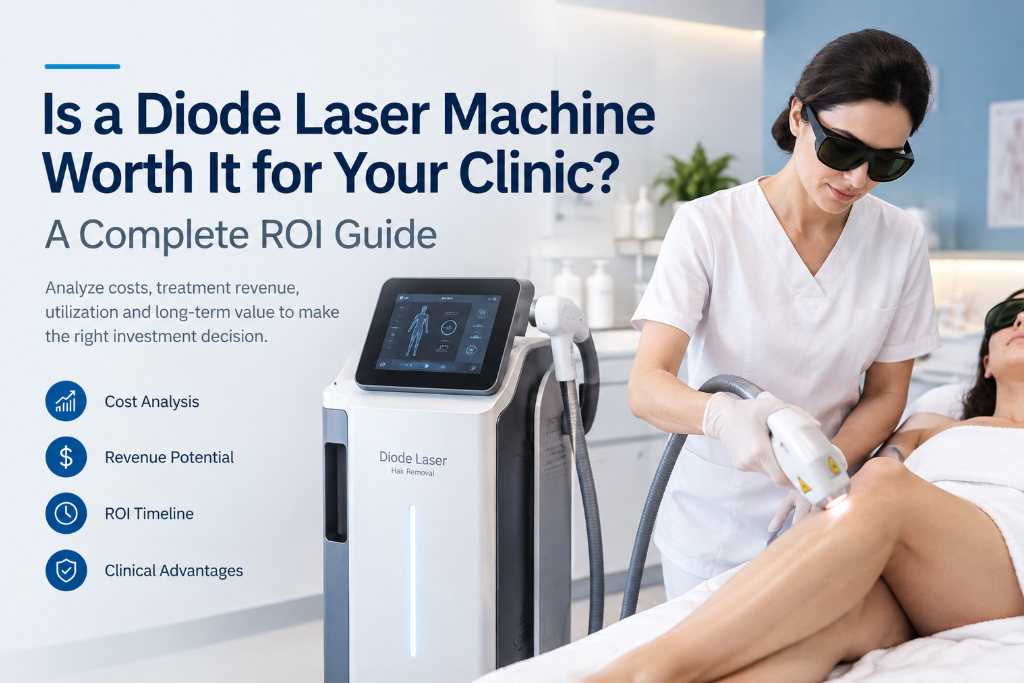
Is a Diode Laser Machine Worth It for Your Clinic?
Quick Answer
A diode laser machine can be worth the investment for a clinic, but the answer depends on patient demand, treatment pricing, machine utilization, equipment cost, operating expenses, and how quickly the clinic can build a recurring client base.
A clinic treating only a few laser hair removal clients each week may struggle to justify a dedicated laser system. In contrast, a clinic with consistent demand, appropriate treatment pricing, and enough appointment capacity can potentially recover its equipment investment within months rather than years.
The important point is that buying a laser is not automatically profitable.
The machine itself does not generate revenue. Booked treatment hours do.
For that reason, this guide looks beyond the purchase price and examines the complete business case, including:
- Equipment cost
- Revenue per treatment
- Machine utilization
- Operating expenses
- Break-even analysis
- Treatment capacity
- Multi-wavelength capability
- Maintenance and downtime
- Marketing and customer acquisition
- When buying a machine may not make financial sense
For clinics considering a diode laser hair removal machine, this approach provides a more realistic way to evaluate the investment.
1. The Real Question Is Not “How Much Does the Machine Cost?”
When clinic owners evaluate laser equipment, the first number they usually look at is the purchase price.
That is important, but it is only one part of the investment.
A better calculation is:
Total Investment = Equipment Cost + Installation + Training + Shipping + Initial Marketing + Working Capital
For example, a clinic might purchase a system for $10,000 but spend additional money on:
- Shipping and installation
- Staff training
- Treatment-room preparation
- Marketing
- Website or booking integration
- Replacement accessories
- Initial consumables
- Insurance or compliance requirements
The machine price therefore should not be treated as the total cost of launching a laser hair removal service.
Typical Equipment Categories
| Equipment Position | Typical Investment | Suitable For |
|---|---|---|
| Entry professional system | Lower investment | New clinics |
| Mid-range system | Moderate investment | Established salons and clinics |
| Multi-wavelength professional system | Higher investment | High-volume practices |
| Premium branded platform | Highest investment | Clinics emphasizing brand positioning |
The exact price varies considerably depending on wavelength configuration, cooling system, power, handpiece design, certifications, software, warranty, and manufacturer support.
The right question is therefore not “What is the cheapest machine?” but “What configuration can generate enough treatment revenue to justify its total cost?”
2. How Does a Diode Laser Machine Generate Revenue?
The economics of laser hair removal are relatively straightforward.
A clinic earns revenue every time a treatment is performed.
Basic Revenue Formula
Monthly Laser Revenue = Average Treatment Price × Treatments Per Day × Working Days
For example:
$150 average treatment × 5 treatments/day × 26 days = $19,500 monthly revenue
But this is revenue, not profit.
The clinic still needs to account for:
- Staff wages
- Rent
- Marketing
- Payment processing
- Equipment maintenance
- Insurance
- Taxes
- Cancellations
- Discounts
- Financing costs
This distinction is essential when evaluating whether a laser purchase is worthwhile.
3. Utilization Is More Important Than the Machine Price
Two clinics can purchase exactly the same laser and achieve completely different financial results.
Why?
Because machine utilization is different.
Consider three hypothetical clinics.
| Clinic | Treatments/Week | Average Price | Approx. Monthly Revenue |
|---|---|---|---|
| Low utilization | 5 | $150 | $3,000 |
| Moderate utilization | 15 | $150 | $9,000 |
| High utilization | 30 | $150 | $18,000 |
These numbers are examples rather than guaranteed industry results.
The key lesson is that a $10,000 machine sitting unused for most of the week is not necessarily a good investment.
A $20,000 machine operating consistently may produce a better return than a $7,000 machine with insufficient patient demand.
The utilization question
Before purchasing equipment, ask:
How many paid laser treatment hours can my clinic realistically book each week?
This is one of the most important questions in the entire ROI calculation.
4. Calculate Break-Even Before You Buy
A simple break-even model can make the decision much clearer.
Break-Even Formula
Break-Even Treatments = Total Investment ÷ Contribution Margin Per Treatment
Suppose:
- Equipment and initial setup = $12,000
- Average treatment price = $150
- Variable cost per treatment = $20
Contribution margin:
$150 − $20 = $130
Break-even treatment volume:
$12,000 ÷ $130 ≈ 93 treatments
This does not mean the clinic will automatically recover the investment after 93 appointments.
Fixed business expenses, marketing costs, taxes, financing, and other overhead still matter.
But it gives the owner a much better starting point than simply saying “the machine pays for itself in three months.”
5. Build Three ROI Scenarios
Instead of assuming one optimistic outcome, clinic owners should model at least three scenarios.
Conservative Scenario
Assume:
- Low patient volume
- Moderate treatment pricing
- Some cancellations
- Higher marketing costs
- Limited machine utilization
The payback period may be considerably longer.
Base Scenario
Assume:
- Stable patient demand
- Normal treatment pricing
- Consistent weekly bookings
- Controlled operating costs
This provides the most useful planning estimate.
High-Utilization Scenario
Assume:
- Strong patient demand
- High appointment utilization
- Multiple treatment areas
- Good customer retention
- Efficient scheduling
This represents the upside potential.
Example
| Scenario | Treatments/Month | Average Price | Gross Revenue |
|---|---|---|---|
| Conservative | 30 | $120 | $3,600 |
| Base | 70 | $150 | $10,500 |
| High utilization | 120 | $160 | $19,200 |
These are illustrative calculations, not guaranteed results.
The advantage of scenario planning is that it prevents a clinic from making an investment decision based entirely on the best-case outcome.
6. What Are the Ongoing Costs?
One reason diode laser systems can be attractive is that the treatment model does not necessarily require the same type of consumable replacement associated with some other technologies.
However, “low operating cost” does not mean “zero operating cost.”
Clinics should budget for:
Maintenance
Depending on the equipment, maintenance may include:
- Cooling-system servicing
- Handpiece maintenance
- Electrical inspection
- Calibration
- Software support
- Replacement components
Handpiece Costs
The handpiece is one of the components that may eventually require servicing or replacement.
Its lifespan depends on:
- Usage
- Cooling performance
- Component quality
- Operating conditions
- Manufacturer design
Staff Costs
The treatment may require trained personnel, so labor must be included in the financial model.
Marketing
A laser machine cannot generate revenue without patients.
Marketing expenses may include:
- Google Ads
- Social media advertising
- Local SEO
- Promotions
- Referral programs
- Website content
- Before-and-after marketing where legally appropriate
This is one of the most frequently overlooked costs in equipment ROI calculations.
7. Machine Utilization Can Matter More Than Machine Specifications
A common purchasing mistake is focusing too heavily on technical specifications.
Buyers may compare:
- Wattage
- Wavelengths
- Spot size
- Cooling temperature
- Repetition rate
- Screen size
These specifications matter, but they do not directly tell you how profitable the machine will be.
Consider two systems:
Machine A
- Lower purchase price
- Basic configuration
- Lower throughput
Machine B
- Higher purchase price
- Multiple wavelengths
- Larger treatment capacity
- Faster workflow
If Machine B allows the clinic to treat significantly more patients each day, the additional purchase cost may be justified.
The correct comparison is therefore:
Additional equipment cost vs additional revenue capacity
8. Why Multi-Wavelength Capability Can Change the Business Case
A multi-wavelength diode platform may provide greater flexibility for clinics treating a diverse patient population.
Common diode laser configurations may include:
- 755 nm
- 808 nm
- 940 nm
- 1064 nm
Each wavelength interacts differently with melanin, penetration depth, and hair characteristics.
However, clinics should not assume that simply adding wavelengths automatically improves ROI.
The financial value depends on whether those additional capabilities actually increase the number of patients the clinic can appropriately serve.
For example:
If 95% of your current patients can already be treated effectively with your existing configuration, paying significantly more for additional wavelengths may provide limited incremental value.
But if your clinic regularly receives patients with different skin and hair characteristics, a broader configuration may provide more business flexibility.
For buyers evaluating platforms such as aurora laser, the important question is therefore not simply how many wavelengths are advertised, but whether those wavelengths match the clinic's patient mix and treatment strategy.
9. Treatment Speed Has a Direct Business Impact
Treatment speed affects revenue capacity.
Suppose one system requires considerably more time to complete a full-leg treatment than another.
If the clinic performs several full-body or large-area treatments every day, those additional minutes accumulate.
Example
Assume:
- Average appointment = 60 minutes
- 6 available treatment hours/day
The theoretical capacity is approximately:
6 treatments/day
If workflow improvements reduce average treatment time to 45 minutes, theoretical capacity becomes:
8 treatments/day
That does not mean the clinic will automatically book eight patients.
But it demonstrates why:
Treatment speed can create revenue capacity even when treatment prices remain unchanged.
10. Cooling Technology Also Affects Business Performance
Cooling is often discussed as a comfort feature, but it can also influence workflow.
A professional diode system may use technologies such as:
- Sapphire contact cooling
- TEC cooling
- Water cooling
- Air cooling
Effective thermal management can support consistent operation and improve the treatment experience.
For clinics, the practical questions are:
- Can the system operate reliably during busy periods?
- Does cooling remain stable during repeated treatments?
- Is the handpiece comfortable to use?
- How easy is the cooling system to maintain?
- What happens if the cooling system requires service?
A machine with impressive output but poor thermal management may create operational problems.
11. Downtime Has a Financial Cost
Downtime is one of the hidden costs of laser equipment ownership.
Imagine a clinic normally generates:
$800 of laser revenue per working day
If equipment failure causes three days of downtime:
$800 × 3 = $2,400
The actual financial impact may be even higher because patients could:
- Reschedule
- Request refunds
- Move to another clinic
- Lose confidence in the service
Therefore, manufacturer support and spare-parts availability should be treated as part of ROI.
Ask the supplier:
- How long is the warranty?
- What components are covered?
- How quickly are spare parts shipped?
- Is remote technical support available?
- How are handpiece failures handled?
- Is technician training available?
- What is the expected service life?
A slightly more expensive machine can sometimes have a lower total cost if service and support are substantially better.
12. What About Financing?
Not every clinic purchases equipment with cash.
Financing changes the ROI calculation because the clinic needs to consider:
- Down payment
- Monthly payment
- Interest
- Contract length
- Total financing cost
For example, a $15,000 machine financed over several years may have a manageable monthly payment, but the total amount paid will exceed the cash purchase price.
Therefore, compare:
Monthly equipment payment vs expected monthly contribution from laser treatments
If the machine generates insufficient treatment volume to cover the financing payment and related operating costs, the investment becomes much riskier.
13. When Buying a Diode Laser Machine May NOT Be Worth It
This is an important part of the decision that many equipment articles overlook.
A diode laser may not be a good investment if:
You Have Very Low Patient Demand
If the clinic currently performs only a handful of laser treatments each month, buying expensive equipment may create unnecessary capital costs.
Your Market Is Extremely Price Competitive
If competitors charge very low prices, achieving attractive margins may be difficult.
You Have No Marketing Strategy
Buying equipment does not create customers.
You Cannot Allocate Treatment Time
If the machine has no dedicated treatment capacity, utilization may remain too low.
Staff Training Is Insufficient
A sophisticated machine requires appropriate training and operating procedures.
After-Sales Support Is Weak
Long-distance service delays can create significant downtime.
You Are Choosing Based Only on the Lowest Price
The cheapest system may not be the lowest-cost option over its useful life.
14. When Does Buying Make More Sense?
A diode laser investment becomes more attractive when several conditions are present.
Strong Existing Patient Demand
If your clinic already has customers asking for laser hair removal, the acquisition risk is lower.
Repeat Treatment Potential
Hair-removal services typically involve multiple treatment sessions, creating opportunities for repeat bookings.
Adequate Treatment Capacity
The clinic has enough appointment availability to use the machine consistently.
Appropriate Pricing
The clinic's pricing supports a reasonable contribution margin.
Reliable Supplier Support
The manufacturer can provide technical support, spare parts, training, and warranty service.
Long-Term Business Strategy
The clinic plans to offer laser hair removal as a core service rather than a temporary promotion.
15. How to Compare Two Machines Properly
Do not compare machines using price alone.
Use a purchasing matrix.
| Factor | Machine A | Machine B |
|---|---|---|
| Purchase price | ||
| Number of wavelengths | ||
| Laser source | ||
| Cooling system | ||
| Treatment speed | ||
| Handpiece design | ||
| Warranty | ||
| Spare-parts availability | ||
| Training | ||
| Technical support | ||
| Certification | ||
| Expected utilization | ||
| Financing cost | ||
| Total ownership cost |
The most important line may be:
Expected revenue contribution
A machine that costs $5,000 more but increases realistic treatment capacity can potentially be a better investment.
16. A Better ROI Formula for Clinic Owners
For a more realistic analysis, use:
Net Monthly Contribution = Laser Revenue − Variable Costs − Additional Labor − Marketing − Maintenance − Financing Costs
Then:
Estimated Payback Period = Total Initial Investment ÷ Net Monthly Contribution
This is much more useful than claiming that every clinic will recover its investment within a fixed number of months.
Example
Suppose:
- Machine + setup = $12,000
- Monthly treatment revenue = $12,000
- Variable and incremental operating costs = $4,000
Net monthly contribution:
$12,000 − $4,000 = $8,000
Estimated simple payback:
$12,000 ÷ $8,000 = 1.5 months
But if the same clinic generates only $4,000 revenue with $2,500 in incremental costs:
$4,000 − $2,500 = $1,500
Payback becomes:
$12,000 ÷ $1,500 = 8 months
This illustrates why the same machine can have completely different ROI depending on utilization.
17. What Should You Ask a Diode Laser Manufacturer?
Before purchasing, ask the supplier questions in five categories.
Technical
- What laser wavelengths are available?
- What is the actual operating specification?
- What cooling technology is used?
- What is the expected handpiece lifespan?
- How is output consistency tested?
Regulatory
- Which certifications apply to this exact model?
- What documentation is available?
- Which markets is the equipment intended for?
Commercial
- What is the purchase price?
- What is included?
- What is the MOQ?
- What are shipping costs?
- Are spare parts included?
Service
- What does the warranty cover?
- How long does technical support take?
- How are repairs handled?
- Where are replacement parts supplied from?
Business
- What training is included?
- Is treatment protocol guidance provided?
- Can the system be customized?
- Can the configuration be maintained for future orders?
These questions help shift the purchasing decision from “Which machine is cheapest?” to “Which system provides the strongest long-term business case?”
18. Diode Laser ROI: A Practical Decision Framework
Use this five-step process before placing an order.
Step 1: Estimate Existing Demand
Review the number of customers currently asking about laser hair removal.
Step 2: Estimate Realistic Utilization
Do not assume full capacity.
Start with a conservative booking estimate.
Step 3: Determine Your Average Treatment Price
Use your actual local market rather than a supplier's suggested price.
Step 4: Calculate Contribution Margin
Subtract the costs directly associated with delivering the treatment.
Step 5: Calculate Payback
Compare the total investment with the expected monthly contribution.
If the result still looks attractive under the conservative scenario, the investment is much easier to justify.
19. What Is the Biggest Mistake Clinic Owners Make?
The biggest mistake is often confusing technical capability with business value.
A machine can have:
- More wavelengths
- Higher power
- Advanced cooling
- Larger display
- More accessories
But if the clinic cannot generate enough demand, those features may not produce a meaningful return.
Conversely, a simpler system may be highly profitable if:
- Patient demand is strong
- Treatment pricing is appropriate
- Utilization is high
- Downtime is low
- Operating costs are controlled
Therefore:
The best diode laser is not necessarily the most powerful machine. It is the machine whose capabilities match your clinic's actual business model.
20. Final Buyer Checklist
Before purchasing, answer these questions:
- How many laser treatments can I realistically book each month?
- What is my average treatment price?
- What is my contribution margin per treatment?
- What is the total equipment investment?
- What are my financing costs?
- What are my maintenance costs?
- How much downtime can I tolerate?
- Does the wavelength configuration match my patient population?
- Is the cooling system suitable for my expected workload?
- Is the treatment speed appropriate?
- What does the warranty cover?
- Are spare parts readily available?
- Is technical support accessible?
- Do I have a marketing plan?
- Does the investment remain attractive under a conservative scenario?
If you cannot answer these questions, you probably do not have enough information to make the purchase yet.
Frequently Asked Questions
Is a diode laser machine worth it for a small clinic?
It can be, but patient volume matters more than clinic size. A small clinic with strong local demand may achieve better utilization than a large clinic with limited laser bookings.
How long does it take for a diode laser machine to pay for itself?
There is no universal payback period. It depends on equipment cost, treatment pricing, patient volume, operating costs, financing, and machine utilization. A clinic should calculate its own conservative, base, and high-utilization scenarios.
How much does a diode laser hair removal machine cost?
The price varies widely depending on wavelength configuration, cooling, power, handpiece design, certifications, manufacturer, warranty, and support. Buyers should compare the complete equipment package rather than relying on a single advertised price.
Is a more expensive diode laser always better?
No. A more expensive system may provide additional capabilities, but those capabilities only create business value if the clinic actually needs them.
Are multi-wavelength diode lasers worth the extra cost?
They can be worthwhile for clinics serving a diverse patient population or wanting broader treatment flexibility. However, the additional cost should be compared with realistic incremental demand.
What is the most important factor when calculating laser ROI?
Realistic machine utilization. A machine generates revenue only when it is being used for paid treatments.
Does treatment speed affect ROI?
Yes. Faster treatment workflows can increase the number of appointments that fit into the clinic's schedule. However, higher theoretical speed does not guarantee higher revenue unless there is sufficient patient demand.
What hidden costs should I consider?
Consider training, shipping, maintenance, handpiece replacement, staff time, marketing, financing, insurance, downtime, and spare parts.
Should a new clinic buy a diode laser immediately?
Not necessarily. A new clinic should first estimate local demand, pricing, available treatment capacity, and customer acquisition costs. Renting, partnering, or delaying the purchase may sometimes be financially safer.
Conclusion
So, Is a Diode Laser Machine Worth It?
For many clinics, it can be—but only when the business fundamentals support the investment.
The most important variables are not simply the machine's advertised power or purchase price.
They are:
| Factor | Why It Matters |
|---|---|
| Patient demand | Determines potential utilization |
| Treatment price | Determines revenue per appointment |
| Utilization | Determines how much revenue the machine can generate |
| Operating cost | Determines contribution margin |
| Machine price | Determines capital required |
| Treatment speed | Affects appointment capacity |
| Wavelength configuration | Determines treatment flexibility |
| Cooling | Influences comfort and operational consistency |
| Warranty & support | Reduces downtime risk |
| Marketing | Determines how quickly capacity becomes booked |
The strongest investment is therefore not necessarily the cheapest machine or the most expensive one.
It is the system that fits your patient demand, treatment pricing, operating model, budget, and long-term growth strategy.
Before buying, calculate your expected revenue under conservative assumptions and determine how many treatments are required to reach break-even.
If the numbers still work without relying on unrealistic patient volume or aggressive pricing, a diode laser can become a meaningful revenue-generating service for your clinic.
For clinics comparing a diode laser hair removal machine for professional use, the next step should be to evaluate the equipment's specifications, cooling system, wavelength configuration, service support, and total cost of ownership—not simply the headline purchase price.
Manufacturer Perspective
Mecavie Laser provides professional diode laser platforms for clinics, salons, distributors, and OEM customers. Its product configurations can be evaluated according to wavelength requirements, treatment workflow, cooling technology, customization needs, and business application.
The goal is not simply to sell a machine. The goal is to help buyers choose a configuration that makes sense for the way their clinic actually operates.