

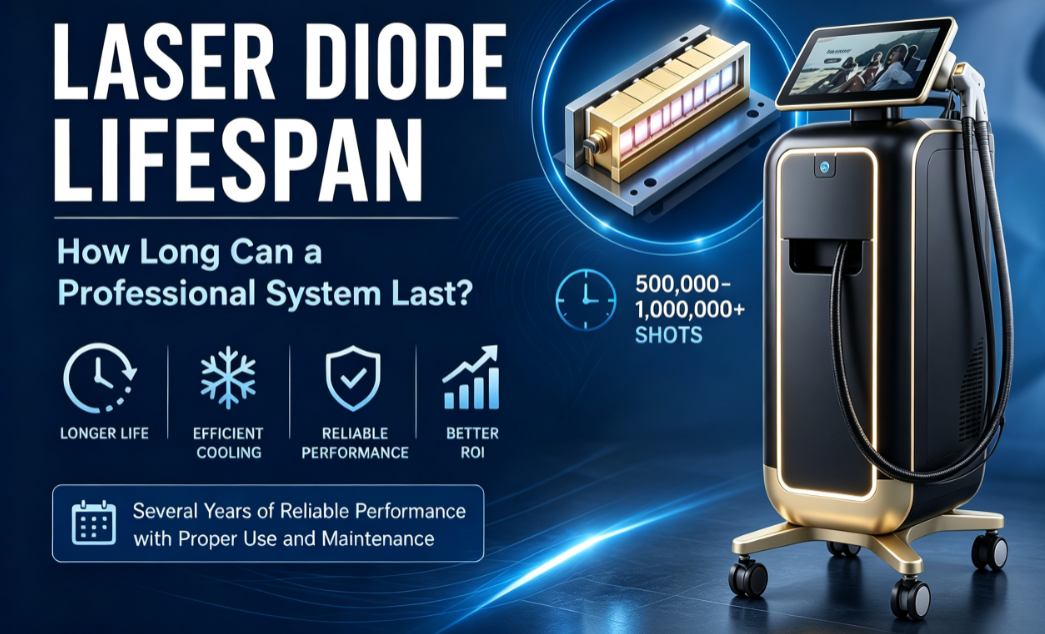
Laser Diode Lifespan: How Long Can a Professional System Last?
Quick Answer
When evaluating laser diode lifespan, clinic owners and distributors want to know how long a professional diode laser system can deliver stable clinical performance. For buyers of diode laser hair removal equipment, the answer is not a single number because the diode modules, cooling system, electronics, and handpiece all have different service lives.
In professional clinical environments, a well-designed diode laser system can provide several years of reliable operation when it is properly maintained and operated within its intended specifications. However, advertised shot counts should not be treated as the only measure of equipment lifespan.
The practical lifespan of a diode laser depends on several factors, including:
-
Diode module quality
-
Operating temperature
-
Cooling system design
-
Treatment intensity and frequency
-
Power supply stability
-
Maintenance practices
-
Handpiece usage
-
Availability of replacement components and technical support
The most important point is that effective clinical lifespan is different from theoretical component lifespan. A system may continue to power on for years while its energy stability, cooling performance, or treatment consistency has already declined.
What Does “Lifespan” Mean in a Diode Laser System?
A diode laser does not have one universal lifespan.
A professional system contains multiple components, and each component can have a different service life. The laser diode module is obviously important, but it is only one part of the complete system.
A typical professional diode laser system includes:
-
Laser diode modules
-
Handpiece
-
Cooling system
-
Power supply
-
Control electronics
-
Mainboard and internal components
-
Display and user interface
-
Water circulation or refrigeration components
-
Optical components
-
Software and control systems
This means that asking "How long does a diode laser last?" is similar to asking how long a vehicle lasts. The answer depends not only on the main engine but also on cooling, electronics, maintenance, operating conditions, and replacement parts.
For clinics, the more useful question is:
How long can the system maintain stable energy output and reliable treatment performance?
That is the definition of lifespan that matters most for a commercial treatment environment.
Laser Diode Lifespan: Shots vs. Years
One of the most confusing aspects of diode laser equipment is the difference between shot count and service life.
Manufacturers may advertise very large theoretical shot counts for their diode modules. These specifications are useful for comparing equipment, but they are normally measured under controlled conditions.
Real-world operation is different.
A diode laser used in a busy clinic may operate for several hours per day, with repeated high-energy treatments and continuous thermal load. The actual degradation rate therefore depends on how the system is operated.
Important variables include:
-
Fluence
-
Pulse duration
-
Repetition frequency
-
Treatment duration
-
Daily treatment volume
-
Ambient temperature
-
Cooling performance
-
Maintenance frequency
-
Electrical stability
A machine that produces a large number of pulses under laboratory conditions does not automatically have a longer clinical lifespan than a machine with a lower advertised shot count.
Why Shot Count Alone Is Not Enough
Suppose two machines have similar advertised shot counts.
One has:
-
Strong thermal management
-
Stable power delivery
-
High-quality diode modules
-
Regular maintenance
-
Replaceable components
The other has:
-
Limited cooling capacity
-
Less stable electronics
-
Poor internal heat management
-
Difficult-to-replace components
The first system may provide more consistent clinical performance over its working life even if the headline shot count is similar.
This is why professional buyers should evaluate system architecture, not just the number printed in the product specification.
How Long Can a Professional Diode Laser System Last?
For a professional system, lifespan is better evaluated in terms of years of reliable clinical operation rather than a single pulse number.
A properly designed and maintained system can commonly be expected to provide several years of service, while individual components may require replacement earlier.
A useful way to think about lifespan is:
| Component | Typical Lifespan Consideration |
|---|---|
| Diode module | Depends heavily on operating conditions and thermal management |
| Handpiece | Wear component; lifespan depends on treatment volume |
| Cooling system | Designed for long-term operation but requires regular maintenance |
| Power supply | Can last for years when operated within specification |
| Electronics | Influenced by heat, electrical stability, and component quality |
| Main console | Often remains in service for many years with proper maintenance |
The key distinction is between component survival and clinical performance.
A diode module does not necessarily need to completely fail before it becomes a concern. Gradual changes in output stability, thermal performance, or treatment consistency can affect the practical value of the system.
Handpiece Lifespan and Shot Count
The handpiece is one of the components that clinics should evaluate separately from the main console.
Depending on the system design, the handpiece may contain the diode modules, optical components, cooling channels, or other treatment-critical parts.
Its useful life depends heavily on:
-
Number of treatments
-
Shots delivered per treatment
-
Energy level
-
Treatment frequency
-
Cooling performance
-
Maintenance
-
Handling and storage
For example, a clinic performing a small number of treatments each week may experience significantly slower handpiece wear than a high-volume clinic using the system continuously throughout the day.
High-Volume vs. Low-Volume Use
| Clinic Usage | Expected Effect |
|---|---|
| Low-volume clinic | Lower daily shot count and thermal load |
| Medium-volume clinic | Moderate component wear |
| High-volume clinic | Greater thermal load and faster handpiece usage |
| Continuous daily operation | Cooling and maintenance become especially important |
This is why buyers should ask manufacturers not only:
"How many shots can the handpiece deliver?"
but also:
"What is the expected service life under typical clinical operating conditions?"
That second question provides more useful information for long-term purchasing decisions.
How to Estimate Diode Laser Lifespan Based on Clinic Usage
One practical way to evaluate equipment lifespan is to estimate the number of shots your clinic will generate over time.
A simple calculation is:
Daily shots × treatment days per year × years of operation = approximate cumulative shot volume
For example, imagine a clinic performs:
-
8 treatments per day
-
300 treatment days per year
-
1,500 shots per treatment
The estimated annual shot volume would be:
8 × 300 × 1,500 = 3.6 million shots per year
This does not mean the machine will automatically fail after reaching a specific number. Instead, it gives the buyer a framework for understanding how heavily the equipment will be used.
A high-volume clinic should therefore place greater emphasis on:
-
Cooling capacity
-
Diode module quality
-
Handpiece serviceability
-
Replacement availability
-
Preventive maintenance
-
Manufacturer support
A lower-volume salon may place relatively more emphasis on overall reliability, ease of maintenance, and long-term component availability.
Why Cooling System Design Affects Laser Diode Lifespan
Cooling is one of the most important factors affecting long-term diode performance.
Laser diodes generate heat during operation. As treatment energy and operating frequency increase, the thermal load also increases.
If this heat is not removed effectively, several problems can occur:
-
Increased thermal stress
-
Reduced output stability
-
Faster component degradation
-
Reduced treatment consistency
-
Increased risk of system downtime
This is particularly important for clinics performing multiple treatments consecutively.
Common Cooling Technologies
Professional diode laser systems may incorporate several cooling approaches, including:
-
Water circulation
-
Compressor refrigeration
-
Thermoelectric cooling
-
TEC-based cooling
-
Sapphire contact cooling
-
Heat exchangers and heat sinks
-
Multiple-stage thermal management
These technologies may perform different functions.
For example, internal cooling can help control the temperature of the laser components, while sapphire contact cooling is primarily associated with cooling the treatment area and improving patient comfort.
A strong system design considers both component thermal management and patient-contact cooling.
Thermal Management During Long Treatment Sessions
A system that works well for a short treatment session may not perform identically during continuous operation.
As the treatment workload increases, the cooling system has to remove heat continuously.
This is why clinics with high treatment volume should ask:
-
Can the system operate continuously for extended periods?
-
How quickly does the cooling system recover between treatments?
-
What coolant or water maintenance is required?
-
Is there a temperature monitoring system?
-
Does the machine provide overheating protection?
-
Can cooling components be serviced or replaced?
For a busy clinic, thermal management is not simply a comfort feature.
It is part of the equipment's long-term reliability.
Power Supply and Electronics Also Affect Lifespan
Diode degradation is not the only potential source of equipment failure.
The power supply and internal electronics are equally important.
A diode laser requires stable electrical power to deliver consistent energy. Poor-quality or unstable power components can contribute to:
-
Output fluctuations
-
Electrical stress
-
Overheating
-
Control-system errors
-
Premature component failure
-
Unexpected downtime
This is one reason a professional system should be evaluated as a complete engineering platform rather than simply as a laser diode.
When comparing suppliers, buyers should ask about:
-
Power supply manufacturer
-
Electrical protection
-
Cooling architecture
-
Mainboard quality
-
Internal component accessibility
-
Replacement parts
-
Technical support
A high-quality diode module cannot compensate for an unreliable power system.
Maintenance Practices That Can Extend System Lifespan
Even a well-designed machine requires proper maintenance.
Maintenance requirements vary between manufacturers, but clinics should generally follow the service schedule provided with the equipment.
Important maintenance areas include:
Cooling Circuit
If the system uses water circulation, the coolant or water should be maintained according to the manufacturer's specifications.
The clinic should monitor:
-
Water quality
-
Water level
-
Filters
-
Flow rate
-
Cooling temperature
-
Signs of contamination
-
Leaks
Poor cooling maintenance can gradually reduce thermal performance.
Airflow and Ventilation
Air-cooled components and refrigeration systems require adequate ventilation.
Dust accumulation around air inlets, filters, fans, and heat exchangers can reduce airflow and increase thermal load.
Handpiece Inspection
The handpiece should be checked regularly for:
-
Cooling performance
-
Physical damage
-
Optical surface condition
-
Cable condition
-
Abnormal temperature
-
Shot count
Preventive Maintenance
Waiting for a machine to fail is usually more expensive than identifying a problem early.
Clinics should maintain records of:
-
Treatment volume
-
Shot count
-
Service dates
-
Cooling maintenance
-
Error codes
-
Component replacement
-
Performance issues
This creates a useful maintenance history for the equipment.
What Causes Diode Laser Degradation?
Several factors can accelerate diode degradation.
1. Excessive Thermal Stress
High operating temperatures can accelerate semiconductor degradation.
This makes cooling one of the most important considerations when evaluating long-term system reliability.
2. High Treatment Volume
High-volume clinics place greater cumulative stress on the system.
A machine operating for several hours every day experiences a very different workload from one used only a few times per week.
3. High Energy Operation
Operating at higher energy levels increases the thermal and electrical demands placed on the system.
The equipment should always be operated within the manufacturer's specified parameters.
4. Poor Maintenance
Blocked filters, inadequate coolant maintenance, poor airflow, and neglected service can reduce cooling efficiency.
5. Electrical Instability
Poor-quality power components or unstable electrical conditions can affect system reliability.
6. Dust and Environmental Conditions
Dust can accumulate around cooling components and reduce airflow or heat dissipation.
Clinics should therefore consider the operating environment as part of equipment maintenance.
Professional vs. Entry-Level Diode Laser Systems
Not all diode laser systems are designed for the same workload.
An entry-level system may be suitable for lower treatment volumes, while a professional system designed for busy clinics may place greater emphasis on:
-
Thermal management
-
Stable energy delivery
-
Component quality
-
Cooling performance
-
Serviceability
-
Replaceable handpieces
-
Continuous operation
-
Technical support
This does not mean that the most expensive machine automatically has the longest lifespan.
Instead, buyers should evaluate whether the system's engineering matches the expected workload.
For a high-volume clinic, reliability under continuous use can be more important than a high theoretical shot count.
What Should Buyers Ask Before Purchasing?
If you are comparing professional diode laser system options, ask the supplier specific questions rather than relying only on marketing specifications.
1. What Is the Diode Module Rating?
Ask:
-
Which diode module is used?
-
What is its rated operating range?
-
Is the rating based on laboratory or clinical conditions?
-
Can the diode module be replaced?
2. How Is the Laser Cooled?
Ask:
-
Does the system use water, air, TEC, compressor refrigeration, or multiple cooling methods?
-
How is the diode module cooled?
-
How is the patient's skin cooled?
-
What happens during extended treatment sessions?
3. What Is the Handpiece Service Life?
Ask:
-
What is the expected shot count?
-
Is there an internal shot counter?
-
Can the handpiece be refurbished?
-
Can individual components be replaced?
4. What Maintenance Is Required?
Ask:
-
How often should the cooling circuit be serviced?
-
How often should filters be checked?
-
What coolant should be used?
-
Does the manufacturer provide a maintenance schedule?
5. What Happens After the Warranty Ends?
This question is often overlooked.
Ask:
-
Are replacement handpieces available?
-
Are diode modules available?
-
Are cooling components available?
-
Can the manufacturer provide technical support several years after purchase?
-
How long are spare parts expected to remain available?
Long-term parts availability can have a major impact on the practical lifespan of professional equipment.
Expected Lifespan: What Should Clinics Really Compare?
Instead of comparing machines only by advertised shot count, buyers should evaluate several dimensions simultaneously.
| Factor | Why It Matters |
|---|---|
| Diode module quality | Influences output stability and degradation |
| Cooling system | Controls thermal stress |
| Power supply | Supports consistent energy delivery |
| Handpiece design | Determines serviceability and replacement cost |
| Treatment volume | Determines cumulative workload |
| Maintenance | Helps preserve cooling and system performance |
| Parts availability | Determines how long the system can remain serviceable |
| Technical support | Reduces long-term downtime |
A machine with a slightly lower advertised shot count may ultimately be a better investment if it has stronger cooling, better component quality, easier maintenance, and reliable technical support.
How to Evaluate Lifespan When Comparing Manufacturers
Manufacturers do not always present lifespan specifications in the same format.
One supplier may advertise:
"100 million shots."
Another may provide:
"Several years of clinical operation."
Neither number should automatically be considered superior.
Instead, request supporting information.
Compare:
Diode specification
What diode modules are used and under what operating conditions?
Cooling specification
How is the laser cooled during long treatment sessions?
Clinical workload
What operating conditions were used to determine the stated lifespan?
Serviceability
Can the handpiece, diode module, cooling system, and power supply be replaced?
Support
Are spare parts and technical assistance available after the warranty period?
This approach provides a more realistic picture of equipment longevity.
Frequently Asked Questions
What is the typical laser diode lifespan?
There is no universal lifespan because diode performance depends on operating conditions, thermal management, energy settings, treatment volume, and maintenance. Professional systems can provide several years of clinical service when properly designed and maintained.
Does a higher shot count mean a longer lifespan?
Not necessarily.
A higher advertised shot count can be useful, but it does not tell the whole story. Cooling, operating temperature, diode quality, power stability, and maintenance can have a major impact on effective service life.
How does cooling affect laser diode lifespan?
Effective cooling helps control the temperature of the laser components during operation. Poor thermal management can increase stress on the diode modules and contribute to faster degradation.
Does a busy clinic reduce diode laser lifespan?
High treatment volume increases cumulative workload and thermal stress. However, a professional system designed for high-volume operation can be engineered to handle extended treatment schedules more effectively.
Is the handpiece lifespan the same as the console lifespan?
No.
The handpiece is generally a more frequently replaced component because it experiences direct treatment use. The main console and internal electronics may remain in service much longer.
How often should the cooling system be maintained?
Maintenance intervals depend on the system design and manufacturer instructions. Clinics should follow the specified schedule for coolant, water, filters, airflow, and other cooling components.
What is more important: shot count or cooling?
Both matter, but shot count should not be considered independently.
For high-volume professional use, cooling architecture, thermal stability, diode quality, and maintenance can be just as important as the advertised shot count.
Can a diode laser last 10 years?
A well-designed professional system may remain in service for many years, but individual components may require replacement during that period.
The more useful question is whether the manufacturer can provide replacement parts, handpieces, technical support, and maintenance throughout the expected service life.
Conclusion
Laser diode lifespan is not determined by one number.
A professional diode laser system is made up of multiple components, each with different degradation characteristics. Diode modules, handpieces, cooling systems, power supplies, and electronics all contribute to the overall service life of the equipment.
For clinics purchasing diode laser hair removal equipment, the most important factors to evaluate are not simply the advertised shot count. Cooling architecture, thermal management, diode quality, power stability, maintenance requirements, serviceability, and long-term parts support all influence how long the system can continue delivering reliable clinical performance.
When comparing a professional diode laser system, look beyond the headline specifications. Ask how the diode rating was determined, how the cooling system performs during extended treatments, what components can be replaced, and what technical support is available after the initial warranty period.
Ultimately, the best measure of lifespan is not how long a machine can remain powered on. It is how long it can maintain stable energy delivery, effective cooling, reliable operation, and consistent clinical performance under real-world treatment conditions.