

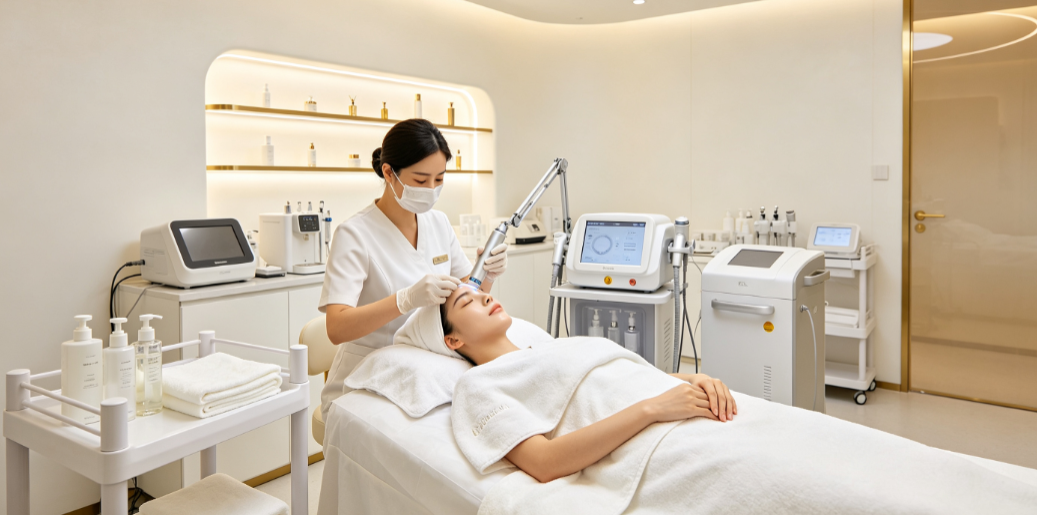
New Salon One-Stop List: Laser, Body & Skin Aesthetic Gear
Why New Salons Need a Strategic Equipment Plan
Opening a beauty salon or medspa is not just about renting a space and buying machines. Your equipment selection directly determines three things:
-
What services you can offer — and therefore what clients you can attract
-
How much revenue you can generate per treatment room — your ceiling
-
How quickly you can break even and start profiting — your timeline
Many new salon owners make the same mistake: they buy a random collection of machines based on supplier recommendations, without understanding market demand or calculating ROI. The result? A $30,000+ investment that takes 18 months to pay back, while competitors with smarter setups recover their capital in 4 months.
This guide provides a complete one-stop buying framework for new salons. Instead of just listing machines, we will cover:
-
The three core services that generate 80% of new salon revenue
-
How to choose the right equipment tier for your market positioning
-
A real-world ROI calculation for each machine category
-
Common pitfalls that waste startup budget
-
A phased purchase plan to reduce financial pressure
The Three Pillars of a Profitable Salon Service Menu
Industry data consistently shows that new salons generate the majority of their revenue from three service categories:
| Service Category | Typical Revenue Share | Client Return Rate |
|---|---|---|
| Laser Hair Removal | 35–45% | High (6–8 sessions per client) |
| Body Contouring | 25–35% | Medium (3–6 sessions per client) |
| Skin Rejuvenation | 20–30% | Very High (monthly recurring) |
These three pillars are not just revenue sources—they are client acquisition and retention engines. Laser hair removal brings clients in consistently; body contouring raises average ticket value; and skin rejuvenation turns one-time visitors into long-term members.
Skipping any one pillar means leaving money on the table and handing clients to competitors who offer complete solutions.
A high-quality laser waxing machine is the cornerstone of this strategy, as hair removal treatments bring steady repeat bookings all year round. When selecting your core equipment, prioritize systems that can deliver consistent results across diverse client needs.
Core Machine 1: Laser Hair Removal — Your Steady Client Acquisition Channel
Why This Is the Foundation
A commercial-grade laser hair removal system is the most predictable revenue generator for new salons. Unlike body contouring or skin treatments, which often require consultation and trust-building, hair removal has near-universal demand across genders, ages, and skin types.
For most clients, it is a 6-session commitment over 4–6 months, creating recurring revenue and multiple touchpoints to cross-sell other services. A client who comes in for six hair removal sessions is far more likely to try body contouring or facial treatments than a one-time visitor.
How to Choose the Right Equipment
| Factor | What to Look For | Why It Matters |
|---|---|---|
| Wavelength | Four-wavelength (755nm + 808nm + 940nm + 1064nm) | Covers all skin types (Fitzpatrick I-VI). Single or dual-wavelength systems limit your client base |
| Cooling System | Sapphire contact cooling or TEC | Reduces pain; improves client retention |
| Shot Lifespan | 60+ million shots | Dramatically lowers long-term cost per treatment; means the handpiece never needs replacement |
| Certification | FDA 510(k), CE, ISO 13485 | Legal requirement; protects against liability |
| Portability | Portable vs. vertical cabinet | Portable saves space for small salons; vertical offers higher power for volume |
Why Four-Wavelength Is the "Complete Package"
Most entry-level systems offer only single-wavelength (808nm) or dual-wavelength (808+755nm), which means you cannot safely treat darker skin types (Fitzpatrick V-VI). A 755nm + 808nm + 940nm + 1064nm four-wavelength combination ensures you can safely treat any client who walks through your door — regardless of skin tone.
This is the single most important differentiator between a "professional-grade" and an "entry-level" device. When evaluating your equipment options, this should be your first filter.
ROI Calculation Example
| Input | Conservative Estimate | Notes |
|---|---|---|
| Equipment cost | $1,500 – $2,500 | Factory-direct four-wavelength professional device, far below traditional brand pricing |
| Average package price | $1,200 (6 sessions) | $200 per session, 6-session package |
| Cost per session (consumables + electricity) | $5 | Almost zero consumable cost |
| Profit per package | $1,170 | |
| Break-even packages | ~2 packages | $2,500 ÷ $1,170 ≈ 2.1 packages |
| Break-even sessions | ~13 sessions | 2.1 packages × 6 sessions = ~13 sessions |
Interpretation: At a 6-session package priced at $200/session, a **$2,500 four-wavelength system** requires only about 2–3 packages (or 13–18 individual sessions) to recover the full cost. If your salon books 10–15 sessions per week, break-even occurs within 1–2 weeks.
This means even a newly opened small salon can recover the cost of its core equipment within the first month — every session after that is nearly pure profit.
Equipment Tier Recommendation
| Market Position | Recommended Configuration | Estimated Cost (Factory Direct) |
|---|---|---|
| Entry-level / Small salon | Four-wavelength portable system (755+808+940+1064nm) | $1,500 – $2,500 |
| Mid-range / Growing salon | Four-wavelength portable + enhanced cooling | $2,500 – $4,000 |
| Premium / High-volume | Four-wavelength vertical cabinet + 60M shot lifespan | $4,000 – $8,000+ |
Key Insight: Traditional brands sell four-wavelength devices through distributors at $15,000–$40,000+. Factory-direct equipment offers the same core technology for under $2,500 — which is exactly why new salons can achieve such rapid payback.
Common Mistake to Avoid
Buying a single or dual-wavelength system to save money.
A 808nm-only or 808+755nm dual-wavelength device may seem cheaper, but it limits you to a narrower client base (Fitzpatrick I-IV). In diverse markets (US, Europe, Middle East), this means turning away up to 30–40% of potential clients with darker skin tones. The few hundred dollars saved upfront quickly vanish when clients choose competitors with four-wavelength systems. Four-wavelength is not an "option" — it determines how large a market you can serve.
Core Machine 2: Body Contouring — Your High-Ticket Revenue Booster
Why This Is the Second Purchase
Once your laser hair removal system builds a steady client base, body contouring becomes your highest-margin service. Typical single-session prices range from $200 to $500, and complete treatment courses (6–10 sessions) can generate $1,500 to $5,000 per client.
Unlike hair removal, where clients expect multiple sessions, body contouring is often a discretionary purchase. This means higher perceived value and less price sensitivity.
Technology Comparison: Which One to Choose?
| Technology | Primary Effect | Best For | Typical Course Price |
|---|---|---|---|
| HIFEM (Magnetic Slimming) | Muscle building + moderate fat reduction | Clients wanting toned, lifted appearance | $2,000 – $6,000 |
| RF Cavitation | Fat reduction + skin tightening | Clients with localized fat deposits | $1,500 – $4,000 |
| Cryolipolysis | Targeted fat freezing | Stubborn, pinchable fat areas | $2,500 – $5,000 |
| EMS | Surface muscle toning | Mild muscle activation | $800 – $2,500 |
How to Match Technology to Your Client Base
-
If your market is fitness-conscious (ages 25–45): Prioritize HIFEM for muscle definition.
-
If your market is post-weight-loss or older (ages 40–60): Prioritize RF cavitation or cryolipolysis for fat reduction.
-
If you serve a broad demographic: Consider a platform that combines multiple technologies.
ROI Calculation Example
| Input | Value |
|---|---|
| Equipment cost | $12,000 |
| Average package price | $2,400 (8 sessions) |
| Cost per session | $3 – $5 (minimal consumables) |
| Profit per package | $2,360 |
| Break-even packages | 5–6 packages |
| Break-even sessions | 40–48 sessions |
Interpretation: If your salon sells one body contouring package per week, break-even occurs within 5–6 months. With consistent marketing, many salons achieve this in 2–3 months.
Common Mistake to Avoid
Buying a cheap, uncertified device to save money.
Counterfeit or uncertified body contouring machines are widespread. They often lack stable energy output, leading to inconsistent results, client complaints, and even safety risks. Always verify FDA and CE certifications for the exact model you are purchasing.
Equipment Tier Recommendation
| Market Position | Recommended Technology | Estimated Cost |
|---|---|---|
| Entry-level | EMS or basic RF cavitation | $2,000 – $5,000 |
| Mid-range | Dedicated HIFEM or RF device | $6,000 – $15,000 |
| Premium | Multi-technology platform (HIFEM + RF) | $15,000 – $35,000+ |
Core Machine 3: Skin Rejuvenation — Your Client Retention Engine
Why This Completes the Package
Skin rejuvenation is the highest-retention service in aesthetic clinics. Unlike hair removal (which eventually ends) or body contouring (which is course-based), facial treatments generate monthly recurring revenue from clients who return for maintenance.
A client who visits monthly for skin rejuvenation is worth $3,000–$6,000 per year in recurring revenue, far exceeding the lifetime value of a one-time client.
Technology Options and Their Roles
| Technology | Primary Effect | Ideal Use Case |
|---|---|---|
| Hydra Dermabrasion | Cleansing, exfoliation, hydration | All skin types, weekly/monthly maintenance |
| RF Lifting | Skin tightening, collagen stimulation | 30–60 age group, sagging skin |
| Picosecond Laser | Pigment removal, scar reduction | Hyperpigmentation, acne scars |
| Multi-function Facial Devices | Combination of above | Small salons with limited treatment rooms |
How to Choose for a New Salon
For a startup with limited space and budget, a multi-function facial device is often the most practical choice. It combines 4–5 core technologies in one unit, allowing you to offer a full facial menu without buying separate machines.
Once you build a steady facial client base, consider adding a dedicated picosecond or RF device to upgrade treatment depth and justify premium pricing.
ROI Calculation Example
| Input | Value |
|---|---|
| Equipment cost | $6,000 |
| Average session price | $150 |
| Monthly clients (per machine) | 20 clients |
| Monthly revenue | $3,000 |
| Monthly operating cost | $200 |
| Payback period | 2 months |
Interpretation: Even at a moderate capacity of 20 sessions per month, a $6,000 facial device pays for itself within 2 months. After that, it generates consistent monthly profit with very low operating costs.
One-Stop Purchase Advantages — And When They Make Sense
Buying all three core machines as a bundle offers clear advantages for new salons:
| Advantage | Impact |
|---|---|
| Wholesale discount | Save 20–40% compared to separate purchases |
| Unified training | Learn one operating system across all equipment |
| Simplified after-sales | One supplier for warranty and support |
| Integrated service packages | Create bundled promotions (e.g., Laser + Body + Face package) |
When selecting your Professional Aesthetic Devices as part of a bundle, ensure that each system meets the certification and performance standards outlined in this guide.
However, bundling is not always the right choice. If your market research shows that one service category dominates demand, start with that machine and add others later. There is no benefit to buying equipment that sits idle for the first 6 months.
Equipment Buying Checklist for New Salons
Before placing an order, verify every machine against these criteria:
| Criteria | Why It Matters |
|---|---|
| FDA 510(k) or CE certification | Legal compliance; safety; insurability |
| ISO 13485 manufacturing standard | Quality management system for medical devices |
| Published shot lifespan (for laser systems) | Reveals long-term replacement costs |
| Replacement part availability | Prevents costly downtime when parts fail |
| Free training | Reduces mistakes and speeds up service launch |
| Warranty terms | 2-year minimum; check what is covered |
| Supplier references | Ask for existing client contacts in your market |
| Sample unit test | If possible, test the device before bulk order |
Phased Purchase Plan: Reducing Startup Financial Pressure
For most new salons, the smartest approach is not buying all machines at once, but following a phased plan:
| Phase | Timeframe | Purchase | Goal |
|---|---|---|---|
| Phase 1 | Month 1–3 | Laser hair removal system | Build steady client base and monthly cash flow |
| Phase 2 | Month 4–6 | Skin rejuvenation device | Increase client retention and recurring revenue |
| Phase 3 | Month 7–12 | Body contouring device | Capture high-ticket revenue from loyal clients |
This phased approach reduces initial capital requirement, allows you to test market demand, and generates revenue to fund subsequent purchases. It also gives you time to build a skilled team before expanding into more complex services.
Final Recommendation
A well-planned equipment purchase is the foundation of a profitable salon. It does not mean buying the most expensive equipment; it means buying the right machines for your market, your budget, and your growth plan.
For most new salons, the recommended order is:
-
Laser hair removal system — steady client acquisition (cost $1,500–$2,500, four-wavelength configuration)
-
Skin rejuvenation device — monthly recurring revenue (cost $4,000–$8,000)
-
Body contouring device — high-margin, high-ticket services (cost $6,000–$12,000)
This order balances risk, cash flow, and long-term profitability — giving you the best chance to survive the first 12 months and thrive beyond. When selecting your Professional Aesthetic Devices, prioritize certification, wavelength coverage, and supplier support over upfront price — the long-term value will always justify the investment. And remember, a reliable laser waxing machine as your first purchase creates the steady client flow needed to fund everything else.