

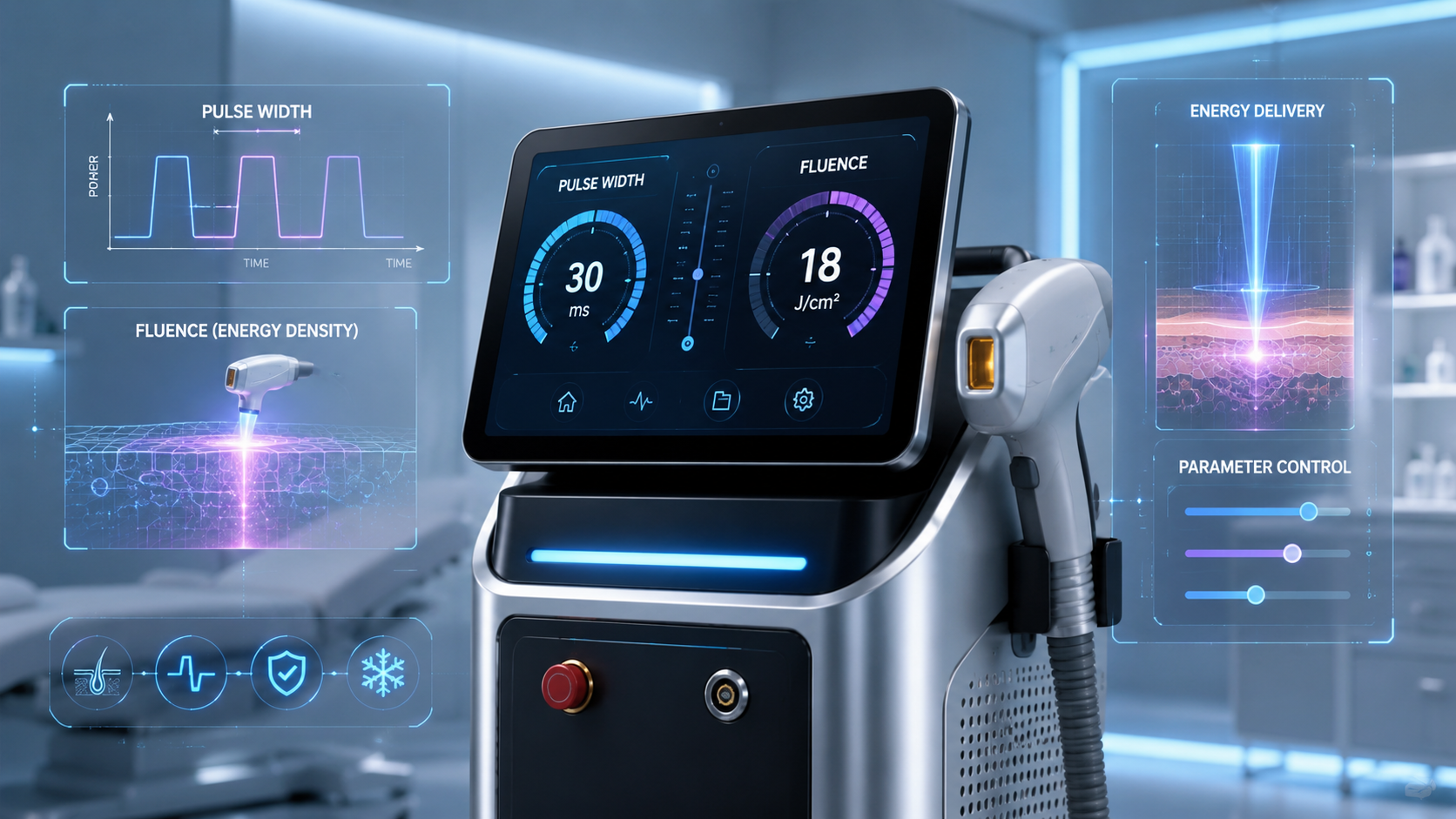
Pulse Width and Fluence: What Buyers Need to Know When Choosing a Diode Laser Machine
Quick Answer
When evaluating a diode laser hair removal machine, two technical specifications buyers should understand are pulse width and fluence. Pulse width determines how long each laser pulse is delivered, while fluence describes the laser energy delivered per unit area. Together, these parameters influence how energy is delivered to the hair follicle and surrounding skin, making them important considerations for treatment safety, consistency, and performance.
For buyers comparing different laser systems, understanding pulse width and fluence is essential because these settings affect how a machine can be configured for different hair characteristics, skin types, and treatment requirements.
This guide explains what pulse width and fluence mean, how they work together, what buyers should evaluate, and which questions to ask suppliers before purchasing a professional diode laser system.
Introduction
When investing in a diode laser hair removal machine, buyers often focus on the specifications that are easiest to compare, including wavelength, power output, cooling technology, spot size, and price.
However, pulse width and fluence are equally important technical parameters.
Pulse width determines the duration of each laser pulse, while fluence determines how much energy is delivered over a specific treatment area. The relationship between these settings affects energy delivery, treatment customization, patient comfort, and the ability to adapt treatments to different hair and skin characteristics.
For clinic owners and distributors, understanding these parameters can make it easier to distinguish between machines based only on marketing specifications and systems that provide meaningful control over treatment settings.
This guide covers:
- What pulse width means
- What fluence means
- How the two parameters work together
- Why they matter for treatment safety
- How settings can vary by skin and hair characteristics
- What buyers should check during a machine demonstration
- Questions to ask diode laser suppliers
What Are Pulse Width and Fluence?
Pulse Width: Pulse Duration
Pulse width, also called pulse duration, refers to how long a laser pulse is emitted.
It is normally measured in milliseconds (ms).
A shorter pulse delivers the available energy over a shorter period, while a longer pulse distributes the energy over a longer period.
Why Pulse Width Matters
Pulse duration influences how heat is delivered to the target area.
In general:
- Shorter pulse widths can be useful for certain finer hair characteristics but require careful parameter selection.
- Longer pulse widths can provide more controlled heat delivery for certain treatment conditions.
- Wider pulse-width adjustment gives practitioners greater flexibility when treating different clients.
Rather than assuming that a shorter or longer pulse is always better, buyers should look for equipment that provides an appropriate adjustable range.
Fluence: Laser Energy Density
Fluence describes the amount of laser energy delivered per unit area.
It is measured in:
J/cm² — joules per square centimeter.
Fluence is one of the main parameters determining the amount of energy reaching the treatment area.
Why Fluence Matters
If fluence is too low for the treatment objective, the delivered energy may not produce the intended effect.
If fluence is too high for the patient's skin type, hair characteristics, cooling capacity, and treatment parameters, the risk of unwanted thermal effects can increase.
Therefore, the appropriate fluence should not be considered as one universal number.
It depends on factors including:
- Wavelength
- Skin type
- Hair thickness
- Hair density
- Treatment area
- Pulse width
- Spot size
- Cooling performance
- The specific laser system
How Pulse Width and Fluence Work Together
Pulse width and fluence should be evaluated together rather than independently.
For example, changing pulse duration changes how quickly the energy is delivered, while changing fluence changes the amount of energy delivered over the treatment area.
This relationship is important when configuring a professional laser system.
General Considerations
Different treatment situations may require different combinations of:
- Pulse width
- Fluence
- Repetition rate
- Spot size
- Cooling level
For example, practitioners may adjust parameters based on whether the client has:
- Fine or coarse hair
- Light or dark skin
- Different treatment areas
- Different levels of treatment sensitivity
The goal is not simply to use the highest available fluence or the shortest possible pulse. The goal is to select an appropriate combination of parameters for the treatment.
Why Pulse Width and Fluence Matter for Safety
Laser hair removal is based on the principle of selective photothermolysis, in which laser energy is selectively absorbed by the target chromophore while minimizing unwanted effects on surrounding tissue.
Pulse duration is important because tissue responds to heat over time.
The concept of Thermal Relaxation Time (TRT) helps explain why pulse duration matters. Different structures in the skin and hair follicle dissipate heat at different rates.
For this reason, laser parameters should be selected according to the characteristics of the target and surrounding tissue rather than using one fixed setting for every client.
Fluence and Treatment Safety
Fluence also needs to be considered together with pulse width and cooling.
An excessively high energy density may increase thermal exposure, particularly when other treatment parameters are not appropriately adjusted.
Conversely, insufficient energy may produce limited treatment effects.
Therefore, professional operators should evaluate:
- Fluence
- Pulse width
- Wavelength
- Cooling
- Skin type
- Hair characteristics
as a complete parameter set.
Understanding Parameter Ranges
Different professional laser systems can have significantly different parameter ranges.
For example, FDA-cleared devices may have specifications covering relatively broad ranges for fluence, pulse width, and repetition rate.
This means buyers should not judge a machine simply by asking:
“What is the maximum fluence?”
Instead, ask:
“What is the adjustable range, how accurately can it be controlled, and how consistently does the machine deliver the selected setting?”
This distinction is important because maximum specifications do not necessarily represent the settings used during normal clinical operation.
How Wavelength Influences Parameter Selection
Pulse width and fluence should also be considered together with wavelength.
Different wavelengths interact with tissue differently because of their absorption and penetration characteristics.
For example, an 808 diode laser is widely used in professional hair removal because it provides a balance between penetration depth and melanin absorption.
When evaluating an 808 diode laser system, buyers should therefore look beyond the wavelength itself and check:
- Pulse-width range
- Fluence range
- Energy stability
- Spot size
- Cooling performance
- Repetition rate
- Handpiece design
A machine with a familiar wavelength but limited parameter control may provide less treatment flexibility than a system with a well-designed adjustable parameter range.
Recommended Parameters by Skin and Hair Characteristics
There is no single pulse-width and fluence combination that is appropriate for every patient.
Clinical parameters may vary according to:
| Factor | Why It Matters |
|---|---|
| Skin type | Determines epidermal melanin absorption and safety considerations |
| Hair thickness | Coarse hair may require different energy delivery than fine hair |
| Hair density | Influences treatment strategy and energy distribution |
| Treatment area | Different areas can have different sensitivity and hair characteristics |
| Wavelength | Changes penetration and absorption characteristics |
| Cooling | Helps manage epidermal heat during treatment |
For darker skin types, practitioners generally need to pay particular attention to epidermal protection and parameter selection.
The appropriate settings should always follow the equipment manufacturer's instructions and professionally established treatment protocols.
What This Means for Buyers
When comparing a professional laser diode hair removal machine, don't evaluate only:
- Maximum wattage
- Maximum fluence
- Number of wavelengths
- Marketing claims
Instead, ask whether the system provides practical control over the parameters that operators actually use.
Important specifications include:
Adjustable Pulse Width
Look for a system that allows operators to adjust pulse duration rather than locking treatment to a single fixed setting.
Adjustable Fluence
Check whether fluence can be adjusted precisely enough for different treatment requirements.
Independent Parameter Control
Determine whether pulse width and fluence can be adjusted independently or whether changing one automatically restricts the other.
Stable Energy Delivery
The displayed setting should correspond to consistent energy delivery during treatment.
Integrated Cooling
Cooling performance should be evaluated together with the available fluence and pulse-width settings.
What to Look for When Buying a Diode Laser
1. Adjustable Pulse Width Range
Ask suppliers:
“What is the pulse width range of your diode laser system, and can the operator adjust it independently?”
Check:
- Minimum pulse width
- Maximum pulse width
- Adjustment increments
- Independent control
- Available treatment modes
A broader adjustable range can provide greater flexibility, but the useful range depends on the actual treatment applications supported by the machine.
2. Fluence Control Accuracy
Ask:
“What is the fluence range and adjustment increment of your system?”
Important questions include:
- Can fluence be adjusted in small increments?
- Does the machine maintain consistent output?
- Is the displayed fluence verified during quality control?
- Can the supplier provide output-testing documentation?
For professional clinics, consistency is often more valuable than simply having an extremely high maximum setting.
3. Built-In Safety Features
When comparing equipment, check whether the system includes:
- Skin contact sensors
- Skin-type detection
- Cooling integration
- Treatment parameter controls
- Emergency stop functions
- Temperature monitoring
These features can help reduce operator error and improve treatment control.
However, automated features should complement, rather than replace, professional training and appropriate treatment protocols.
4. Clinical and Regulatory Documentation
Before purchasing, ask suppliers for:
- Applicable regulatory documentation
- Clinical data where available
- Device specifications
- Testing documentation
- User manuals
- Treatment protocols
For products marketed in the United States, buyers should verify the applicable FDA status and documentation rather than relying on general claims such as “FDA approved.”
A supplier should be able to provide the relevant documentation for the specific device being purchased.
How to Evaluate Pulse Width and Fluence During a Demo
A live demonstration is one of the best ways for a buyer to evaluate whether the machine's specifications are meaningful in practice.
Step 1: Check Pulse Width Adjustability
Ask the supplier to demonstrate:
- Minimum pulse width
- Maximum pulse width
- Adjustment increments
- Independent pulse-width control
Watch how quickly the machine responds when the operator changes the settings.
Step 2: Test Fluence Consistency
If appropriate testing equipment is available, buyers can compare displayed settings with measured output.
Check:
- Different fluence levels
- Different pulse widths
- Repeated pulses
- Output consistency
This helps determine whether the machine performs consistently across different settings.
Step 3: Assess Cooling Integration
Cooling should not be evaluated separately from laser parameters.
During a demonstration, ask:
- Does cooling remain stable during continuous operation?
- Does cooling respond appropriately to parameter changes?
- What is the cooling temperature range?
- How does the system prevent excessive skin heating?
A strong cooling system is particularly important when the machine is designed for high-volume professional use.
Step 4: Review Clinical Documentation
Ask the supplier to provide:
- Clinical study summaries
- Regulatory documentation
- Before-and-after case studies
- Device specifications
- Treatment protocols
Do not rely solely on marketing images or maximum parameter claims.
Frequently Asked Questions
What is the ideal pulse width for diode laser hair removal?
There is no single ideal pulse width for every treatment. The appropriate setting depends on factors such as skin type, hair characteristics, wavelength, treatment area, fluence, and the specific laser system.
For this reason, professional equipment should provide enough pulse-width flexibility to accommodate different treatment requirements.
What fluence is safe for dark skin?
There is no universal fluence that is safe for every darker skin type or every laser system.
For Fitzpatrick IV–VI skin types, practitioners generally need to consider epidermal melanin absorption carefully and select appropriate fluence, pulse duration, wavelength, and cooling settings.
Treatment should follow the manufacturer's instructions and appropriate professional protocols.
Can pulse width and fluence be adjusted independently?
Not on every system.
Higher-quality professional laser systems may provide independent control of these parameters, giving operators greater flexibility when configuring treatments.
Buyers should confirm this capability during a product demonstration rather than assuming it from the product specifications.
How does pulse width affect treatment speed?
Pulse width determines the duration of each individual pulse, while overall treatment speed also depends on repetition rate, spot size, treatment area, and operator technique.
Therefore, a longer pulse does not automatically mean that an entire treatment session will take longer.
Is higher fluence always better?
No.
Higher fluence does not automatically mean better treatment results.
The appropriate energy level depends on the patient's skin type, hair characteristics, wavelength, pulse duration, cooling system, and treatment protocol.
Using excessive energy without appropriate parameter control can increase the risk of unwanted thermal effects.
What happens if pulse width is too short?
An excessively short pulse can deliver energy too rapidly for the treatment conditions and may increase the risk of unwanted thermal effects.
The appropriate pulse duration depends on the target tissue, wavelength, fluence, and patient characteristics.
What happens if pulse width is too long?
An excessively long pulse may allow heat to spread beyond the intended target and can change the thermal response of the tissue.
Therefore, longer is not necessarily better. Pulse duration should be selected together with fluence and the other treatment parameters.
Should I prioritize pulse-width adjustability or fluence range?
Both should be evaluated.
A professional system should provide practical control over both pulse duration and energy density.
However, buyers should focus on usable and consistent parameter control, rather than simply choosing the machine with the largest numbers on the specification sheet.
Conclusion
Pulse width and fluence are two important parameters that buyers should understand when evaluating professional diode laser hair removal equipment.
Pulse width controls how long each laser pulse is delivered, while fluence determines the amount of energy delivered per unit area. Their relationship affects energy delivery, treatment customization, patient comfort, and safety.
When evaluating a diode laser system, buyers should look beyond maximum power and marketing claims. Check the adjustable pulse-width range, fluence control, energy stability, cooling integration, safety features, and supporting documentation.
For clinics considering an 808 diode laser, these parameters should be evaluated alongside wavelength, cooling, spot size, and repetition rate.
Ultimately, when comparing a laser diode hair removal machine, the most important question is not simply:
“How powerful is the machine?”
It is:
“How precisely and consistently can the machine control the parameters needed for safe and effective treatment?”