

Sapphire Contact Cooling in Laser Hair Removal: How It Works
A Technical Guide for Salon Owners and Clinic Buyers
If you're evaluating salon laser equipment CE certified for your clinic, you've likely encountered the term "sapphire contact cooling" in technical specifications. But what does it actually do? And why is it considered essential for professional laser hair removal?
This guide explains the science behind sapphire contact cooling, how it protects the skin during treatment, and why it's a critical feature for any painless laser hair removal device.
The Problem: Heat Damage to the Skin
Laser hair removal works by delivering light energy to target melanin in hair follicles. To effectively damage the follicle, clinicians need to use high radiant exposures—often 60 J/cm² or higher. However, melanin is also present in the epidermis (the outer layer of skin). Without adequate protection, the laser energy can cause:
-
Burns and blistering on the skin surface
-
Permanent scarring or textural changes
-
Hyperpigmentation or hypopigmentation
-
Significant treatment pain
This is why cooling is not optional for professional laser hair removal—it's a clinical necessity.
How Sapphire Contact Cooling Works
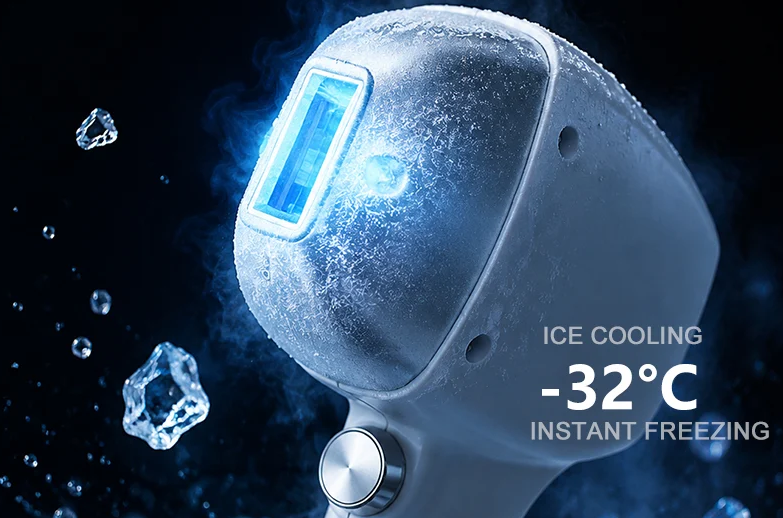
Sapphire contact cooling uses a chilled sapphire window pressed directly against the skin during laser treatment. The mechanism operates through three simultaneous effects:
1. Pre-Cooling
The sapphire window is pre-cooled to approximately 5°C before the laser pulse is delivered. This reduces the baseline temperature of the epidermis before any heat is applied, creating a thermal buffer.
2. Heat-Sinking (Active Cooling)
During the laser pulse, the sapphire window acts as a heat sink—it draws heat away from the skin surface immediately after the pulse. This removes thermal energy that would otherwise accumulate in the epidermis.
3. Index Matching
A less obvious but equally important effect: when the sapphire window contacts the skin, it reduces the refractive index mismatch at the skin surface. This effectively reduces the fluence (energy density) within the epidermis, providing additional protection without reducing the energy reaching the target hair follicle.
Clinical Evidence: What the Research Shows
A landmark study from Johns Hopkins University examined the clinical response of skin to 800-nm laser irradiation with varying degrees of sapphire contact cooling.
The Study Setup:
-
Three subjects received laser pulses at 60 J/cm² with 30ms pulse duration
-
Each subject received three test sites:
-
Pre-cooled with a chilled (5°C) sapphire window (pre-cooling + heat-sinking)
-
Room-temperature (20°C) sapphire window only (heat-sinking without pre-cooling)
-
No cooling at all
-
The Results:
| Cooling Condition | Clinical Outcome |
|---|---|
| Pre-cooled (5°C) + heat-sinking | No evidence of epidermal or dermal damage |
| Heat-sinking only (20°C) | Minor perifollicular epidermal damage; no permanent injury |
| No cooling | Ulceration, sustained erythema, permanent textural change |
Conclusion: Pre-cooling with a chilled sapphire window prevented all epidermal damage, even at the highest effective treatment energies.
Why Sapphire Is the Material of Choice
Not all cooling plates are created equal. Sapphire has specific physical properties that make it ideal for this application:
| Property | Benefit |
|---|---|
| High thermal conductivity | Transfers heat away from skin rapidly |
| Optical transparency at 755-1064nm | Allows laser light to pass through without absorption or scattering |
| High durability | Withstands repeated clinical use and cleaning |
| Biocompatibility | Safe for direct skin contact |
These properties make sapphire the industry standard for professional salon laser equipment CE certified, as confirmed by multiple FDA 510(k) clearances.
Temperature Ranges in Professional Systems
Different cooling systems achieve different skin temperatures. A modern painless laser hair removal device typically maintains the sapphire window at:
Some high-end 808nm diode laser systems utilize continuous sapphire contact cooling combined with air and closed water circulation, enabling continuous operation for up to 20 hours.
Clinical Benefits of Sapphire Contact Cooling
1. Safe High-Energy Treatments
Proper cooling allows clinicians to use higher fluence levels while keeping the epidermis safe. As the Johns Hopkins study concluded, "by judiciously selecting the laser pulse duration and pre-cooling and heat-sinking the epidermis... epidermal damage can be avoided while administering the highest, most effective radiant exposures".
2. All Skin Types Can Be Treated
A multi-wavelength system—such as those offering 755nm, 810nm, and 1064nm—combined with sapphire contact cooling, can safely treat patients across all Fitzpatrick skin types (I–VI), including tanned skin. Without adequate cooling, treating darker skin types carries a significantly higher risk of hyperpigmentation and burns.
3. Virtually Painless Treatments
The combination of pre-cooling and active heat-sinking reduces thermal sensation on the skin surface. Many professional devices now market themselves as a painless laser hair removal device because patients experience minimal discomfort during treatment. As one clinical source notes, "the skin temperature [is] cooled to -5°C ~ 0°C, [to] avoid skin thermal injury" and maximize patient comfort.
Sapphire Cooling in FDA-Cleared Devices
The importance of sapphire contact cooling is reflected in regulatory approvals. For example:
-
The VEGA system (FDA 510(k) K242859) features a "sapphire-tipped contact cooling system" and is cleared for permanent hair reduction on all skin types (Fitzpatrick I–VI), including tanned skin.
-
The Ice Cooling IPL Hair Removal Device (FDA 510(k) K242039) uses a sapphire treatment window with continuous ice cooling throughout the hair removal process to "provide users with a more comfortable experience".
What to Look for When Buying Salon Laser Equipment
When evaluating salon laser equipment CE certified, consider these cooling-related factors:
| Feature | What to Check | Why It Matters |
|---|---|---|
| Cooling type | Sapphire contact cooling (not air or gel) | Provides both pre-cooling and heat-sinking simultaneously |
| Temperature range | -5°C to 5°C | Wider range allows treatment customization for different skin types |
| CE certification | Valid CE marking for the specific model | Ensures compliance with European safety standards |
| FDA clearance | Verifiable 510(k) number for the exact model | Confirms the device meets U.S. regulatory standards |
| Continuous operation | 10+ hours of continuous use | Important for high-volume clinics |
A reliable painless laser hair removal device should integrate sapphire contact cooling as a core feature, not an optional add-on. The clinical evidence shows that without adequate cooling, you cannot safely deliver the high-energy treatments required for effective, permanent hair reduction.
Frequently Asked Questions
Q1: Why is sapphire used instead of other materials for cooling?
A: Sapphire combines high thermal conductivity, optical transparency across the 755–1064nm wavelength range, durability, and biocompatibility. These properties allow it to both cool the skin effectively and transmit laser energy without absorption.
Q2: Can a device without sapphire cooling still be effective?
A: Yes, but with significant limitations. Devices without active cooling (or with inferior cooling systems) cannot safely deliver high fluence levels. This may result in less effective hair reduction, more pain, or increased risk of skin injury.
Q3: Is sapphire cooling the same as cryogen cooling?
A: No. Sapphire contact cooling uses a chilled window in direct contact with the skin to conduct heat away. Cryogen spray cooling (DCD) uses a burst of cold liquid sprayed onto the skin before each pulse. Both can be effective, but they operate through different mechanisms.
Q4: How does sapphire cooling affect treatment time?
A: Sapphire cooling itself does not directly affect treatment time. However, by allowing higher energy delivery and reducing pain, it can make larger treatment areas faster and more comfortable to complete.
Q5: Does CE certification guarantee that a device has sapphire cooling?
A: No. CE certification confirms the device meets European safety standards but does not specify cooling technology. Always check the technical specifications to confirm the cooling type.
Conclusion
Sapphire contact cooling is a clinically proven technology that enables safe, effective, and comfortable laser hair removal. By simultaneously pre-cooling the skin, acting as a heat sink during the pulse, and providing index matching, it protects the epidermis while allowing high-energy treatments.
When choosing salon laser equipment CE certified, look for devices with sapphire contact cooling as a core feature. Whether you're treating fair or dark skin, this technology allows you to deliver effective results with minimal discomfort—making it the foundation of any professional painless laser hair removal device.