

Laser Hair Removal Cooling System: Types, Benefits and How to Choose
Quick Answer
A laser hair removal cooling system helps control heat at the skin surface during laser treatment. Because laser energy is converted into heat when absorbed by melanin in the hair follicle, effective cooling can improve treatment comfort and help protect the epidermis.
Professional diode laser systems may use air cooling, contact cooling, sapphire cooling, TEC cooling, water cooling, or a combination of several methods.
For salons and clinics, the best cooling configuration depends not only on cooling temperature but also on treatment volume, handpiece design, wavelength, maintenance requirements, and overall system reliability.
Introduction
Cooling is an important part of modern professional 808 laser hair removal equipment.
When a diode laser delivers energy to the skin, melanin in the hair absorbs part of that energy and converts it into heat. The objective is to concentrate sufficient thermal energy around the hair follicle while limiting unnecessary heating of surrounding tissue.
This creates an important engineering challenge:
How can a laser deliver effective energy while keeping the skin surface within an appropriate temperature range?
This is where a laser hair removal cooling system becomes important.
However, not all cooling technologies work in the same way. Some cool the skin indirectly with air, while others create direct contact between a cooled treatment window and the skin.
Understanding these differences can help salons make better equipment purchasing decisions.
What Does a Laser Hair Removal Cooling System Do?
The primary function of a cooling system is to manage heat generated during laser treatment.
A typical treatment process can be simplified as:
Laser energy → melanin absorption → heat generation → follicle heating
At the same time, the cooling system works to control heat at the skin surface:
Cooling → surface temperature control → improved comfort and epidermal protection
An effective cooling system should therefore do more than simply produce a low temperature.
It should provide:
- stable temperature control
- consistent contact or airflow
- adequate heat removal
- reliable performance during repeated treatments
- compatibility with the laser handpiece
- manageable maintenance requirements
This is why cooling performance should be evaluated as part of the complete laser platform rather than as an isolated specification.
Main Types of Cooling Used in Laser Hair Removal
Professional systems generally use several different cooling approaches.
| Cooling Method | How It Works | Main Advantage | Main Consideration |
|---|---|---|---|
| Air Cooling | Cool air is directed toward the treatment area | Simple and easy to maintain | Less direct cooling |
| Contact Cooling | A cooled window touches the skin | Direct surface cooling | Requires good window contact |
| Sapphire Cooling | A sapphire treatment window transfers heat away from skin | Good optical transmission and thermal performance | More dependent on handpiece design |
| TEC Cooling | Thermoelectric module actively controls temperature | Precise temperature management | Adds system complexity |
| Water Cooling | Circulating liquid removes heat | Suitable for thermal management | Requires additional maintenance |
| Combined Cooling | Uses two or more methods | Stronger thermal control | Higher system complexity |
The important point is that different cooling technologies solve different engineering problems.
Air Cooling
Air cooling uses fans or a dedicated airflow path to reduce heat around the treatment area.
Advantages
- relatively simple construction
- easy routine maintenance
- no direct contact between cooling surface and skin
- suitable for many professional systems
Limitations
Air has relatively low thermal conductivity compared with direct-contact cooling methods.
As a result, air cooling may not provide the same localized cooling effect as a cooled treatment window.
For clinics performing high-volume treatments, airflow design and heat dissipation therefore become important considerations.
Contact Cooling
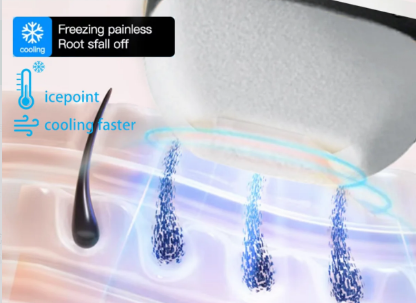
Contact cooling places a cooled surface directly against the skin.
Because the cooling element is physically touching the treatment area, heat can be transferred away from the skin more directly than with airflow alone.
This approach can provide:
- localized cooling
- improved treatment comfort
- better control of surface temperature
- consistent cooling at the treatment window
However, the performance depends heavily on the design of the cooling window, temperature control system, contact pressure, and heat dissipation structure.
Sapphire Cooling
Sapphire is commonly used as the contact window in some professional diode laser handpieces.
Its characteristics make it suitable for optical treatment systems because it can combine:
- high optical transmission
- good thermal conductivity
- mechanical durability
- resistance to repeated clinical use
In a sapphire contact-cooling handpiece, the cooled sapphire window is placed against the skin while laser energy passes through the treatment window.
The key benefit is therefore not simply that the material is sapphire.
The entire cooling architecture matters, including:
- sapphire window thickness
- contact area
- thermoelectric cooling
- heat dissipation
- temperature monitoring
- handpiece construction
This distinction is important when comparing professional laser systems.
A machine advertising a "sapphire tip" does not automatically have superior cooling performance.
What Is TEC Cooling?
TEC stands for thermoelectric cooling.
It uses the Peltier effect to transfer heat from one side of a semiconductor module to the other.
In laser hair removal equipment, TEC technology can be integrated into the handpiece to actively control the temperature of a contact cooling surface.
A typical system may work like this:
TEC module → cooling plate → sapphire window → skin
The heat removed from the skin must then be transferred away from the TEC module.
Therefore, TEC performance depends not only on the semiconductor module itself but also on the system's heat dissipation design.
This is one reason buyers should avoid judging cooling capability from a single temperature number.
Why Some Systems Combine Multiple Cooling Technologies
High-performance professional laser platforms may combine several cooling methods.
For example:
TEC + sapphire contact cooling + water circulation + air cooling
Each component can serve a different function.
| Component | Primary Function |
|---|---|
| TEC | Active temperature control |
| Sapphire window | Direct skin contact and optical transmission |
| Water circulation | Heat removal from internal components |
| Air cooling | Additional heat dissipation |
A combined architecture can be useful for systems designed for frequent treatments or extended operating periods.
However, more cooling components also mean more components that need to be monitored and maintained.
Therefore, more cooling technologies do not automatically mean a better machine.
Why Cooling Matters for Treatment Comfort
Laser hair removal can produce a noticeable heat sensation.
Cooling can reduce the amount of heat experienced at the skin surface and make treatment more comfortable.
For professional practices, this can influence the overall patient experience.
Better comfort may contribute to:
- easier treatment sessions
- improved patient acceptance
- greater willingness to complete a treatment course
- a more premium service experience
However, cooling should not be described as making every treatment completely painless.
Individual comfort depends on factors such as:
- hair density
- hair thickness
- treatment area
- skin type
- treatment parameters
- wavelength
- individual pain sensitivity
Cooling and Skin Protection
Cooling also has an important role in controlling unwanted heating of the epidermis.
The laser should deliver sufficient energy to the intended target while minimizing unnecessary thermal exposure to surrounding tissue.
Effective cooling can help manage surface heat, but it does not eliminate treatment risks.
Clinical safety still depends on:
- appropriate patient selection
- correct treatment parameters
- skin assessment
- wavelength selection
- operator training
- device calibration
- proper treatment technique
Therefore, cooling should be viewed as one part of the safety system, rather than a substitute for proper clinical practice.
Cooling System Comparison for Professional Buyers
For salons considering different professional laser platforms, the following framework can be useful.
| Factor | Air Cooling | Contact/Sapphire Cooling | Combined Cooling |
|---|---|---|---|
| Surface cooling | Moderate | Stronger direct cooling | Strong |
| Handpiece complexity | Lower | Moderate | Higher |
| Maintenance | Generally simpler | Moderate | More involved |
| Treatment comfort | Good | Very good | Very good |
| Thermal management | Basic to moderate | Moderate to strong | Strong |
| High-volume suitability | Depends on system design | Good | Often better |
| Initial system complexity | Lower | Moderate | Higher |
These are general engineering characteristics. Actual performance depends on the specific device design.
What Should Salons Check Before Buying?
When evaluating a professional diode laser, do not ask only:
"How cold does the handpiece get?"
Instead, ask a broader set of questions.
1. How Is the Cooling Generated?
Ask whether the system uses:
- air cooling
- contact cooling
- TEC
- water circulation
- or a combination
2. Is the Cooling Temperature Stable?
A very low advertised temperature does not necessarily mean better clinical performance.
Ask suppliers about:
- temperature control
- cooling consistency
- temperature monitoring
- performance during continuous operation
Stable cooling can be more important than an impressive minimum temperature specification.
3. How Is Heat Removed From the Machine?
This is particularly important for high-volume salons.
A cooling system must ultimately move heat away from the treatment area and internal components.
Check:
- ventilation design
- heat exchanger
- water circulation
- fan configuration
- thermal protection
- automatic shutdown or protection functions
4. How Much Maintenance Does It Require?
Different cooling systems create different maintenance requirements.
Ask about:
- water replacement
- filter cleaning
- fan maintenance
- coolant circulation
- handpiece cleaning
- service intervals
- replacement parts
A cooling system that performs well but requires excessive maintenance may increase the long-term operating burden.
Cooling Should Be Evaluated With Wavelength
Cooling technology should never be evaluated independently from the laser wavelength.
Professional diode systems may use configurations such as:
- 755nm
- 808nm
- 940nm
- 1064nm
- multi-wavelength combinations
Different wavelengths interact differently with melanin and penetrate tissue differently.
Therefore, the appropriate combination of:
wavelength + fluence + pulse duration + spot size + cooling
is more meaningful than focusing on cooling temperature alone.
For buyers comparing professional laser equipment, this integrated approach provides a much better basis for evaluation.
Cooling System vs. Treatment Speed
Treatment speed is another factor that should be considered.
A salon may perform dozens of treatments each week, so the system needs to maintain stable performance under repeated use.
Ask manufacturers:
- Can the cooling system operate continuously?
- Does output change after prolonged operation?
- Is there automatic thermal protection?
- How long does the system require between treatments?
- Can the handpiece maintain consistent cooling during high-volume use?
These questions are especially important for busy clinics and salons.
Common Buying Mistakes
Mistake 1: Choosing the Lowest Temperature
A lower temperature is not automatically better.
The cooling system must balance:
cooling performance + laser energy delivery + patient comfort + system stability
Mistake 2: Assuming Sapphire Automatically Means Better Cooling
Sapphire is a useful optical and contact-cooling material, but the material itself does not determine the entire cooling performance.
The TEC module, heat dissipation system, temperature control and handpiece construction also matter.
Mistake 3: Ignoring Long-Term Maintenance
Buyers sometimes focus on purchase price while overlooking:
- coolant maintenance
- filter replacement
- handpiece service
- cooling module replacement
- technical support
These costs should be included when calculating total ownership cost.
Mistake 4: Comparing Cooling Specifications Without Testing the Device
A demonstration can reveal things that a specification sheet cannot.
During a demonstration, evaluate:
- handpiece temperature stability
- contact feel
- cooling consistency
- ergonomics
- treatment speed
- noise
- recovery between treatments
For larger purchases, testing the actual device is preferable to relying only on marketing specifications.
Frequently Asked Questions
What is a laser hair removal cooling system?
A laser hair removal cooling system controls heat at the skin and/or inside the laser handpiece during treatment. Common approaches include air, contact, sapphire, TEC and water cooling.
Is sapphire cooling better than air cooling?
Sapphire contact cooling provides direct cooling at the treatment window, while air cooling works indirectly. Which is better depends on the complete device design and intended application.
Does TEC cooling make laser hair removal painless?
TEC cooling can improve treatment comfort by actively controlling the temperature of the cooling surface, but it cannot guarantee a completely painless treatment for every patient.
Why do diode lasers need cooling?
Laser energy produces heat when absorbed by the target. Cooling helps manage heat at the skin surface and supports treatment comfort and epidermal protection.
What cooling system is best for a salon?
There is no single best configuration for every salon. Buyers should consider treatment volume, handpiece design, wavelength, cooling stability, maintenance requirements and after-sales support.
Final Takeaway
A laser hair removal cooling system is more than a comfort feature. It is an important part of the thermal-management architecture of professional diode laser equipment.
Air cooling, contact cooling, sapphire cooling, TEC cooling and water cooling each have different advantages and limitations. Some systems combine several technologies to achieve more comprehensive thermal management.
For salons and clinics, the best purchasing decision should not be based on the lowest advertised temperature.
Instead, evaluate:
- cooling stability
- wavelength configuration
- energy consistency
- handpiece design
- treatment volume
- maintenance requirements
- thermal protection
- manufacturer support
A well-designed cooling system, combined with appropriate laser parameters and professional operation, can contribute to a more comfortable and consistent hair removal experience.