

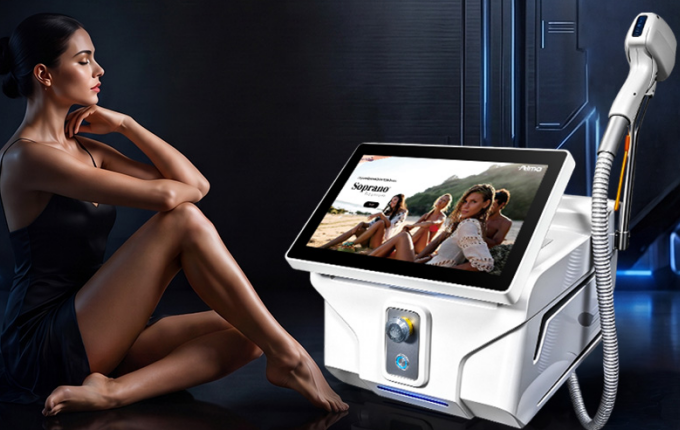
Which Laser Hair Rem for Small Salons: Portable vs Vertical?
A Practical Guide for Salon Owners
When you're running a small salon, every square foot counts. Your equipment decisions directly impact your treatment capacity, client experience, and bottom line. Both portable and vertical laser hair removal machines have their strengths—but which one is right for you?
We've compiled the 7 most common questions salon owners ask to help you make an informed decision for your Beauty Laser equipment investment.
Q1: What's the main difference between portable and vertical laser hair removal machines?
A: The core difference comes down to design and mobility.
| Portable Machine | Vertical Machine | |
|---|---|---|
| Design | Flat, compact, similar to a desktop chassis | Upright column or console, similar to a floor-standing unit |
| Mobility | Easy to move between rooms or transport | Designed to stay in one place, difficult to move |
| Footprint | Small, can sit on a table or cart | Large, requires dedicated floor space |
Despite their size difference, modern portable devices can now deliver professional-grade power comparable to vertical systems, especially in models using high-density diode stack technology.
Q2: My salon has limited space. Which one should I choose?
A: For small salons with limited space, a portable machine is the smarter choice.
Vertical machines require dedicated floor space, which is a significant burden in a small salon. Portable machines can easily sit on a table or cart, taking up no floor space at all. Many portable devices can also be moved between treatment rooms, allowing you to service multiple rooms with a single machine and maximizing equipment utilization.
Q3: What's the difference in treatment efficiency?
A: It depends on the body areas you primarily treat.
-
Vertical machines excel at treating large areas like the back and legs. The practitioner can stand and perform fast, continuous treatments on vertical surfaces with greater efficiency.
-
Portable machines are more flexible for smaller areas and body curves such as the underarms, bikini line, and face. The practitioner can sit for more precise control over delicate areas.
Key insight: With technological advancements, portable 808nm diode laser systems have significantly improved in power and spot size, with many models approaching the treatment efficiency of traditional vertical systems. If your clients are primarily large-area treatments, vertical may be more efficient; if mainly small-to-medium areas, portable is sufficient.
Q4: Which one is more comfortable to operate?
A: It depends on your therapists' work habits and physical endurance.
Vertical machines allow therapists to maintain an upright posture throughout the treatment, reducing back strain during long days. Portable machines typically require the therapist to sit during operation. If the device is heavy, prolonged use may cause some strain on the wrist and arms. However, many modern portable models feature lightweight designs that make them easier to handle.
Q5: I need a machine that can treat all skin types. Which one should I choose?
A: Whether portable or vertical, the key factor is the wavelength combination.
The core value of a professional Beauty Laser equipment system lies in its wavelength configuration. A four-wavelength system (755nm, 808nm, 940nm, and 1064nm) is considered the "complete package" in diode laser technology, capable of covering all skin types from light to dark:
-
755nm (Alexandrite wavelength): Extremely high melanin absorption, ideal for Fitzpatrick skin types I-III (lighter skin).
-
808nm (Diode gold wavelength): The optimal balance between absorption and penetration, suitable for the widest range of skin types (Fitzpatrick IV-V).
-
940nm: Deeper penetration, more effective for darker skin (Fitzpatrick IV-VI) and coarser hair.
-
1064nm (Nd:YAG wavelength): The deepest penetration, the safest choice for treating darker skin (Fitzpatrick V-VI).
Conclusion: As long as the device has complete four-wavelength capability, whether portable or vertical, it can safely and effectively serve all clients.
Q6: Which one offers better value for a limited budget?
A: For small salons with a limited budget, portable machines have a lower initial investment and are a more accessible entry point.
| Portable Machine | Vertical Machine | |
|---|---|---|
| Initial Investment | Lower, the preferred choice for first-time buyers | Higher, requires more substantial capital preparation |
| Payback Period | Generally shorter due to lower entry cost | Generally longer, but with higher potential |
| Best For | Starting out, testing market demand | Stable client flow, maximizing efficiency |
However, a vertical machine—while requiring a higher upfront investment—can deliver faster long-term returns through higher treatment efficiency if your client volume is sufficient. Evaluate based on your average daily client count.
Q7: Can you give a direct purchasing recommendation?
A: Here's a quick decision guide based on your specific situation:
Choose a portable machine if:
-
✅ Your salon has limited space and cannot accommodate a large floor-standing unit.
-
✅ You want the flexibility to move the device between rooms.
-
✅ You primarily treat small-to-medium areas, or you're starting out with a smaller budget.
Choose a vertical machine if:
-
✅ You have ample treatment room space for a fixed setup.
-
✅ You treat a high volume of clients daily and need to maximize efficiency.
-
✅ You primarily focus on large-area treatments like the back and legs.
Whichever you choose, prioritize equipment with complete four-wavelength capability (755/808/940/1064nm) and an effective cooling system. These two core specifications are what truly determine treatment efficacy and client satisfaction.