

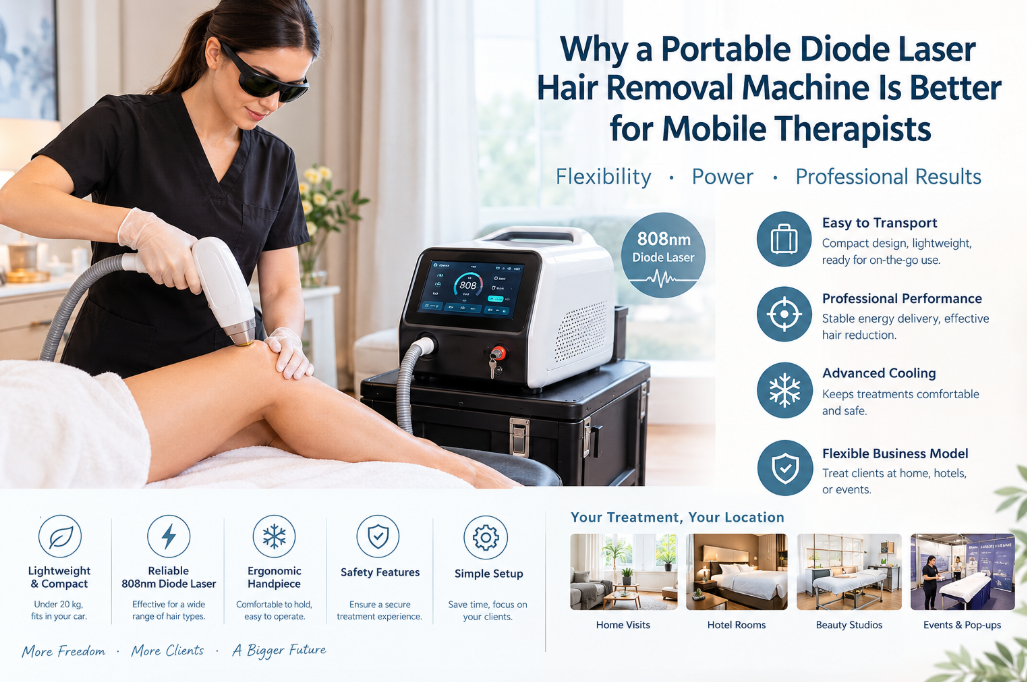
Why a Portable Diode Laser Hair Removal Machine Is Better for Mobile Therapists
Quick Answer
A portable diode laser for mobile therapists can turn hair-removal equipment from a fixed-location asset into a flexible service platform. The main advantage is not simply that the machine is smaller. Portability can change how therapists schedule appointments, transport equipment, use treatment spaces, serve different client locations, and control business overhead.
For mobile professionals, however, portability should never be evaluated separately from laser performance. A practical system needs to combine manageable weight, reliable energy delivery, effective cooling, an ergonomic handpiece, straightforward setup, transport protection, safety features, and dependable technical support.
The right question is therefore not simply whether a laser is portable. It is whether the equipment remains practical, reliable, and professionally usable when it is repeatedly moved between treatment locations.
1. Why Mobility Matters More for Mobile Therapists
A traditional aesthetic clinic is built around a fixed location. The client comes to the treatment room, and the equipment stays there.
A mobile therapist works differently.
The therapist may travel to:
-
Private residences
-
Hotel rooms
-
Temporary treatment spaces
-
Shared beauty studios
-
Wellness facilities
-
Events or pop-up locations
-
Multiple service areas within a city
This changes the equipment requirements.
A machine that performs well in a permanent treatment room may become inconvenient when it must be packed, transported, unpacked, connected, cleaned, and stored repeatedly.
For mobile practitioners, therefore, equipment mobility becomes part of the treatment workflow.
The value of a portable system can be considered through five practical questions:
-
How easily can it be transported?
-
How quickly can it be prepared for treatment?
-
Can it operate reliably outside a permanent clinic environment?
-
How much space does it require?
-
Can the therapist maintain a consistent professional workflow at different locations?
These questions are more useful than simply asking how many kilograms the machine weighs.
2. Portable Does Not Mean Simply Lightweight
One of the most common mistakes when purchasing mobile aesthetic equipment is defining portability only by weight.
A genuinely mobile system needs to be considered as an entire transportation package.
Important physical characteristics include:
-
Overall equipment weight
-
Machine dimensions
-
Carrying handles
-
Wheels or trolley compatibility
-
Protective case
-
Handpiece storage
-
Cable management
-
Connector durability
-
Screen protection
-
Stability during transport
A lightweight machine without adequate protection may actually be less suitable for frequent travel than a slightly heavier system with better transport engineering.
For a mobile therapist, the equipment may experience repeated:
transport → setup → treatment → breakdown → transport → storage
This cycle can occur dozens or hundreds of times during the equipment's service life.
Consequently, mechanical durability matters alongside laser specifications.
3. The Business Advantage: Bringing the Service to the Client
The biggest difference between a fixed clinic and a mobile practice is the direction of travel.
In a conventional model:
Client → Clinic → Treatment
In a mobile model:
Therapist + Equipment → Client → Treatment
A portable diode laser hair removal machine supports the second model by allowing the therapist to deliver the service where the client is located.
This can be particularly useful for customers who value:
-
Convenience
-
Privacy
-
Flexible scheduling
-
Reduced travel
-
At-home services
-
Personalized appointments
The equipment therefore becomes more than a treatment tool.
It becomes part of the service proposition.
For a mobile therapist, convenience can be integrated into the product offering itself rather than treated as an additional marketing feature.
4. Lower Fixed Overhead Can Change Equipment Economics
Mobile businesses often operate with a different cost structure from traditional clinics.
A fixed clinic may need to maintain:
-
Treatment rooms
-
Reception areas
-
Waiting areas
-
Utilities
-
Long-term commercial leases
-
Permanent equipment storage
A mobile therapist may instead allocate more resources to:
-
Transportation
-
Scheduling
-
Equipment
-
Insurance
-
Marketing
-
Client acquisition
-
Mobile storage
This does not mean mobile operation is automatically cheaper.
Travel time, mileage, parking, setup time, and equipment handling become additional operating considerations.
The important point is that a portable laser can allow the business to allocate resources differently.
Fixed clinic vs. mobile model
| Factor | Fixed Clinic | Mobile Therapist |
|---|---|---|
| Treatment location | Permanent | Variable |
| Equipment movement | Minimal | Frequent |
| Room cost | Higher | Potentially lower |
| Travel requirement | Mainly client travel | Mainly therapist travel |
| Storage | Dedicated space | Compact storage needed |
| Setup frequency | Low | High |
| Geographic service area | Location-dependent | Potentially broader |
| Scheduling flexibility | Moderate | Potentially high |
The economic benefit of portability therefore depends on whether the therapist can convert mobility into sufficient appointment demand.
5. Equipment Setup Time Matters More Than It Appears
Mobile treatments involve more than the treatment itself.
A therapist may need to:
-
Arrive at the location
-
Carry the equipment inside
-
Position the machine
-
Connect power
-
Connect the handpiece
-
Check cooling
-
Prepare the treatment environment
-
Confirm safety procedures
-
Configure treatment parameters
-
Complete the treatment
-
Clean the equipment
-
Pack everything again
If equipment setup and breakdown take too long, the therapist loses productive time between appointments.
This means a good mobile system should have a workflow that is easy to repeat.
Useful design features can include:
-
Simple startup
-
Clear touchscreen controls
-
Accessible connectors
-
Organized cable routing
-
Easy handpiece storage
-
Quick system checks
-
Straightforward cleaning procedures
The goal is not merely to make the machine easy to carry.
The goal is to reduce non-treatment time throughout the entire appointment cycle.
6. Why the Handpiece Is Especially Important for Mobile Use
The treatment handpiece is one of the most frequently handled components of a diode laser system.
For mobile therapists, its importance becomes even greater because the handpiece is repeatedly:
-
Connected
-
Disconnected
-
Packed
-
Transported
-
Unpacked
-
Used for extended periods
A practical handpiece should therefore be evaluated for:
Ergonomics
The shape and weight can influence operator fatigue during repeated treatments.
Cable design
The cable should be flexible enough for treatment but durable enough to withstand routine handling.
Cooling interface
The treatment tip should provide the cooling performance specified by the manufacturer.
Serviceability
Ask whether the handpiece can be repaired or replaced independently if necessary.
Storage
The system should provide a practical method for protecting the handpiece during transportation.
These considerations are easy to overlook because the main console receives most of the marketing attention.
For a mobile therapist, however, the handpiece is part of the daily workflow.
7. 808nm Diode Technology: What Should Mobile Therapists Evaluate?
An 808nm diode laser machine is commonly used in professional diode laser hair-removal systems.
However, wavelength alone should not determine the purchasing decision.
A mobile therapist should also evaluate:
-
Energy delivery stability
-
Pulse-duration control
-
Spot size
-
Repetition rate
-
Cooling performance
-
Handpiece ergonomics
-
Control interface
-
Treatment-area flexibility
-
Safety monitoring
The practical objective is to select a system whose complete configuration fits the intended treatments.
For example, a system designed around an appropriate spot size and efficient workflow may be more useful for a mobile therapist than a machine with a more impressive headline specification but cumbersome handling characteristics.
8. Cooling Is Both a Treatment and Workflow Consideration
Cooling is particularly important in diode laser hair removal because the treatment involves controlled delivery of optical energy to the skin.
For mobile practice, cooling has another dimension: consistency outside a permanent clinic environment.
The therapist may work in locations with different:
-
Ambient temperatures
-
Room sizes
-
Ventilation conditions
-
Electrical environments
The cooling system should therefore be evaluated for how it performs during the manufacturer's intended operating conditions.
Common cooling approaches may include:
-
Contact cooling
-
Sapphire cooling
-
TEC-assisted temperature control
-
Air cooling
-
Water-based cooling systems
-
Combined cooling architectures
Instead of asking only whether the system has "cold sapphire" or another cooling feature, ask how the system manages heat during repeated treatments.
A useful procurement checklist includes:
-
Cooling temperature control
-
Cooling response
-
Temperature monitoring
-
Cooling-system maintenance
-
Coolant requirements, where applicable
-
Protection against abnormal temperature conditions
For mobile therapists, a self-contained cooling architecture can also reduce the amount of equipment and consumables that need to be transported.
9. Safety Becomes More Important Outside a Traditional Clinic
A permanent clinic usually has a controlled treatment environment.
A mobile therapist may not have the same degree of environmental consistency.
The treatment location can vary in:
-
Room layout
-
Lighting
-
Electrical outlets
-
Client positioning
-
Available working space
-
Equipment placement
This makes standardized safety procedures particularly important.
A professional diode laser device should be evaluated for appropriate safety features and documentation, including where applicable:
-
Emergency stop controls
-
System fault detection
-
Temperature monitoring
-
Key or access controls
-
Warning indicators
-
Electrical safety
-
User documentation
-
Protective equipment requirements
Equipment features cannot replace professional training and local regulatory compliance.
Mobile operation should therefore be treated as a professional service environment, not as an informal home-use scenario.
10. The Treatment Environment Should Influence the Equipment Choice
Portability gives the therapist more freedom, but it also introduces more variables.
Before buying, consider where treatments will actually be performed.
Residential appointments
The machine may need to fit into relatively small rooms.
Important considerations include:
-
Compact footprint
-
Easy positioning
-
Cable management
-
Low setup complexity
Hotel appointments
Transportation and presentation become particularly important.
A professional-looking machine and organized carrying system can contribute to the overall client experience.
Shared studios
The equipment may need to be moved between storage and treatment areas regularly.
Durability and quick setup become more important.
Events
The therapist may need to transport equipment alongside other supplies.
In this situation, overall equipment volume and transportation efficiency can influence business practicality.
The best configuration therefore depends partly on the real-world environments in which the equipment will operate.
11. Portability vs. Treatment Capacity
Portability involves trade-offs.
A mobile therapist may not need the same configuration as a high-volume aesthetic center.
A large stationary system can potentially provide advantages in areas such as:
-
Larger physical interfaces
-
Higher-throughput workflows
-
More extensive cooling architecture
-
Larger treatment accessories
-
Dedicated treatment-room integration
A portable system may instead prioritize:
-
Compact dimensions
-
Manageable weight
-
Mobility
-
Flexible placement
-
Faster setup
-
Lower space requirements
This does not mean one category universally replaces the other.
The correct question is:
What level of treatment capacity does the business actually need?
If a therapist performs a relatively limited number of appointments each day and spends significant time traveling, portability may have greater operational value.
If the business operates from a permanent location with high treatment volume, throughput and duty-cycle considerations may become more important.
12. Travel Time Should Be Included in the Business Model
Mobility creates an important cost that is not visible on the machine specification sheet: travel time.
Suppose a therapist schedules several mobile appointments across a wide geographic area.
The working day includes:
Treatment Time + Travel Time + Setup Time + Breakdown Time
Therefore, the number of appointments per day should not be calculated solely from treatment duration.
A more realistic capacity calculation is:
Daily Capacity = Available Working Hours ÷ Average Complete Appointment Cycle
Where the appointment cycle includes:
-
Treatment
-
Setup
-
Cleaning
-
Packing
-
Travel
This can substantially change the economics of mobile practice.
A machine that saves only a few minutes of treatment time may have limited business impact if travel between appointments takes much longer.
Conversely, a compact system that reduces setup and transportation friction can have meaningful operational value.
13. How Portability Can Support Premium Mobile Services
Mobile services do not necessarily need to compete only on price.
A therapist may build a service around:
-
Convenience
-
Privacy
-
Personalized scheduling
-
Home visits
-
Flexible appointment times
-
Premium customer experience
In that context, the laser becomes part of a broader service package.
For example, a mobile therapist might structure appointments around:
Consultation → Preparation → Treatment → Aftercare Guidance → Follow-Up
The equipment supports the treatment stage, but the perceived value of the overall service comes from the complete experience.
This is why equipment selection should be connected to the business model rather than evaluated in isolation.
14. How to Evaluate Reliability for Frequent Transportation
Repeated transportation creates different reliability requirements from stationary operation.
Before purchasing, ask the manufacturer about:
Mechanical durability
How is the system designed to withstand routine transportation?
Connector durability
Which connectors are frequently removed and reconnected?
Handpiece protection
How should the handpiece be stored during transportation?
Cooling-system protection
Does moving the equipment affect the cooling system or startup procedure?
Electrical requirements
Can the system operate safely with the electrical infrastructure normally found in intended treatment locations?
Service procedures
If a component fails while the therapist is mobile, how quickly can the issue be diagnosed and resolved?
These questions can reveal differences between a machine that is merely compact and one that has genuinely been designed around mobile professional use.
15. What About Multi-Wavelength Portable Systems?
Some portable diode systems combine multiple wavelengths.
Potential configurations may include combinations involving:
-
755 nm
-
808 nm
-
940 nm
-
1064 nm
A multi-wavelength platform may provide broader treatment flexibility, but additional wavelengths can also increase system complexity and purchase cost.
The important question is whether the additional capability will actually be used.
A therapist should consider:
-
Target client population
-
Hair characteristics
-
Skin characteristics
-
Treatment portfolio
-
Expected appointment volume
-
Budget
-
Training requirements
Buying additional technology simply because it is available does not necessarily create additional business value.
The best configuration is the one that matches the therapist's actual service requirements.
16. Portable Equipment and Client Experience
A mobile treatment happens in the client's personal environment, so equipment presentation can influence the perceived professionalism of the service.
Consider:
-
Clean equipment surfaces
-
Organized cables
-
Professional carrying case
-
Well-maintained handpiece
-
Clear touchscreen interface
-
Efficient setup
-
Consistent hygiene procedures
A compact system can help the therapist create a more organized treatment area without requiring a large amount of space.
This is particularly relevant for home appointments, where the treatment area may be considerably smaller than a conventional clinic room.
17. When a Portable Diode Laser May Not Be the Right Choice
Portability has clear benefits, but it should not automatically be prioritized.
A larger stationary system may make more sense when:
-
The clinic has a dedicated treatment room
-
Hair-removal demand is consistently high
-
Several operators use the equipment
-
Large treatment areas dominate the service menu
-
Treatment throughput is a major business priority
-
The equipment rarely needs to be moved
A portable system may be less suitable if transportation becomes a burden rather than a benefit.
For example, if the therapist operates almost entirely from one permanent location, the advantages of portability may have little economic significance.
This is why equipment selection should begin with business workflow, not product category.
18. A Practical Decision Framework for Mobile Therapists
Before purchasing, score the equipment internally against six practical categories—not as a universal product ranking, but as a checklist for your own business requirements.
Mobility
Can one person transport the complete system comfortably and safely?
Setup
Can the machine be prepared without unnecessary steps?
Treatment capability
Does the configuration support the intended treatment areas and protocols?
Cooling
Can the cooling system support the manufacturer's intended operating conditions?
Reliability
Is the system designed for repeated handling and transportation?
Support
Can the manufacturer provide training, troubleshooting, documentation, and replacement parts?
A machine that performs well across these categories is more likely to fit a mobile workflow than one that simply has attractive headline specifications.
19. Questions to Ask the Manufacturer
Before ordering, mobile therapists should ask suppliers:
About portability
-
What is the complete system weight?
-
What are the packed dimensions?
-
Is a protective case included?
-
Is trolley transportation supported?
-
How should the handpiece be protected?
About operation
-
What electrical requirements does the system have?
-
How long does startup normally take?
-
What maintenance is required between treatments?
-
What cooling system is used?
About the laser
-
What wavelengths are available?
-
What is the spot-size configuration?
-
What pulse-duration range is supported?
-
How is energy output tested?
-
How is temperature monitored?
About service
-
What does the warranty cover?
-
Are replacement handpieces available?
-
Which spare parts are normally stocked?
-
What technical support is available?
-
Is operator training included?
These questions provide a much stronger basis for comparison than simply asking for the lowest quotation.
20. Frequently Asked Questions
Is a portable diode laser suitable for mobile therapists?
It can be suitable when its physical design, treatment capabilities, cooling, safety features, and service support match the requirements of mobile professional practice. Portability alone does not determine suitability.
Is 808nm enough for mobile hair-removal services?
An 808nm configuration is commonly used in professional diode laser hair-removal systems. Whether it is appropriate for a particular practice depends on the intended clients, treatment protocols, equipment configuration, training, and applicable requirements.
Does a portable system have to be battery powered?
No. Portability and battery operation are separate concepts. Many professional systems are designed to operate from conventional electrical power while remaining compact enough for transportation.
How important is cooling for a mobile diode laser?
Cooling is important because it contributes to thermal management and patient comfort. For mobile use, buyers should also consider whether the cooling system can operate consistently under the environmental conditions expected during professional use.
Can professional diode laser equipment be used in clients' homes?
Potentially, depending on the equipment, operator qualifications, local regulations, treatment environment, and safety requirements. A professional portable system should not be treated as equivalent to an unsupervised consumer home-use device.
Should mobile therapists choose single- or multi-wavelength equipment?
The choice depends on the actual treatment portfolio and client population. Multi-wavelength systems can provide additional flexibility but may also increase cost and system complexity.
Conclusion
The value of portable diode laser technology for mobile therapists goes beyond saving space.
A well-designed system can support a different business model by allowing the therapist to bring professional hair-removal services directly to clients while reducing dependence on a permanent treatment room.
However, successful mobile operation requires more than a compact enclosure. Buyers should evaluate transportability, setup time, handpiece ergonomics, cooling, energy delivery, safety, durability, treatment capacity, maintenance, and supplier support as one integrated system.
The most suitable equipment is therefore not necessarily the smallest or the most powerful. It is the system that fits the therapist's actual travel pattern, appointment volume, treatment portfolio, working environment, and long-term business model.
For mobile professionals building or expanding a hair-removal service, portability becomes valuable when it reduces operational friction without compromising the requirements of professional treatment.