

Best Diode Laser Wavelength for Dark Skin Hair Removal: A Professional Guide
Introduction
Choosing the best diode laser wavelength for dark skin hair removal requires more than selecting the longest wavelength listed on a device specification sheet. Practitioners must consider epidermal melanin, hair characteristics, laser architecture, pulse duration, fluence, spot size, cooling performance, and the client's skin response.
For clients with Fitzpatrick skin types IV–VI, longer wavelengths can reduce competing absorption by epidermal melanin. The long-pulsed 1064nm Nd laser is widely recognized as an important option for darker skin, while 800–810nm diode lasers can also be used when appropriate treatment parameters and safety protocols are followed. The choice depends on the device and the individual treatment scenario.
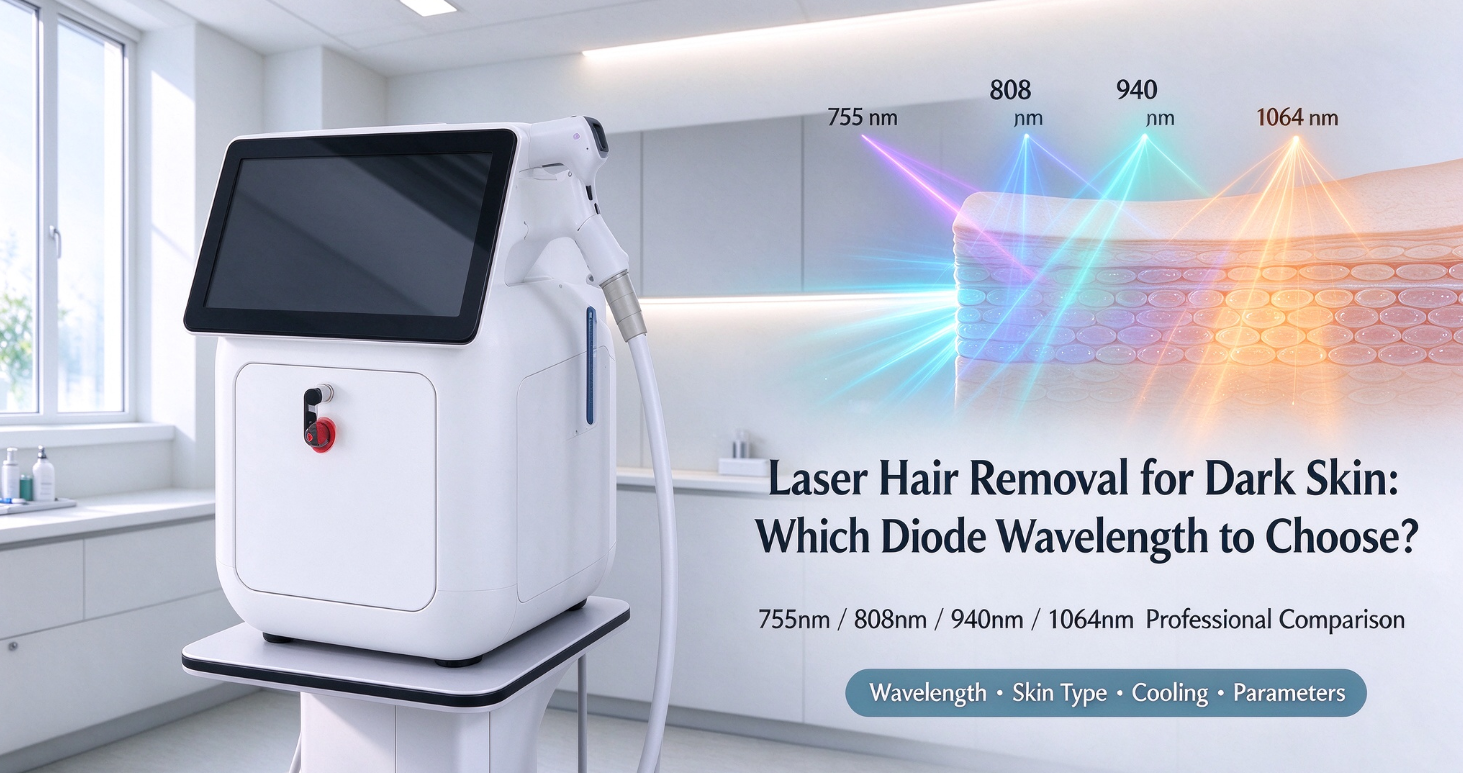
For aesthetic clinics and equipment buyers, this distinction matters when evaluating a single-wavelength system against a multi-wavelength platform. A device combining 755nm, 808nm, 940nm, and 1064nm may offer broader configuration options, but the actual benefit depends on how the wavelengths are generated, delivered, and controlled.
Understanding these factors helps practitioners select appropriate equipment, establish realistic treatment expectations, and avoid assuming that more wavelengths automatically mean better results.
1. Why Wavelength Matters for Dark Skin Hair Removal
Laser hair removal uses selective photothermolysis: melanin in the hair absorbs optical energy, which is converted into heat and transferred to follicular structures. The objective is to damage the targeted hair-producing structures while limiting injury to surrounding tissue.
The challenge is that epidermal melanin also absorbs laser energy. In darker skin, this competing absorption can increase the risk of burns, blistering, and post-inflammatory hyperpigmentation if the device or treatment parameters are unsuitable.
Wavelength influences both melanin absorption and the distribution of optical energy in tissue. However, it is only one part of the treatment system.
Other factors include:
-
Fluence: Energy delivered per unit area, commonly expressed in J/cm².
-
Pulse duration: The time over which the energy is delivered.
-
Spot size: The dimensions of the treatment area, which influence optical penetration and coverage.
-
Repetition rate: The number of pulses delivered per second.
-
Cooling: The method used to limit excessive heating of the epidermis.
-
Treatment technique: The movement pattern, overlap, and protocol specified for the device.
A longer wavelength may reduce epidermal melanin absorption relative to a shorter wavelength, but it does not eliminate thermal injury risk. Excessive fluence, inappropriate pulse settings, insufficient cooling, or unsuitable treatment technique can still cause complications.
Consequently, wavelength selection should be based on the complete device and treatment protocol rather than a single headline specification.
2. Comparing 755nm, 808nm, 940nm, and 1064nm
Each wavelength has different optical characteristics. The following comparison is a general technical guide, not a universal treatment prescription.
| Wavelength | Common association | Potential application | Important consideration |
|---|---|---|---|
| 755nm | Alexandrite lasers and certain diode systems | Strong melanin interaction can be useful for selected lighter skin and hair combinations | Higher epidermal melanin absorption can make treatment more challenging on deeply pigmented skin |
| 808–810nm | Diode lasers | Widely used for professional hair removal across a range of skin types | Skin type, fluence, pulse duration, cooling, and treatment technique remain important |
| 940nm | Certain diode-based systems | Can contribute to a multi-wavelength system's optical characteristics | Its independent clinical advantage for hair removal should not be assumed without supporting evidence |
| 1064nm | Long-pulsed Nd lasers and some multi-wavelength platforms | Lower melanin absorption and greater penetration make it particularly relevant to darker skin | Laser architecture, pulse characteristics, output, and treatment settings still require evaluation |
A critical distinction is that 1064nm is traditionally associated with Nd laser technology, not conventional diode laser emission. Some commercial platforms advertise a four-wavelength configuration containing 1064nm alongside diode wavelengths. Buyers should verify whether the system uses a genuine diode source at that wavelength, a separate laser source, or another architecture.
The same principle applies to any claim that a device combines four wavelengths in a single handpiece or treatment pulse. The manufacturer should explain how the wavelengths are generated and delivered.
This matters because two systems with the same advertised wavelengths may have different optical designs, operating modes, and evidence supporting their intended use.
3. Which Wavelength Is Most Suitable for Dark Skin?
When evaluating the best diode laser wavelength for dark skin hair removal, distinguish between the wavelength that is technically available and the treatment system that has appropriate evidence for the intended skin type.
Why 1064nm is important
The long-pulsed 1064nm Nd laser has relatively low absorption by epidermal melanin compared with shorter hair-removal wavelengths. This characteristic can provide a useful safety advantage when treating deeply pigmented skin.
A review of laser and light treatments for Fitzpatrick IV–VI skin types identified longer wavelengths, appropriate device selection, and suitable treatment parameters as important factors in safe hair reduction. A separate systematic review and meta-analysis examined comparative evidence for several hair-removal technologies in skin of color. Review of darker skin types · Systematic review and meta-analysis.
Nevertheless, the evidence for 1064nm Nd should not automatically be transferred to every device marketed as a 1064nm diode system. The laser source, pulse duration, fluence, cooling, and clinical protocol need to be considered.
Can an 808nm diode laser treat darker skin?
Yes. Appropriately designed 800–810nm diode systems can be used on selected darker skin types under suitable protocols. The relevant clinical literature emphasizes careful parameter selection and the potential for adverse effects when energy delivery is inappropriate.
The practical question is not whether 808nm is categorically safe or unsafe. It is whether the specific system, its operating parameters, and the practitioner's protocol are suitable for the individual client.
What should practitioners evaluate first?
Before choosing a wavelength, practitioners should assess:
-
The client's Fitzpatrick skin type and current tanning status.
-
Hair color, thickness, density, and treatment area.
-
The laser source and available operating modes.
-
The device's supported fluence and pulse-duration ranges.
-
The effectiveness and limitations of its cooling system.
-
The manufacturer's instructions, contraindications, and safety guidance.
These factors provide a more reliable basis for treatment planning than a universal claim that one wavelength is always best.
4. How Multi-Wavelength Technology Expands Treatment Flexibility
A multi-wavelength laser platform combines different wavelengths to provide more configuration options within one equipment system. Depending on its design, this can help a clinic adapt its treatment approach to different hair characteristics, skin types, and anatomical areas.
For a professional multi wavelength laser, the main potential advantage is flexibility rather than an automatic improvement in clinical outcomes.
What a four-wavelength system can offer
A laser diode hair removal 4 wavelength platform may combine 755nm, 808nm, 940nm, and 1064nm. The exact role of each wavelength depends on the system's optical architecture and how the energy is delivered.
Potential benefits for clinics include:
-
Broader configuration options: Different wavelength combinations may be available for different treatment requirements.
-
Equipment consolidation: One platform may serve a wider range of applications than a single-wavelength system, depending on its verified capabilities.
-
Workflow flexibility: Operators may be able to adjust settings or select supported modes without changing equipment.
-
Commercial positioning: A well-documented platform can give clinics more options when developing treatment services.
However, the number of wavelengths alone does not establish that the device treats all hair types, works equally well on all skin tones, or delivers better results than a well-designed single-wavelength system.
Buyers should verify whether the wavelengths operate simultaneously, sequentially, or through selectable modes. They should also determine whether the quoted specifications apply to the complete system or to individual sources.
Does 940nm improve hair removal?
The answer depends on the device design and supporting evidence. A 940nm wavelength may contribute to the optical characteristics of a combined system, but it should not automatically be described as a wavelength specifically for deeper follicles or reduced skin redness.
Such claims require appropriate technical or clinical support. The actual treatment effect depends on the complete optical and thermal interaction, not wavelength alone.
5. Cooling and Treatment Parameters: Why Wavelength Is Not Enough
Cooling is an important component of professional laser hair removal, particularly when treating skin with higher epidermal melanin content.
Sapphire contact cooling is one commonly used approach. By maintaining contact with the treatment area, a suitable cooling system can help manage epidermal heat during energy delivery. Other cooling designs may use different methods and operating principles.
However, cooling does not make an unsuitable wavelength or excessive treatment setting safe.
What to assess in a cooling system
| Evaluation factor | Why it matters |
|---|---|
| Cooling method | Identifies how heat is removed or controlled |
| Contact surface | Affects how cooling is transferred to the treatment area |
| Temperature control | Helps determine how cooling conditions are maintained |
| Operating stability | Indicates whether performance remains consistent during intended use |
| Maintenance requirements | Helps prevent avoidable cooling-system problems |
| Treatment compatibility | Establishes whether cooling is appropriate for the device's intended parameters |
Practitioners should also follow the manufacturer's instructions for fluence, pulse duration, repetition rate, movement speed, and overlap. Test spots and observation of the skin response may be appropriate under the applicable clinical protocol.
For equipment buyers, a supplier should provide clear operating instructions and explain the cooling system's specifications and limitations. A phrase such as "ice cooling" or "sapphire cooling" is not, by itself, evidence of a particular clinical outcome.
6. Clinical Evidence: What It Can and Cannot Prove
Clinical evidence should be assessed according to the exact claim being made.
A study reporting hair-count reduction does not necessarily establish permanent removal of every treated hair. A study of one laser source does not automatically validate a different device simply because the wavelength is similar.
When reviewing clinical evidence, check the following:
-
Device identity: Was the exact system or laser type identified?
-
Study population: Were the relevant skin types included?
-
Treatment protocol: Were wavelength, fluence, pulse duration, and session schedule reported?
-
Outcome measurement: Was hair reduction assessed using standardized methods?
-
Follow-up: Were results evaluated after sufficient time to observe regrowth?
-
Safety outcomes: Were burns, pigmentary changes, and other adverse events documented?
-
Study limitations: Were sample size, comparison groups, and potential bias addressed?
The systematic review of hair-removal technologies in skin of color provides useful context for comparing clinical evidence, but its findings should not be treated as validation of every commercial multi-wavelength device. Read the review.
For manufacturers and distributors, this distinction is particularly important. General research on laser hair removal can explain the underlying technology, while product-specific evidence is needed to support claims about a particular system.
Avoid using phrases such as "zero risk," "guaranteed permanent removal," or "safe for every skin type" without appropriate evidence and qualifications.
7. How Clinics Should Evaluate a Professional Multi-Wavelength Device
For clinics considering a new system, the choice should reflect both treatment requirements and operational needs.
A technically sophisticated device is useful only if its specifications, operating procedures, maintenance requirements, and support arrangements match the clinic's intended use.
Equipment evaluation checklist
| Category | Questions to ask the supplier |
|---|---|
| Laser architecture | What laser sources generate each advertised wavelength? |
| Wavelength delivery | Are wavelengths selectable, combined, or delivered through separate modes? |
| Output specifications | What are the verified fluence, pulse duration, spot size, and repetition-rate ranges? |
| Applicator design | Which handpieces and spot sizes are included? |
| Cooling | How is cooling controlled, and what maintenance is required? |
| Safety | What instructions, contraindications, and safety features are documented? |
| Quality and compliance | Which applicable certificates and test reports cover the exact model? |
| Clinical support | What training and treatment guidance are available? |
| Warranty and service | What are the written warranty terms and repair arrangements? |
| Product configuration | Which accessories, software features, and options are included in the quotation? |
For clinics with diverse client populations, a multi-wavelength platform may be worth considering if it provides meaningful treatment flexibility and appropriate evidence for its intended applications.
For clinics with a narrower treatment profile, a well-supported single-wavelength system may also be appropriate. The best purchase is the one that matches the clinic's needs and can be operated within the manufacturer's documented requirements.
8. Key Takeaways for Clinics and Equipment Buyers
When comparing the best diode laser wavelength for dark skin hair removal, focus on the complete treatment system rather than one specification.
-
1064nm: Long-pulsed Nd is an important option for darker skin because of its lower epidermal melanin absorption.
-
808–810nm: Common diode wavelengths that may be suitable for a range of skin types when the device and treatment protocol are appropriate.
-
755nm: Higher melanin absorption can be useful for selected lighter-skin and hair combinations but requires additional care in deeply pigmented skin.
-
940nm: Its role should be evaluated according to the specific system design and supporting evidence.
-
Multi-wavelength platforms: May offer greater configuration flexibility, but more wavelengths do not automatically guarantee superior results.
-
Cooling and treatment parameters: Remain essential parts of safety and efficacy assessment.
-
Clinical evidence: Should match the device, skin type, treatment protocol, and specific claim being made.
A professional equipment decision should combine technical specifications, clinical evidence, safety guidance, and the clinic's intended applications. This approach supports better-informed purchasing decisions and more realistic treatment expectations.
Frequently Asked Questions
Is 1064nm always the safest wavelength for dark skin?
Long-pulsed 1064nm Nd is widely regarded as an important option for deeply pigmented skin because of its relatively low epidermal melanin absorption. However, no wavelength is universally risk-free. The laser source, treatment settings, cooling, and individual skin response all matter.
Can a four-wavelength diode laser treat Fitzpatrick skin types I–VI?
A four-wavelength system may offer a broad range of treatment configurations, but the wavelength count alone does not prove suitability for every skin type. Check the exact device's intended use, supporting evidence, operating limits, and manufacturer's instructions.
Is 1064nm a diode laser wavelength?
1064nm is traditionally associated with Nd laser technology. Some commercial systems advertise it as part of a multi-wavelength platform, so buyers should verify the actual source and architecture rather than infer the technology from the wavelength alone.
Is a multi-wavelength laser better than an 808nm system?
Not necessarily. A multi-wavelength platform may offer greater flexibility, while a well-designed 808nm system may be appropriate for a clinic's intended applications. Compare the full technical specifications, evidence, workflow, safety guidance, and cost.
Does sapphire cooling guarantee safe hair removal?
No. Cooling can help manage epidermal heat, but it cannot eliminate all risks. Appropriate treatment parameters, patient assessment, operator training, and adherence to the device instructions remain necessary.