

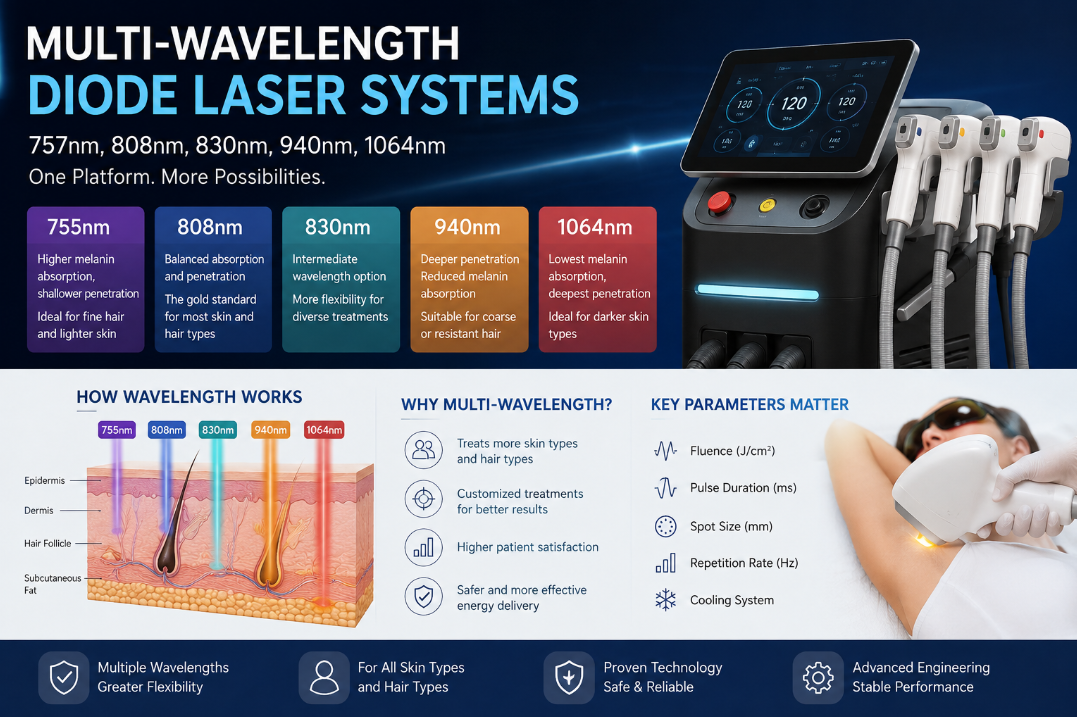
Multi-Wavelength Diode Laser Systems: Technical Overview
Quick Answer
Multi-wavelength diode laser systems combine two or more diode laser wavelengths in a single platform, allowing practitioners to adjust energy delivery according to hair characteristics, skin type, treatment area, and clinical requirements. Common configurations include 755nm, 808nm, 830nm, 940nm, and 1064nm.
The main technical advantage of a multi-wavelength system is not simply the number of wavelengths. Each wavelength has different optical absorption and penetration characteristics, so combining wavelengths can give practitioners greater flexibility than relying on a single wavelength.
However, wavelength alone does not determine treatment performance. Fluence, pulse duration, spot size, repetition rate, cooling, laser source quality, and operator technique also influence treatment results.
Introduction
A multi-wavelength diode laser system integrates multiple semiconductor laser wavelengths into one professional platform.
Traditional diode laser systems often rely on a single wavelength, such as 808nm. While a single wavelength can provide effective hair removal for many patients, clinics increasingly use multi-wavelength platforms to provide greater treatment flexibility.
The reason is straightforward: hair follicles differ in depth, hair thickness, pigmentation, and response to treatment. At the same time, epidermal melanin varies between patients.
Laser wavelength therefore becomes an important variable when designing a treatment strategy.
Rather than asking which wavelength is universally "best," practitioners should understand how different wavelengths interact with melanin, tissue, and follicular structures and then select appropriate treatment parameters.
1. Why Wavelength Matters in Diode Laser Hair Removal
The basic principle of laser hair removal is selective photothermolysis.
Laser energy is absorbed by chromophores, primarily melanin in the hair shaft and follicular structures. The absorbed energy is converted into heat, which damages the follicular structures responsible for hair growth.
The challenge is that melanin is also present in the epidermis.
Therefore, an effective treatment must balance:
-
Melanin absorption
-
Penetration depth
-
Energy density
-
Pulse duration
-
Epidermal protection
-
Cooling
-
Hair characteristics
-
Skin pigmentation
This is why wavelength selection cannot be considered independently from the rest of the treatment system.
2. How Different Wavelengths Behave
The most commonly discussed wavelengths in professional diode laser platforms include:
| Wavelength | General Optical Profile | Typical Role |
|---|---|---|
| 755nm | Higher melanin absorption, relatively shallower penetration | Fine or lighter hair in appropriate patients |
| 808nm | Balanced absorption and penetration | General-purpose hair removal |
| 830nm | Intermediate wavelength option | Additional treatment flexibility |
| 940nm | Longer wavelength with different absorption characteristics | Specialized multi-wavelength configurations |
| 1064nm | Lower melanin absorption and deeper penetration | Darker skin and deeper/coarser hair |
These descriptions should be treated as general technical characteristics rather than universal treatment rules.
Actual clinical selection depends on skin type, hair characteristics, treatment area, fluence, pulse duration, cooling, and operator experience.
3. 755nm: Higher Melanin Absorption
The 755nm wavelength has relatively high absorption by melanin compared with longer wavelengths.
This characteristic can make it useful for certain patients with finer or lighter-pigmented hair, particularly when the target follicle is relatively superficial.
Typical characteristics
-
Relatively high melanin absorption
-
Shallower penetration than longer wavelengths
-
Useful for selected fine-hair applications
-
Commonly incorporated into multi-wavelength systems
The trade-off is that higher melanin absorption can also increase interaction with epidermal melanin.
For this reason, patient selection, energy settings, and epidermal cooling remain important.
4. 808nm: The Core Diode Laser Wavelength
The 808nm diode laser machine has become one of the most widely used configurations in professional hair removal systems.
Its popularity comes from its practical balance between melanin absorption and penetration depth.
For many clinics, 808nm provides a versatile foundation for treating common hair-removal areas.
Typical characteristics
-
Balanced melanin absorption
-
Moderate penetration depth
-
Suitable for many common treatment areas
-
Widely used in professional diode laser platforms
-
Frequently combined with other wavelengths
Because 808nm is already highly versatile, multi-wavelength systems do not necessarily replace it. Instead, they commonly use it as one component of a broader wavelength platform.
5. 830nm: An Additional Wavelength for Treatment Flexibility
830nm sits between the commonly used 808nm and longer wavelengths.
In multi-wavelength platforms, 830nm can provide another wavelength option when manufacturers want to broaden the system's treatment range.
However, buyers should not assume that adding another wavelength automatically produces better clinical outcomes.
The practical value of 830nm depends on:
-
How the wavelength is generated
-
Available fluence
-
Pulse duration
-
Spot size
-
Cooling
-
Energy stability
-
Treatment protocol
A five-wavelength system should therefore be evaluated as an integrated energy-delivery platform rather than simply counted by the number of wavelengths.
6. 940nm: A Longer-Wavelength Configuration
940nm is another wavelength used in some multi-wavelength diode laser platforms.
Compared with shorter diode laser wavelengths, its optical absorption characteristics are different, which can make it useful as part of a broader wavelength configuration.
However, claims that 940nm universally "blocks follicle nutrition" or guarantees superior hair reduction should be treated cautiously.
Its practical value depends on the complete treatment system and the parameters used.
When evaluating 940nm, consider:
-
Available fluence
-
Pulse duration
-
Energy stability
-
Spot size
-
Cooling
-
Actual treatment protocol
-
Clinical evidence for the intended application
This is a better way to evaluate 940nm than assuming that a longer wavelength is automatically more effective.
7. 1064nm: Deep Penetration and Lower Melanin Absorption
The 1064nm wavelength has lower melanin absorption than shorter wavelengths and is associated with deeper penetration.
This characteristic makes it particularly relevant when treating patients with higher levels of epidermal pigmentation.
It is also commonly considered for coarse or deeper-rooted hair.
Typical characteristics
-
Lower melanin absorption
-
Greater penetration depth
-
Useful for darker skin types when appropriately selected
-
Commonly used for coarse or deeper hair
-
Frequently combined with 755nm and 808nm
However, 1064nm should not be treated as a universal "dark skin setting."
Safe and effective treatment still depends on:
-
Patient assessment
-
Fluence
-
Pulse duration
-
Spot size
-
Cooling
-
Hair characteristics
-
Operator technique
8. Why Combine Multiple Wavelengths?
The primary reason for combining wavelengths is treatment flexibility.
A single wavelength has a fixed optical profile.
A multi-wavelength system gives practitioners several optical options within one platform.
For example:
Single wavelength
808nm
Provides a widely applicable general-purpose configuration.
Dual wavelength
808nm + 1064nm
Provides additional flexibility for different skin pigmentation and hair characteristics.
Triple wavelength
755nm + 808nm + 1064nm
Combines shorter, intermediate, and longer wavelength characteristics.
Four-wavelength configuration
755nm + 808nm + 940nm + 1064nm
Provides an even broader wavelength selection.
Five-wavelength configuration
755nm + 808nm + 830nm + 940nm + 1064nm
Provides the greatest wavelength flexibility among these configurations, assuming the system can deliver stable and useful energy across all five wavelengths.
The important point is that more wavelengths do not automatically mean better results.
The engineering quality of the system determines whether those additional wavelengths provide meaningful practical value.
9. Multi-Wavelength Architecture
A professional multi-wavelength diode laser is more than several wavelengths placed inside the same housing.
The laser source may contain multiple diode modules or laser bars, each designed to generate a particular wavelength.
These components then need to be integrated with:
-
Power electronics
-
Energy control
-
Cooling
-
Optical delivery
-
Handpiece
-
Software
-
Temperature monitoring
-
Safety systems
This makes system engineering particularly important.
A manufacturer may advertise five wavelengths, but buyers should also ask how those wavelengths are generated and delivered.
10. Laser Source and Energy Stability
The laser source is one of the most important components inside a diode laser system.
Multiple wavelength modules must operate consistently while the system manages heat and electrical load.
Important technical considerations include:
-
Laser diode quality
-
Module design
-
Electrical stability
-
Thermal management
-
Energy consistency
-
Module lifespan
-
Replacement availability
For high-volume clinics, stable output is especially important because treatment performance should remain consistent during repeated sessions.
This is one reason why a multi-wavelength platform should be evaluated as a complete engineering system rather than by wavelength count alone.
11. Wavelength Is Only One Treatment Parameter
A common mistake is to assume that wavelength determines treatment performance by itself.
In practice, several parameters interact.
Fluence
Fluence describes the amount of energy delivered per unit area, usually expressed in J/cm².
Pulse Duration
Pulse duration determines how long the energy is delivered.
Spot Size
Spot size influences treatment coverage and energy distribution.
Repetition Rate
Higher repetition rates can increase treatment speed when supported by appropriate energy delivery and cooling.
Cooling
Cooling helps protect the epidermis and improve patient comfort.
Therefore:
Wavelength + Fluence + Pulse Duration + Spot Size + Cooling
should be evaluated together.
12. Why Spot Size Matters
Spot size is often overlooked when comparing diode laser systems.
A larger spot can cover more skin with each pulse, which can improve treatment efficiency for large body areas.
For example, larger treatment areas include:
-
Legs
-
Back
-
Chest
-
Arms
-
Abdomen
However, larger is not always better.
Smaller spot sizes can provide more control in areas where precision is important.
A professional platform may therefore benefit from multiple spot-size options rather than a single fixed spot.
13. Cooling and Thermal Management
Multi-wavelength systems can generate substantial heat during operation.
The cooling system therefore plays two roles:
-
Protecting the patient's epidermis
-
Managing heat generated inside the equipment
Professional systems may incorporate:
-
Sapphire contact cooling
-
Water circulation
-
Air cooling
-
Thermoelectric cooling
-
Temperature sensors
-
Thermal monitoring
-
Automated temperature control
Cooling performance should be evaluated under continuous operating conditions.
A system that reaches a low temperature briefly is not necessarily equivalent to one that can maintain stable cooling throughout a high-volume treatment session.
14. Clinical Evidence for Multi-Wavelength Systems
Clinical evidence should be considered when evaluating multi-wavelength technology, but it is important to distinguish between evidence for a specific configuration and claims about all multi-wavelength systems.
For example, clinical research has evaluated triple-wavelength diode laser configurations combining 755nm, 808nm, and 1064nm for hair reduction.
Such studies can provide useful evidence about the specific configuration investigated.
However, results from a triple-wavelength system should not automatically be presented as proof that every four- or five-wavelength platform will produce identical outcomes.
Clinical performance depends on:
-
Laser configuration
-
Treatment parameters
-
Patient population
-
Skin type
-
Hair characteristics
-
Number of sessions
-
Operator technique
-
Follow-up period
This distinction is particularly important when evaluating manufacturer claims.
15. How to Evaluate a Multi-Wavelength Diode Laser
When comparing different systems, do not simply count the wavelengths.
Instead, evaluate the complete technical configuration.
Check:
Wavelength configuration
Which wavelengths are actually available?
Energy range
What fluence can each wavelength deliver?
Pulse control
What pulse-duration options are available?
Spot size
What treatment spot sizes are offered?
Cooling
How is epidermal and internal cooling achieved?
Laser source
Which diode modules are used?
Output stability
How consistently can the system deliver energy?
Treatment speed
How quickly can the system cover large areas?
Handpiece design
Is the handpiece practical for long treatment sessions?
Serviceability
Can key components be replaced if necessary?
This approach provides a much more meaningful technical comparison.
16. Multi-Wavelength vs Single-Wavelength Systems
The choice between single- and multi-wavelength equipment depends on the clinic's requirements.
| Factor | Single-Wavelength | Multi-Wavelength |
|---|---|---|
| Configuration | Simple | More complex |
| Treatment flexibility | Limited | Higher |
| Skin-type flexibility | Depends on wavelength | Broader |
| Hair-type flexibility | More limited | Greater |
| Equipment cost | Usually lower | Usually higher |
| Operation | Simple | More parameter options |
| Upgrade potential | More limited | Potentially greater |
| Maintenance complexity | Lower | Potentially higher |
A single-wavelength system can still be an effective solution when its configuration matches the clinic's patient population.
A multi-wavelength platform becomes more attractive when a clinic wants greater flexibility from a single device.
17. How to Choose the Right Diode Laser Wavelength
There is no single wavelength that is best for every patient.
Instead, diode laser wavelength selection should consider:
-
Fitzpatrick skin type
-
Hair color
-
Hair thickness
-
Follicle depth
-
Treatment area
-
Epidermal pigmentation
-
Previous treatment response
-
Available cooling
-
Treatment parameters
A simplified framework is:
| Patient / Hair Characteristic | Potential Starting Consideration |
|---|---|
| Fine hair, lighter skin | 755nm may be considered |
| General hair removal | 808nm may be considered |
| Broader wavelength flexibility | 830nm may complement other wavelengths |
| Multi-wavelength treatment strategy | 940nm may provide another option |
| Darker skin or deeper/coarser hair | 1064nm may be considered |
These are general technical considerations rather than fixed clinical protocols.
Practitioners should always select treatment parameters based on appropriate patient assessment and manufacturer guidance.
18. Why Multi-Wavelength Does Not Automatically Mean Better
This is one of the most important points for buyers and practitioners.
A machine with five wavelengths is not automatically better than a machine with three.
For example, a poorly engineered five-wavelength system may provide less practical value than a well-engineered three-wavelength system with:
-
Stable energy output
-
Effective cooling
-
Reliable laser modules
-
Appropriate fluence
-
Good pulse control
-
Large treatment spot
-
Strong handpiece design
The number of wavelengths should therefore be viewed as one specification among many.
The real question is:
Can the system deliver useful and stable energy across its available wavelengths?
19. Technical Questions to Ask a Manufacturer
Before selecting a multi-wavelength diode laser system, professional buyers can ask the manufacturer:
About the laser source
-
Which diode modules are used?
-
Are the wavelengths generated by separate modules?
-
What is the expected module lifespan?
-
Can individual modules be replaced?
About energy delivery
-
What is the fluence range?
-
What pulse-duration options are available?
-
What repetition rates are supported?
-
How stable is energy output during continuous operation?
About cooling
-
What cooling technology is used?
-
What temperature can the handpiece maintain?
-
How is internal heat managed?
-
How does the cooling system perform during long treatment sessions?
About the handpiece
-
What spot sizes are available?
-
What is the handpiece weight?
-
Can the handpiece be replaced independently?
-
How long is the expected service life?
These questions can reveal much more about the actual engineering quality of a machine than its headline wavelength count.
20. The Role of Multi-Wavelength Technology in Professional Clinics
For clinics treating a diverse patient population, multi-wavelength systems can provide a practical advantage by allowing practitioners to adjust wavelength selection rather than relying on one fixed optical profile.
A diode laser hair removal machine with multiple wavelengths can therefore serve as a flexible platform for different treatment scenarios.
However, flexibility should not replace clinical judgment.
The practitioner still needs to consider patient assessment, treatment parameters, cooling, treatment history, and appropriate safety protocols.
Frequently Asked Questions
What is a multi-wavelength diode laser system?
A multi-wavelength diode laser system combines two or more diode laser wavelengths within one platform. Common configurations include 755nm, 808nm, 830nm, 940nm, and 1064nm.
Is a multi-wavelength diode laser better than an 808nm system?
Not automatically. Multi-wavelength systems provide greater treatment flexibility, while a well-designed 808nm system can still be highly effective for many hair-removal applications. The better choice depends on the clinic's patient population and treatment requirements.
Why is 808nm so widely used?
808nm provides a practical balance between melanin absorption and penetration depth, making it a versatile wavelength for professional hair removal. It is therefore widely incorporated into both single- and multi-wavelength systems.
What is the advantage of 1064nm?
1064nm has lower melanin absorption and deeper penetration than shorter wavelengths. This can make it useful for appropriately selected patients with darker skin or deeper, coarser hair.
Does adding more wavelengths improve treatment results?
Not necessarily. Additional wavelengths increase flexibility, but actual results depend on energy delivery, treatment parameters, cooling, patient characteristics, and operator technique.
What is the most important specification in a multi-wavelength diode laser?
There is no single specification that determines performance. Wavelength configuration, fluence, pulse duration, spot size, cooling, laser source quality, and output stability should be evaluated together.
What is diode laser wavelength selection?
Diode laser wavelength selection is the process of choosing an appropriate laser wavelength based on factors such as skin pigmentation, hair characteristics, follicle depth, treatment area, and treatment parameters.
Can one multi-wavelength system treat different skin types?
A properly configured multi-wavelength platform can provide greater flexibility across different skin types than a single-wavelength system. However, no machine eliminates the need for appropriate patient assessment and treatment parameter selection.
Conclusion
Multi-wavelength diode laser systems provide a flexible approach to professional hair removal by combining different wavelengths with different optical characteristics.
755nm, 808nm, 830nm, 940nm, and 1064nm each provide different options for energy delivery, and combining them can allow practitioners to adapt treatment strategies to different hair and skin characteristics.
However, wavelength count should never be treated as the sole indicator of equipment quality.
A high-performance system also depends on laser source quality, energy stability, fluence, pulse duration, spot size, repetition rate, cooling, handpiece design, and overall system engineering.
For clinics evaluating a diode laser hair removal machine, the goal should therefore be to understand how the entire platform works rather than simply choosing the machine with the largest number of wavelengths.
Understanding diode laser wavelength selection allows clinics to evaluate multi-wavelength systems more objectively and choose a configuration that matches their actual patient population and treatment requirements.
For manufacturers and professional equipment suppliers, the long-term value of multi-wavelength technology ultimately depends on whether each wavelength can be delivered consistently, safely, and effectively as part of a well-engineered diode laser platform.