

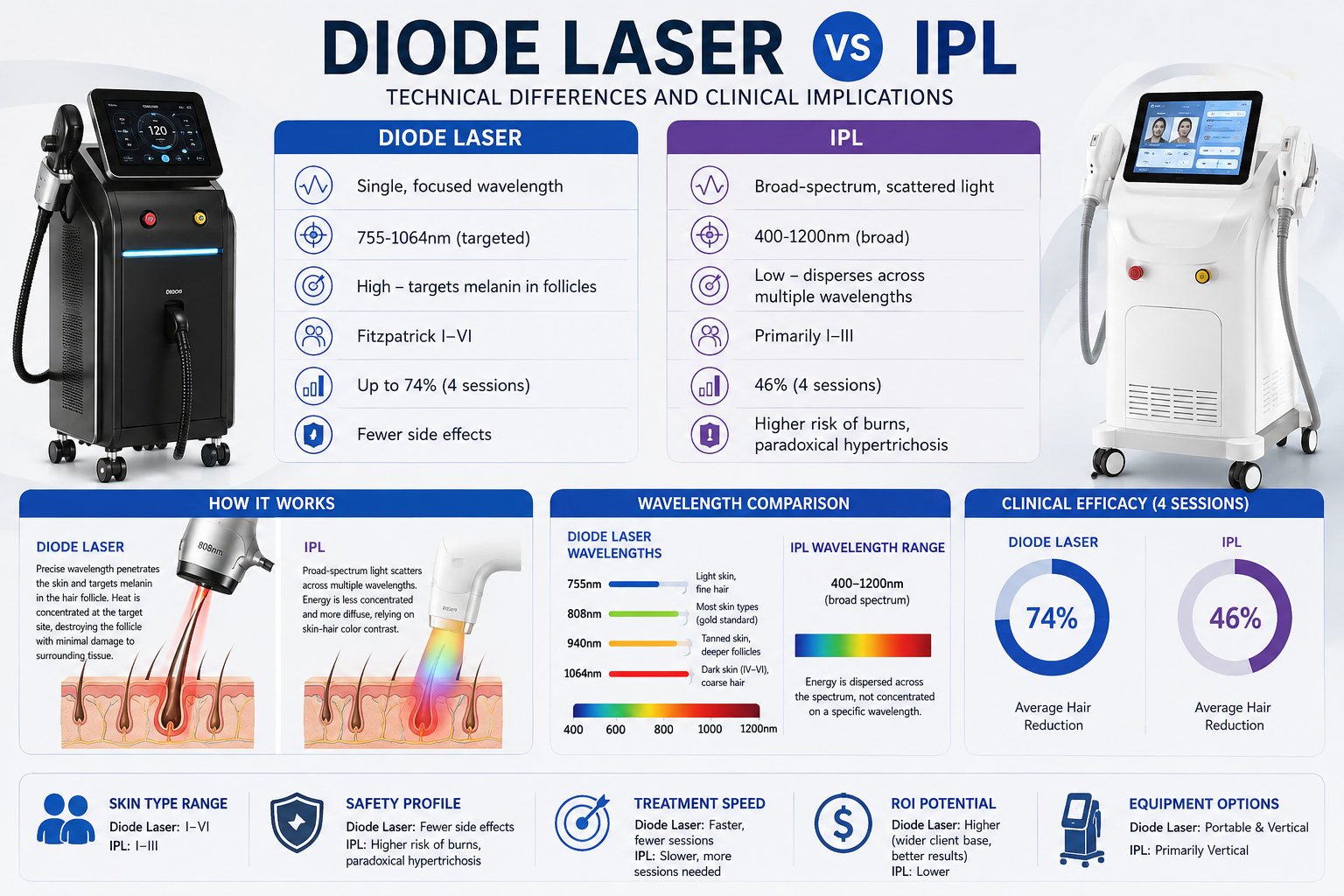
Diode Laser vs IPL: Technical Differences and Clinical Implications
Quick Answer
When comparing diode laser vs IPL, the most important differences are not simply the device's appearance or advertised power. Diode lasers typically deliver energy at a specific laser wavelength, while IPL systems emit a broad spectrum of non-coherent light that is filtered for different applications. These differences affect energy distribution, wavelength selection, pulse characteristics, cooling requirements, treatment flexibility, and patient selection.
For clinics evaluating professional hair-removal equipment, the better technology depends on the treatment population, skin types, hair characteristics, treatment volume, device configuration, and operating requirements. Diode laser systems can provide highly targeted wavelength delivery, while IPL can offer broader light-based applications and a lower entry cost.
Diode Laser vs IPL: What Is the Fundamental Difference?
At a basic level, both diode laser and IPL use light energy to produce controlled thermal effects in the hair follicle.
The difference is how that light is generated and delivered.
A diode laser produces laser light at a specific wavelength, such as approximately 755 nm, 808/810 nm, or 1064 nm depending on the system. IPL uses a broadband flashlamp source that produces a wider range of wavelengths and relies on optical filters to select the usable portion of the spectrum.
Both technologies can work through selective photothermolysis, in which light energy is absorbed by a target chromophore and converted into heat. For hair reduction, melanin in the hair shaft and follicular structures is an important target.
However, wavelength, pulse duration, fluence, spot size, cooling, and treatment protocol all influence the final clinical result. These parameters can be more important than simply labeling a device as "laser" or "IPL."
Diode Laser Technology: Targeted Wavelength Delivery
A diode laser generates light within a defined wavelength band.
For hair-removal systems, common laser wavelengths include:
-
755 nm
-
808/810 nm
-
1064 nm
-
Multi-wavelength combinations
Each wavelength interacts differently with melanin and penetrates tissue to a different extent.
Why Wavelength Matters
Melanin absorbs shorter wavelengths more strongly, while longer wavelengths generally penetrate deeper and have lower absorption by epidermal melanin.
This creates a practical balance between:
Target absorption → penetration depth → epidermal protection → treatment parameters
For example, 808/810 nm diode systems are widely used for hair reduction because they provide a practical balance between melanin absorption and penetration. Longer wavelengths such as 1064 nm are particularly important when treating darker skin types because they reduce epidermal melanin absorption compared with shorter wavelengths.
This does not mean that one wavelength is automatically best for every patient.
Instead, the appropriate wavelength depends on:
-
Skin phototype
-
Hair color
-
Hair thickness
-
Treatment area
-
Tan level
-
Fluence
-
Pulse duration
-
Cooling
-
Operator technique
How IPL Works
IPL, or Intense Pulsed Light, does not generate a single laser wavelength.
Instead, an IPL system uses a broad-spectrum light source and optical filters to control the wavelengths reaching the skin.
Typical IPL systems can operate over a broad wavelength range depending on the device and filter configuration.
The broad spectrum provides flexibility, but it also means that the energy is not delivered in the same narrowly defined wavelength format as a diode laser.
For hair removal, IPL must therefore rely heavily on:
-
Appropriate wavelength filtering
-
Fluence
-
Pulse duration
-
Pulse sequencing
-
Skin cooling
-
Skin-hair contrast
This distinction is one of the most important technical differences between the two technologies.
Diode Laser vs IPL: Wavelength Comparison
| Factor | Diode Laser | IPL |
|---|---|---|
| Light generation | Semiconductor laser | Flashlamp |
| Light type | Laser | Broadband non-coherent light |
| Wavelength | Specific wavelength | Broad spectrum with filters |
| Energy targeting | More wavelength-specific | Distributed across selected spectrum |
| Typical hair-removal wavelengths | 755, 808/810, 1064 nm | Device/filter dependent |
| Wavelength flexibility | Determined by laser configuration | Determined by filters |
| Treatment versatility | Depends on platform | Often broad |
| Energy delivery | More wavelength-specific | Broad-spectrum |
The important point for buyers is that more wavelengths do not automatically mean better performance.
A multi-wavelength diode system can increase treatment flexibility, but the actual clinical value depends on whether those wavelengths are appropriately engineered and used.
Energy Delivery: Why the Numbers Matter
One of the biggest mistakes when purchasing professional laser equipment is comparing machines using only wattage.
A device's advertised electrical or laser-source power does not tell the entire story.
Clinical energy delivery depends on multiple parameters.
Fluence
Fluence describes the amount of energy delivered over an area and is commonly expressed in J/cm².
Higher fluence does not automatically produce better treatment.
The appropriate setting depends on:
-
Skin type
-
Hair characteristics
-
Wavelength
-
Spot size
-
Pulse duration
-
Cooling
-
Treatment area
Excessive energy can increase the risk of unwanted thermal effects, while insufficient energy may produce poor treatment response.
Pulse Duration
Pulse duration determines how long energy is delivered.
Hair follicles have different thermal characteristics depending on their size and structure.
The objective is to deliver sufficient thermal energy to the target while limiting unnecessary heating of surrounding tissue.
Therefore, buyers should evaluate the relationship between:
Wavelength + Fluence + Pulse Duration + Cooling
rather than considering any single specification independently.
Repetition Rate
Repetition rate affects treatment speed.
A system with a higher repetition rate can potentially deliver more pulses over a given period, but treatment efficiency still depends on spot size, energy per pulse, operator technique, and cooling performance.
For high-volume clinics, this becomes particularly important.
A machine that appears powerful on a specification sheet may not necessarily provide faster real-world treatment if its spot size, repetition rate, or thermal management limits practical operation.
Spot Size and Treatment Speed
Spot size is another important difference between professional systems.
A larger spot can cover more skin with each pulse.
This can be particularly useful for:
-
Legs
-
Back
-
Chest
-
Arms
-
Abdomen
-
Full-body treatments
Smaller spot sizes may provide better control for:
-
Facial areas
-
Upper lip
-
Chin
-
Small treatment zones
-
Areas requiring greater precision
Therefore, a professional buyer should ask:
Does the machine's spot-size configuration match the treatment areas that generate the most revenue for the clinic?
This question is often more useful than simply asking whether the machine has "high power."
Cooling Technology: An Often-Overlooked Specification
Cooling is critical for both patient comfort and thermal management.
Professional diode laser systems may use technologies such as:
-
Sapphire contact cooling
-
TEC or semiconductor cooling
-
Water cooling
-
Air cooling
-
Combined cooling systems
Cooling can help reduce epidermal heating and improve treatment tolerance.
For darker skin types, appropriate cooling becomes particularly important because epidermal melanin can compete with follicular melanin for absorbed energy.
Research on laser hair reduction in skin of color emphasizes the importance of wavelength selection, conservative fluence, appropriate pulse duration, and cooling.
For buyers, the question should therefore not simply be:
"Does this machine have cooling?"
Instead, ask:
"How is the laser source cooled, how is the skin cooled, and how does the system maintain thermal stability during repeated treatments?"
Skin Type and Patient Selection
Skin type is one of the areas where comparisons between diode laser and IPL are often oversimplified.
It is not accurate to say that diode laser is automatically suitable for every Fitzpatrick skin type while IPL is automatically restricted to lighter skin.
Clinical outcomes depend on the specific device, wavelength, parameters, cooling system, and treatment protocol.
General Considerations
| Skin Type | General Consideration |
|---|---|
| I–II | Multiple laser and IPL technologies may be suitable |
| III | Diode and IPL may both be options depending on parameters |
| IV | Longer wavelengths and careful parameter selection become increasingly important |
| V–VI | Longer-wavelength laser systems may offer advantages; IPL requires careful device-specific assessment |
For darker skin, longer wavelengths are generally valuable because they reduce the relative absorption of laser energy by epidermal melanin.
However, even diode laser treatment requires appropriate parameters and professional assessment.
A 2019 systematic review of hair-reduction treatments in Fitzpatrick III–VI found that outcomes across diode, Nd:YAG, alexandrite, and IPL were broadly comparable in the available evidence, although laser treatment showed a trend toward greater hair reduction.
This is an important distinction for B2B content: technology selection should be based on patient profile and treatment parameters, not marketing claims about skin types alone.
Clinical Efficacy: What Does the Evidence Actually Show?
Clinical studies do show that both diode laser and IPL can reduce unwanted hair.
However, results vary significantly according to:
-
Body site
-
Number of treatments
-
Follow-up period
-
Device model
-
Wavelength
-
Fluence
-
Pulse duration
-
Patient characteristics
A randomized intrapatient study comparing an 800 nm diode laser with IPL found significant hair reduction with both technologies. At 12 months after treatment, the diode group showed greater mean hair reduction than the IPL group, although the diode treatment was more painful while being faster.
Another randomized study in women with hirsutism found that both IPL and 810 nm diode laser reduced hair counts, with no statistically significant difference at six months.
This demonstrates why a responsible comparison should not claim that diode laser always produces a specific percentage improvement over IPL.
A Better Interpretation
The evidence supports the following conclusions:
-
Both technologies can provide meaningful hair reduction.
-
Diode laser can provide highly targeted wavelength delivery.
-
Some comparative trials show greater long-term hair reduction with diode laser.
-
Other studies show similar outcomes under particular treatment conditions.
-
Pain and side effects depend on device settings and treatment protocol.
-
Patient selection is critical.
-
Long-term outcomes should not be judged from a single study.
This is a much stronger clinical argument than simply saying "laser is better."
Safety: Why Technology Alone Does Not Determine Risk
Both diode laser and IPL can cause adverse effects when inappropriate parameters are used.
Potential reactions can include:
-
Temporary erythema
-
Edema
-
Pain or discomfort
-
Burns
-
Blistering
-
Pigmentary changes
-
Post-inflammatory hyperpigmentation
-
Paradoxical hypertrichosis in uncommon cases
Paradoxical hypertrichosis is not exclusive to IPL. A systematic review found that it is an uncommon complication associated with both laser and light-based hair-removal treatments, with facial and neck treatment being important risk contexts.
Therefore, it is not accurate to market diode laser as completely risk-free.
A safer purchasing and treatment strategy focuses on:
Appropriate wavelength + appropriate parameters + cooling + patient selection + trained operator
Why Darker Skin Requires Special Consideration
The basic challenge of hair removal is that both hair and skin contain melanin.
The ideal treatment selectively heats the follicle while limiting epidermal heating.
When skin contains more melanin, the difference between target and surrounding tissue becomes smaller.
This increases the importance of:
-
Longer wavelengths
-
Appropriate pulse durations
-
Conservative energy settings
-
Effective cooling
-
Multiple treatment sessions
Long-pulsed diode and Nd:YAG lasers have historically been considered useful options for darker skin, while treatment selection should remain device- and parameter-specific.
This is one reason professional clinics should not select equipment based purely on headline wattage.
Diode Laser vs IPL for Different Business Models
Technology selection also has a business dimension.
Clinics Focused on Hair Removal
A diode laser platform may be attractive when hair removal is the clinic's primary service.
Potential advantages include:
-
Dedicated hair-removal wavelength configurations
-
Large spot sizes
-
High repetition rates
-
Professional cooling
-
Multiple wavelength options
-
High treatment throughput
For clinics purchasing diode laser hair removal equipment, these factors can be more important than the machine's external appearance.
Clinics Seeking Multiple Light-Based Applications
IPL may be attractive when the business wants one platform that can support several light-based applications.
Depending on the device, IPL platforms may be marketed for:
-
Hair reduction
-
Pigmentation-related treatments
-
Vascular appearance
-
Photorejuvenation
However, the exact applications depend on the device's filters, specifications, regulatory status, and intended use.
This creates an important purchasing distinction:
Diode laser tends to provide wavelength-specific energy delivery, while IPL can provide broader platform flexibility.
Portable vs Vertical Diode Laser Equipment
Technology selection is not the only purchasing decision.
Once a clinic decides to use diode laser technology, it must also determine which machine configuration is appropriate.
This is where the portable vs vertical laser hair removal machine decision becomes relevant.
Portable Systems
Portable systems typically emphasize:
-
Compact footprint
-
Easy transportation
-
Flexible room usage
-
Lower space requirements
-
Mobile service capability
A portable diode laser hair removal platform can be particularly useful for small clinics, multi-room businesses, and operators who need to move equipment between locations.
Vertical or Floor-Standing Systems
Floor-standing systems generally emphasize:
-
Larger internal component space
-
Higher treatment capacity
-
Larger cooling architecture
-
Larger displays
-
Larger handpiece configurations
-
Dedicated treatment-room installation
For high-volume clinics, these characteristics can become more important than portability.
The form factor itself does not determine clinical efficacy.
A portable machine and a floor-standing machine using the same wavelength and comparable treatment parameters are based on the same underlying laser technology.
The practical differences are more closely related to:
Cooling → power architecture → treatment workflow → ergonomics → capacity → mobility
What Should Clinics Evaluate Before Buying?
When purchasing professional equipment, clinics should compare more than the advertised wavelength.
A practical evaluation should include:
1. Wavelength
Determine whether the wavelength configuration matches the clinic's target patients.
2. Fluence Range
Check whether the system provides an appropriate operating range for its intended applications.
3. Pulse Duration
Evaluate whether pulse settings provide sufficient flexibility for different hair and skin characteristics.
4. Spot Size
Determine whether the handpiece is efficient for the clinic's most common treatment areas.
5. Repetition Rate
Higher repetition rates can improve throughput when combined with appropriate energy delivery and cooling.
6. Cooling
Evaluate both patient-contact cooling and internal thermal management.
7. Handpiece Ergonomics
A machine used throughout the day should be comfortable for the operator.
8. Expected Service Life
Ask about laser-source life, handpiece life, cooling-system maintenance, and replacement components.
9. Technical Support
A professional machine is not only hardware.
Training, troubleshooting, spare parts, warranty coverage, and technical support can significantly affect the total cost of ownership.
Diode Laser vs IPL: Business and ROI Considerations
The purchasing decision should ultimately connect technology to business economics.
| Factor | Diode Laser | IPL |
|---|---|---|
| Initial investment | Often higher | Often lower |
| Wavelength delivery | Specific laser wavelength | Broadband filtered light |
| Hair-removal specialization | Strong | Moderate to strong depending on platform |
| Treatment flexibility | Depends on configuration | Often broad |
| High-volume hair removal | Well suited to dedicated systems | Depends on platform |
| Skin-type flexibility | Depends on wavelength and parameters | More device- and filter-dependent |
| Treatment speed | Depends on spot size and repetition rate | Depends on flashlamp and treatment design |
| Cooling | Often integrated into professional systems | Device dependent |
| Service model | Often hair-removal focused | Often multi-application |
A clinic should calculate ROI using expected treatment volume rather than assuming that a more expensive machine will automatically produce a higher return.
A simple framework is:
Monthly treatment revenue − operating costs = monthly contribution
Then:
Equipment investment ÷ monthly contribution = approximate payback period
The calculation should also account for:
-
Treatment time
-
Number of clients per day
-
Average treatment price
-
Maintenance
-
Consumables
-
Handpiece replacement
-
Downtime
-
Training
-
Marketing costs
Common Buying Mistakes
Mistake 1: Comparing Only Wattage
Higher advertised power does not automatically mean better clinical performance.
Always compare power together with wavelength, fluence, pulse duration, spot size, repetition rate, and cooling.
Mistake 2: Assuming More Wavelengths Are Always Better
A five-wavelength platform is not automatically better than a single-wavelength system.
The additional wavelengths should provide a meaningful benefit for the clinic's patient population.
Mistake 3: Assuming IPL Is Ineffective
IPL can provide meaningful long-term hair reduction.
The correct comparison is between specific devices and treatment protocols, not between marketing categories.
Mistake 4: Choosing Equipment Only by Price
The lowest purchase price may not produce the lowest total cost of ownership.
Consider service life, downtime, handpiece replacement, cooling maintenance, and technical support.
Mistake 5: Ignoring Operator Training
Even advanced equipment requires appropriate treatment protocols.
Technology cannot compensate for poor patient selection or inappropriate settings.
Frequently Asked Questions
Is diode laser better than IPL for hair removal?
Diode laser can provide advantages in wavelength-specific energy delivery, and several comparative studies have found greater hair reduction with diode systems. However, clinical outcomes vary by device, parameters, patient characteristics, and treatment protocol. Both technologies can be effective.
Is IPL a laser?
No. IPL uses broadband, non-coherent light generated by a flashlamp, while a diode laser produces laser light at a defined wavelength.
Which is better for darker skin?
Longer-wavelength laser systems, particularly Nd:YAG and appropriately configured diode systems, can be useful for darker skin when correct parameters and cooling are used. IPL should not be automatically classified as unsuitable for every darker-skinned patient, but device-specific assessment is important.
Is 808 nm diode laser suitable for hair removal?
808/810 nm diode laser technology has extensive clinical use in hair reduction. Its effectiveness depends on fluence, pulse duration, spot size, cooling, hair characteristics, skin type, and treatment protocol rather than wavelength alone.
Does a portable diode laser work as well as a floor-standing machine?
The portable or floor-standing form factor itself does not determine clinical efficacy. What matters is the actual laser configuration, energy delivery, cooling, spot size, and treatment parameters. A properly engineered portable system can use the same underlying diode laser technology as a larger platform.
Should a clinic choose diode laser or IPL?
A clinic focused primarily on professional hair reduction may prefer a dedicated diode laser platform. A business looking for a broader light-based platform may consider IPL. The final decision should be based on patient demographics, treatment menu, treatment volume, available space, budget, and expected ROI.
Conclusion
The comparison between diode laser and IPL is more complicated than simply deciding which technology is "stronger."
Diode laser systems provide wavelength-specific laser energy and can be configured around dedicated hair-removal applications. IPL uses broadband light and can provide broader application flexibility depending on its filters and system design.
Clinical evidence shows that both technologies can produce meaningful hair reduction, while several comparative studies have demonstrated advantages for diode laser in particular treatment settings. At the same time, systematic reviews show that outcomes can overlap considerably depending on patient characteristics and treatment parameters.
For clinics, the most important purchasing factors are therefore:
-
Wavelength
-
Fluence
-
Pulse duration
-
Spot size
-
Repetition rate
-
Cooling
-
Skin-type suitability
-
Hair characteristics
-
Treatment volume
-
Handpiece design
-
Maintenance
-
Technical support
-
Total cost of ownership
For businesses primarily focused on professional hair reduction, properly configured diode laser hair removal equipment can provide a dedicated platform with targeted wavelength delivery and treatment-focused engineering.
Whether a clinic chooses a compact portable diode laser hair removal system or a larger floor-standing platform, the machine should be evaluated according to its actual specifications rather than its size or marketing claims.
Ultimately, the best technology is the one that matches the clinic's patient population, treatment objectives, workflow, and business model.