

Why Wavelength Selection Matters in Diode Laser Hair Removal
Quick Answer
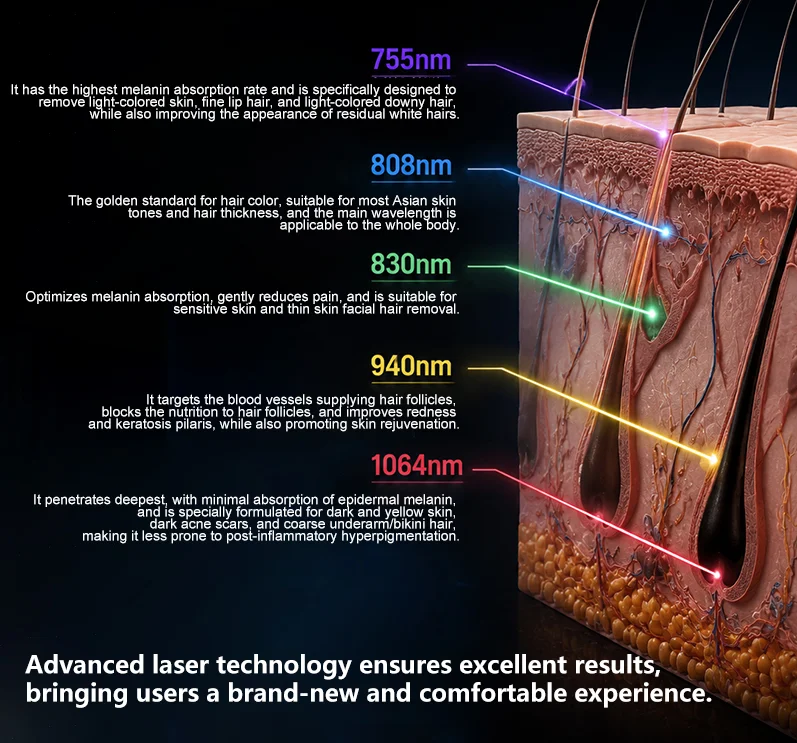
Wavelength selection is one of the most important factors in diode laser hair removal because it determines penetration depth, melanin absorption, treatment safety, and clinical performance. The 808nm diode laser remains one of the most widely used wavelengths because it provides an excellent balance between follicle targeting and skin protection. Advanced systems now combine multiple wavelengths, including 755nm, 808nm, 830nm, 940nm, and 1064nm, to treat a wider range of hair types and skin conditions.
The Clinical Challenge
Many clinics face a common problem: a single-wavelength laser works well for some patients but delivers disappointing results for others. Fine hair may resist treatment, darker skin types risk burns, and inconsistent outcomes lead to unhappy clients and lost revenue.
Wavelength selection is the key to solving these clinical challenges. Understanding how different wavelengths interact with various hair and skin types allows practitioners to deliver consistent, predictable results across a broader patient base.
Introduction
Laser hair removal technology has evolved significantly over the past decade. While early systems focused on a single wavelength, modern clinics increasingly choose multi-wavelength platforms to provide safer and more effective treatments for different patients.
For clinics, med spas, and aesthetic professionals, wavelength selection is not simply a technical specification. It directly affects:
-
Treatment effectiveness
-
Patient safety
-
Comfort level
-
Available treatment applications
-
Business growth potential
Understanding the role of each wavelength helps clinics choose the right diode laser hair removal system.
The Science Behind Laser Hair Removal Wavelengths
Diode laser hair removal works through selective photothermolysis.
The laser energy is absorbed by melanin inside the hair follicle and converted into heat. This thermal energy damages the follicle while minimizing injury to surrounding skin.
Three major factors determine treatment performance:
1. Wavelength
Determines:
-
Penetration depth
-
Melanin absorption
-
Suitable skin types
2. Pulse Duration
Controls how heat is delivered to the follicle.
3. Fluence
Determines whether enough energy reaches the target.
Among these factors, wavelength defines the foundation of safe and effective treatment.
Why 808nm Diode Laser Is Considered the Gold Standard
The 808nm diode laser has become one of the most popular wavelengths in professional hair removal systems.
It provides a balanced combination of:
-
Effective melanin absorption
-
Medium penetration depth
-
Treatment versatility
-
Patient comfort
Compared with shorter wavelengths, 808nm penetrates deeper into the skin while maintaining strong absorption by hair pigment.
This makes it suitable for:
-
Legs
-
Arms
-
Back
-
Chest
-
Full-body hair removal treatments
For many clinics, an 808nm diode laser remains the core technology for reliable hair reduction.
Understanding Modern Multi-Wavelength Laser Systems
Professional clinics increasingly prefer multi-wavelength technology because different wavelengths target different hair and skin characteristics.
Modern systems may combine:
| Wavelength | Main Function |
|---|---|
| 755nm | Targets finer hair and superficial follicles |
| 808nm | Balanced wavelength for general hair removal |
| 830nm | Provides additional follicle targeting and treatment flexibility |
| 940nm | Supports deeper penetration and broader application |
| 1064nm | Ideal for darker skin types and deeper follicles |
A five-wavelength system combining:
755nm + 808nm + 830nm + 940nm + 1064nm
provides broader coverage compared with traditional single or triple wavelength systems.
Why Five-Wavelength Technology Maximizes ROI
Instead of limiting your clinic to one patient demographic, a multi-wavelength system unlocks three distinct revenue streams:
| Wavelength Range | Clinical Application | Business Benefit |
|---|---|---|
| 755nm + 830nm | Target fine, light-colored hair (facial, peach fuzz, upper lip) | Offer premium facial treatments with visible results |
| 808nm | Your workhorse for standard body hair (legs, arms, underarms, bikini) | High-speed efficiency for high-volume treatments |
| 940nm + 1064nm | Safely treat darker skin types (Fitzpatrick IV–VI) with deeper penetration | Expand your client base by up to 40% |
Additional Benefits
Treat More Skin Types Safely
Different wavelengths allow practitioners to adjust treatments according to:
-
Fitzpatrick skin type
-
Hair thickness
-
Treatment area
-
Patient sensitivity
Target Different Hair Types Effectively
Fine facial hair and coarse body hair respond differently to laser energy. Multiple wavelengths provide greater flexibility to handle every hair type.
Improve Clinical Efficiency
A single platform supports a wider range of treatments without requiring multiple separate devices. One machine, one investment, unlimited treatment applications.
Sapphire Cooling Technology: Why It Matters
Wavelength selection must work together with effective cooling technology.
A high-performance sapphire laser hair removal system uses sapphire contact cooling to protect the epidermis during treatment.
Sapphire cooling provides:
-
Lower skin surface temperature
-
Reduced discomfort
-
Better patient experience
-
Improved treatment safety
When delivering high-energy pulses from an 808nm diode laser, sapphire cooling becomes especially important because it allows practitioners to achieve effective fluence while maintaining skin protection.
Choosing the Right Diode Laser System for Your Clinic
When purchasing a professional diode laser hair removal system, clinics should evaluate:
Single Wavelength Systems
Suitable for:
-
Specific patient groups
-
Limited treatment applications
-
Budget-focused clinics
-
Clinics with a niche client demographic
Multi-Wavelength Systems
Suitable for:
-
Diverse patient populations
-
Full-service aesthetic clinics
-
Long-term business expansion
-
Clinics aiming to maximize patient acquisition
A five-wavelength platform provides maximum flexibility by combining:
755nm + 808nm + 830nm + 940nm + 1064nm technology in one system.
Frequently Asked Questions
Why is 808nm diode laser widely used?
The 808nm diode laser provides a strong balance between melanin absorption and penetration depth, making it suitable for many hair removal applications.
What is the best wavelength for laser hair removal?
The best wavelength depends on skin type, hair characteristics, and treatment goals. Multi-wavelength systems provide the greatest flexibility for clinics treating diverse clients.
Does sapphire cooling improve diode laser treatment?
Yes. Sapphire cooling reduces surface temperature, improves comfort, and helps protect the skin during high-energy treatments.
Is a five-wavelength laser hair removal system better than a single wavelength system?
For clinics treating diverse clients, five-wavelength systems offer broader treatment capability and greater flexibility. The ability to switch wavelengths for different patients means fewer treatment limitations and higher client satisfaction.
Conclusion
Wavelength selection plays a critical role in the performance of diode laser hair removal systems.
The 808nm diode laser remains one of the most important wavelengths because of its balance between effectiveness, safety, and versatility.
However, modern clinics are increasingly moving toward multi-wavelength solutions combining:
755nm + 808nm + 830nm + 940nm + 1064nm
By combining advanced wavelength technology with sapphire cooling, a professional sapphire laser hair removal system can deliver safer, more comfortable, and more consistent treatment results.
For clinics looking to expand treatment capabilities, investing in a multi-wavelength diode laser platform provides greater flexibility and long-term value.